
Abstract
The candlelit tour of Oxford’s University Church of St Mary the Virgin on 30 October 2026 brought together the history of the university, Christian controversy, religious memory and the responsibilities of learning. This article reconstructs the Revd Canon Dr William Lamb’s account thematically, retaining its architectural details, historical figures, personal recollections and movement from the church to Compline and the Old Library. Seven photographs supply inscriptions for transcription, translation and comparison. The account is examined through institutional histories, primary texts and scholarship, distinguishing factual correction, chronological compression, contested interpretation and unresolved detail. The resulting inquiry connects the church’s memory palace, Newman’s educational thought, the commemoration of martyrs and the practice of prayer with questions about understanding, judgment and AI-assisted theological work. Historical research sometimes corrects an account; it can also correct the proposed correction, as the discussions of Scotus and Newman demonstrate. My reflection develops from these particular encounters rather than treating the church as an illustration of a ready-made theory. The article preserves distinctions between the vicar’s contribution, subsequent evidence and interpretations developed with AI. It ends with seven questions whose importance has become clearer while their answers remain open.
Keywords: University Church of St Mary the Virgin; Oxford history; inscriptions and religious memory; theological education; human–AI collaboration; authorship; judgment.
An evening and a changing question
On 30 October 2026, the Revd Canon Dr William Lamb led a candlelit tour of Oxford’s University Church of St Mary the Virgin. His account connected the building’s chapels, pillars, monuments and pulpit with the university’s intellectual and religious history. It moved between medieval foundations, Reformation persecution, evangelical revival, the Oxford Movement and the church’s continuing responsibilities towards the city. Compline followed in the chancel, and further historical remarks accompanied the gathering in the Old Library. The evening brought learning, controversy, worship and hospitality into the same place.
The vicar’s organising image was the memory palace. The building offered locations through which a history could be remembered: Adam de Brome’s tomb and the origins of Oriel; the pillars associated with Scotus, Cranmer, Wesley and Newman; a shared memorial to Catholic and Protestant martyrs; a library whose later history included the beginnings of Oxfam. His account also contained smaller details that gave those connections substance: a Sanskrit inscription, a ceiling boss depicting Gandhi, a pulpit’s changing occupants, gas lighting, old choir stalls and schoolboys’ graffiti. These details belong to the historical account, even where a date or interpretation requires qualification.
My reflection begins with that account and the historical questions it raises. The subsequent inquiry widened towards the purposes of education, the recognition of religious difference and what it means to develop a judgment with AI. Those connections emerged afterwards; they should not be attributed retrospectively to the vicar or presented as insights I necessarily had during the tour. I have chosen to keep the central questions open. The task here is to give the evening enough historical substance for the reflection to remain answerable to it (Lamb, 2026).
My photographs add the inscriptions themselves to this account. I reproduce their wording before relating it to the tour, with English translations of the Latin and expanded readings of the English abbreviations. These are reading transcriptions: lettering styles, spacing and ornamental accents are normalised, while line divisions are retained where clear. The difficult blackletter epitaph is separately identified as an expanded reading, with supplied readings marked in brackets. A memorial’s wording is evidence of what its commemorators asserted; the historical truth of every assertion remains a further question (Yin, 2026).
A church arranged for remembering
The university, its college and its neighbours
Adam de Brome’s Chapel provided an account of the university’s beginnings through one particular institutional relationship. Lamb dated this part of the church to 1326, making 2026 its seven-hundredth anniversary, and explained that it had served as the chapel of Oriel College. He distinguished Oriel, across the road, from the church’s other collegiate neighbours, All Souls and Brasenose. The college’s formal name, the House of the Blessed Virgin Mary in Oxford, expressed its connection with a church bearing the same dedication. “Oriel”, he explained, was a nickname associated with a bay window. His humorous rendering of the college as the “Big Bay Window College” made a familiar name seem less self-explanatory.
The tomb brought the founder into the account. Lamb described Adam de Brome’s incumbency at St Mary’s as running from 1320 to 1326 and identified him as the first provost of the college he established. Lamb presented him as a predecessor whose work connected parish, college and university. Oriel’s own history supplies a more graduated chronology: de Brome began a community of scholars in 1324, obtained the royal foundation charter on 21 January 1326, and later acquired the property known as La Oriole. The anniversary remains meaningful, while the documentary history shows a foundation developing through several acts rather than appearing fully formed on one date (Oriel College, n.d.-b).
Lamb explained the chapel’s later change of use through an anecdote about fellows who found it too cold to cross the road and eventually built a chapel of their own. The space at St Mary’s then became associated with the Chancellor’s Court. He asked us to imagine the surviving wooden panelling extended across the arches, enclosing a separate room; he referred to early twentieth-century images showing that arrangement. The physical appearance of the chapel thus became evidence of a different institutional function. Its history included college worship and university jurisdiction, with the same walls serving successive purposes.
The court’s significance became clearer through a deliberately ordinary example. A townsman involved in a pub fight might face the magistrates, whereas a university member could be answerable to the Chancellor’s Court. Lamb described the university court as more lenient and connected the unequal treatment with tensions between town and gown. The reference to college deans and proctors brought that older jurisdiction into a vocabulary familiar to students. He also drew attention to the coats of arms of the first twelve colleges, joking about disputes over their order and declining responsibility for the arrangement. Institutional memory appeared in questions of precedence as well as in legal privilege.
From this history, the vicar turned to the church’s present task of helping the university to be a good neighbour. Its position between the High Street and the university precincts made that responsibility spatially visible. He described a Sunday congregation drawn from both the city and the university and pointed to an exhibition about work with poorer parts of Oxford. The available account gives the project name as “Unequal Oxford”, although the precise title remains to be confirmed. The underlying point was clear: the relationship between university and city could be expressed through shared worship and practical engagement, as well as through the divisions inherited from their history.
Robert Castle and the work that sustains a university
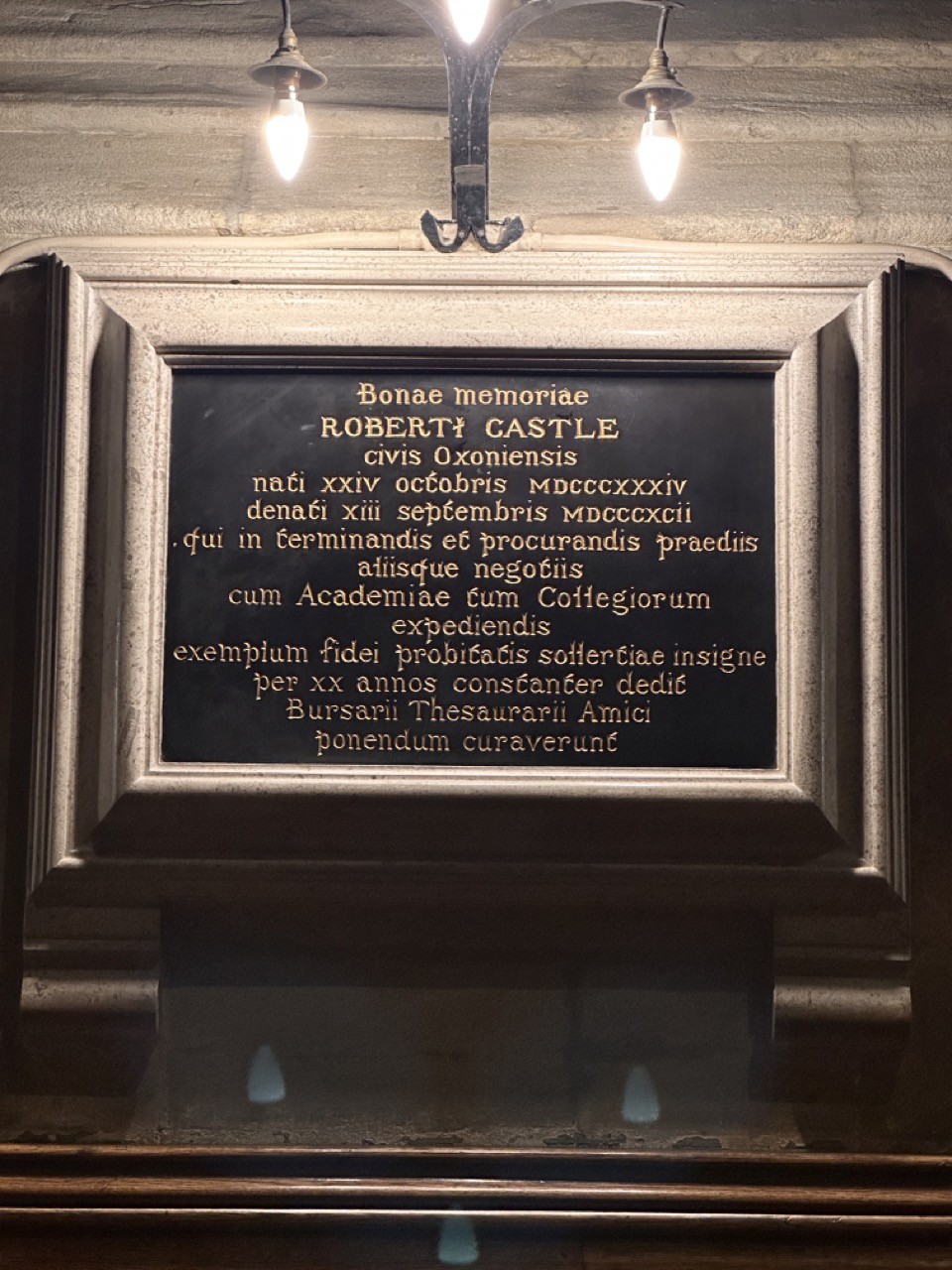
Original inscription in Latin
Bonae memoriae
ROBERTI CASTLE
civis Oxoniensis
nati XXIV octobris MDCCCXXXIV
denati XIII septembris MDCCCXCII
qui in terminandis et procurandis praediis
aliisque negotiis
cum Academiae tum Collegiorum
expediendis
exemplum fidei probitatis sollertiae insigne
per XX annos constanter dedit
Bursarii Thesaurarii Amici
ponendum curaverunt
English translation
To the honoured memory of Robert Castle, a citizen of Oxford, born on 24 October 1834 and deceased on 13 September 1892, who, in determining the boundaries and managing the estates, and in conducting other business, of both the University and the colleges, consistently gave an outstanding example of trustworthiness, integrity and skill for twenty years. Bursars, treasurers and friends arranged for this memorial to be erected.
This memorial extends the university-and-city history beyond the figures discussed in the available account of the tour. I do not attribute a commentary on Castle to Lamb. The inscription itself supplies the connection: civis Oxoniensis identifies an Oxford citizen, while the following lines describe service to the university and colleges. Its named sponsors are bursars, treasurers and friends. Those plural nouns identify the people arranging the commemoration; they should not be turned into a list of offices held by Castle. Likewise, fides here is best understood as trustworthiness or fidelity in service, rather than automatically as a claim about religious belief.
The qualities honoured are precise: reliability, probity and practical competence, sustained over twenty years. This adds something to the vicar’s account of jurisdiction, institutional relationships and being a good neighbour. A university also depends on people who look after property, boundaries and everyday business. The memorial gives that work a place within its public memory. It does not establish that every estate transaction was just; it records how a community chose to honour the person who conducted them. For my later question about whom education should benefit, it broadens the range of contributions worth noticing.
Sanskrit, Gandhi and an international Oxford
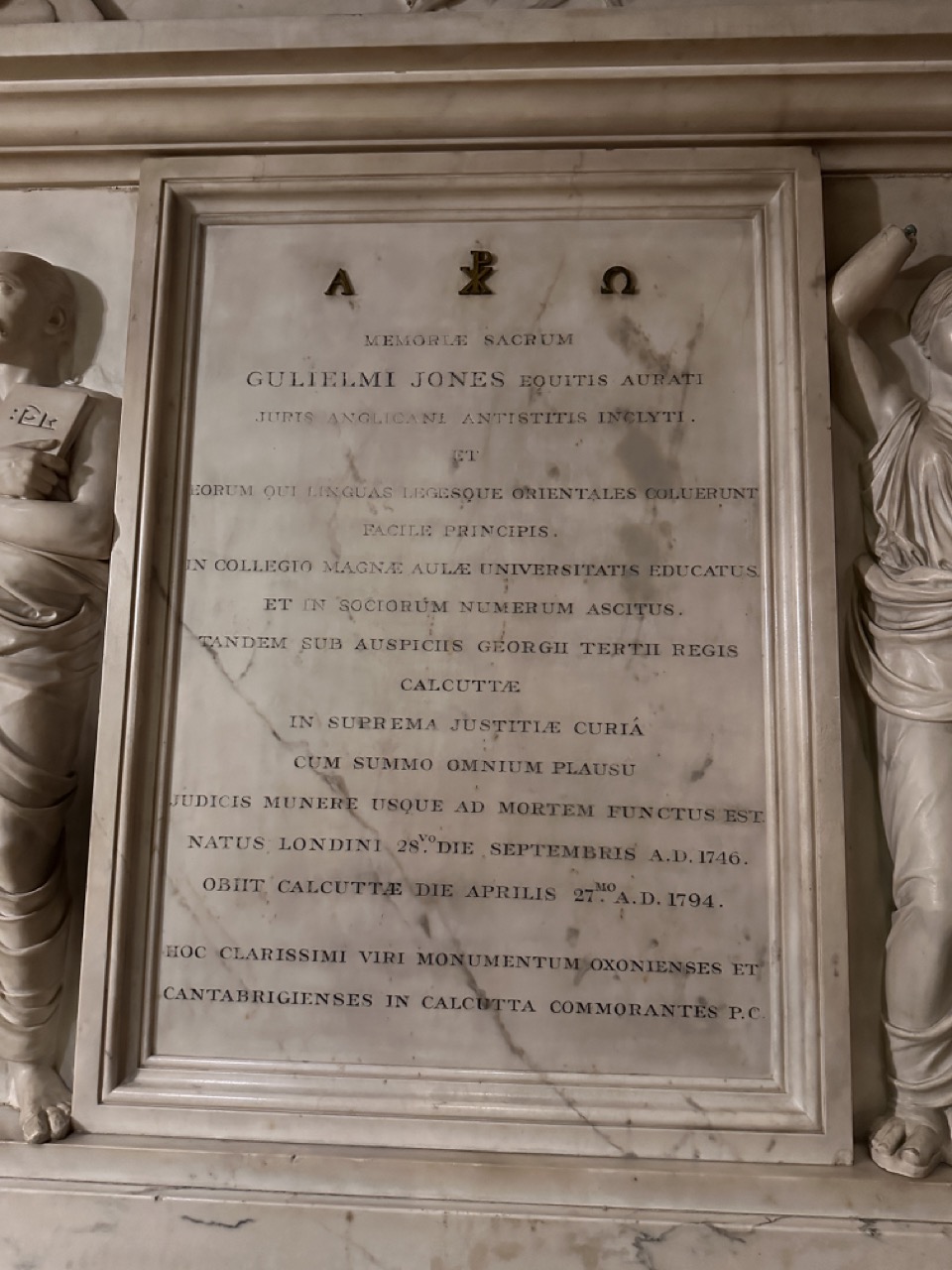
Original inscription in Latin
Above the text are an alpha, a Christogram and an omega. The following transcription records the central Latin panel; the small characters on the flanking sculpture are not sufficiently clear in this photograph for a reliable transcription.
MEMORIÆ SACRUM
GULIELMI JONES EQUITIS AURATI
JURIS ANGLICANI ANTISTITIS INCLYTI.
ET
EORUM QUI LINGUAS LEGESQUE ORIENTALES COLUERUNT
FACILE PRINCIPIS.
IN COLLEGIO MAGNÆ AULÆ UNIVERSITATIS EDUCATUS.
ET IN SOCIORUM NUMERUM ASCITUS.
TANDEM SUB AUSPICIIS GEORGII TERTII REGIS
CALCUTTÆ
IN SUPREMA JUSTITIÆ CURIA
CUM SUMMO OMNIUM PLAUSU
JUDICIS MUNERE USQUE AD MORTEM FUNCTUS EST.
NATUS LONDINI 28VO. DIE SEPTEMBRIS A.D. 1746.
OBIIT CALCUTTÆ DIE APRILIS 27MO. A.D. 1794.
HOC CLARISSIMI VIRI MONUMENTUM OXONIENSES ET
CANTABRIGIENSES IN CALCUTTA COMMORANTES P.C.
English translation
Sacred to the memory of Sir William Jones, a distinguished authority on English law and easily foremost among those who cultivated the languages and laws of the East. Educated at the College of the Great Hall of the University, and admitted to its fellowship, he subsequently, under the auspices of King George III, served as a judge in the Supreme Court of Justice at Calcutta, with the highest approval of all, until his death. Born in London on 28 September 1746. Died at Calcutta on 27 April 1794.
Oxford and Cambridge men residing in Calcutta caused this monument to that most distinguished man to be erected.
The college named is University College. Eques auratus denotes knighthood; antistes here praises an eminent authority in law rather than identifying a bishop. The closing P.C. is conventionally expanded as ponendum curaverunt, “caused [it] to be erected”. The superscript endings attached to the dates are Latin ordinal endings. These details matter because translating a memorial involves recovering institutions and conventions as well as substituting English words for Latin ones.
Another strand began with the memorial to Sir William Jones. Lamb remarked that its Sanskrit inscription was upside down, contrasting the scholar’s command of the language with the apparent limitations of the stonemason. I retain this as a reported observation from the tour; its physical accuracy has not been independently established here. The anecdote nevertheless explains why the monument entered the evening’s account. A memorial intended to honour learning could itself become an occasion for questioning how faithfully knowledge had been transmitted into a material object.
The photograph now makes the evidential limit of that anecdote more exact. The central text is Latin and reads normally in its displayed orientation. It cannot confirm or refute the reported inversion of a Sanskrit inscription elsewhere on the monument. Identifying the language correctly is a necessary first step: a photograph of the right memorial is not automatically a photograph of the particular feature being discussed. The Sanskrit claim consequently remains open.
The readable panel adds a different historical argument. Jones is praised for languages and laws together, and his scholarship is placed beside royal patronage and judicial service in Calcutta. The closing lines identify the commemorating community as Oxford and Cambridge men living there. The connection between learning and imperial institutions is therefore present in the memorial’s own wording, rather than being solely an interpretation brought from outside. Its claim to universal applause is commemorative praise; the inscription cannot establish that everyone affected by his work shared that judgment. Reading it historically means preserving both the honour it offers and the position from which that honour was expressed.
Above the memorial, Lamb identified a ceiling boss depicting Mahatma Gandhi and encouraged visitors to return in daylight to see it more clearly. He connected it with Gandhi’s presence in Britain in 1931 for the London conferences on India’s constitutional future and with Gandhi’s friendship with the Anglican priest Charles Freer Andrews. In the vicar’s telling, Andrews’s work in India and South Africa and his friendship with Gandhi connected the church with a history extending far beyond Oxford. Lamb also related the story to Cambridge: Andrews had studied at Pembroke and served as vice-principal of Westcott House, a position Lamb himself later held. Institutional records confirm that both men served as vice-principal of Westcott House (Cambridge University Library, n.d.); (Harris Manchester College, n.d.).
The vicar used the Gandhi connection to speak about Oxford as a university welcoming people from across the world. That interpretation should be preserved alongside the historical qualification discussed below: Gandhi’s visit to Oxford is established, while his visit to this particular church is less certain. The broader context of Jones also deserves attention. His Sanskrit scholarship and work with Indian intellectual traditions developed alongside his judicial role in Bengal and projects concerned with Hindu and Muslim law under British rule. A scholarly account of his career therefore complicates any simple story of international intellectual exchange (Pantheons research project, n.d.). This is additional historical context, rather than a claim about everything the vicar did or did not discuss.
Four pillars of religious and intellectual history
Before introducing the four pillars around the nave altar, Lamb asked whether anyone knew the expression “memory palace”. A participant described a mnemonic arrangement in which images and locations help a person recall material. Lamb extended the explanation back from the Middle Ages to antiquity and referred to Mary Carruthers’s The Book of Memory and The Craft of Thought. He connected the cultivation of memory with the formation of a critical mind, then observed that search engines and artificial intelligence change how we exercise that faculty. The building itself supplied the demonstration: positions in the church organised a sequence through the history of the university and religion in England.
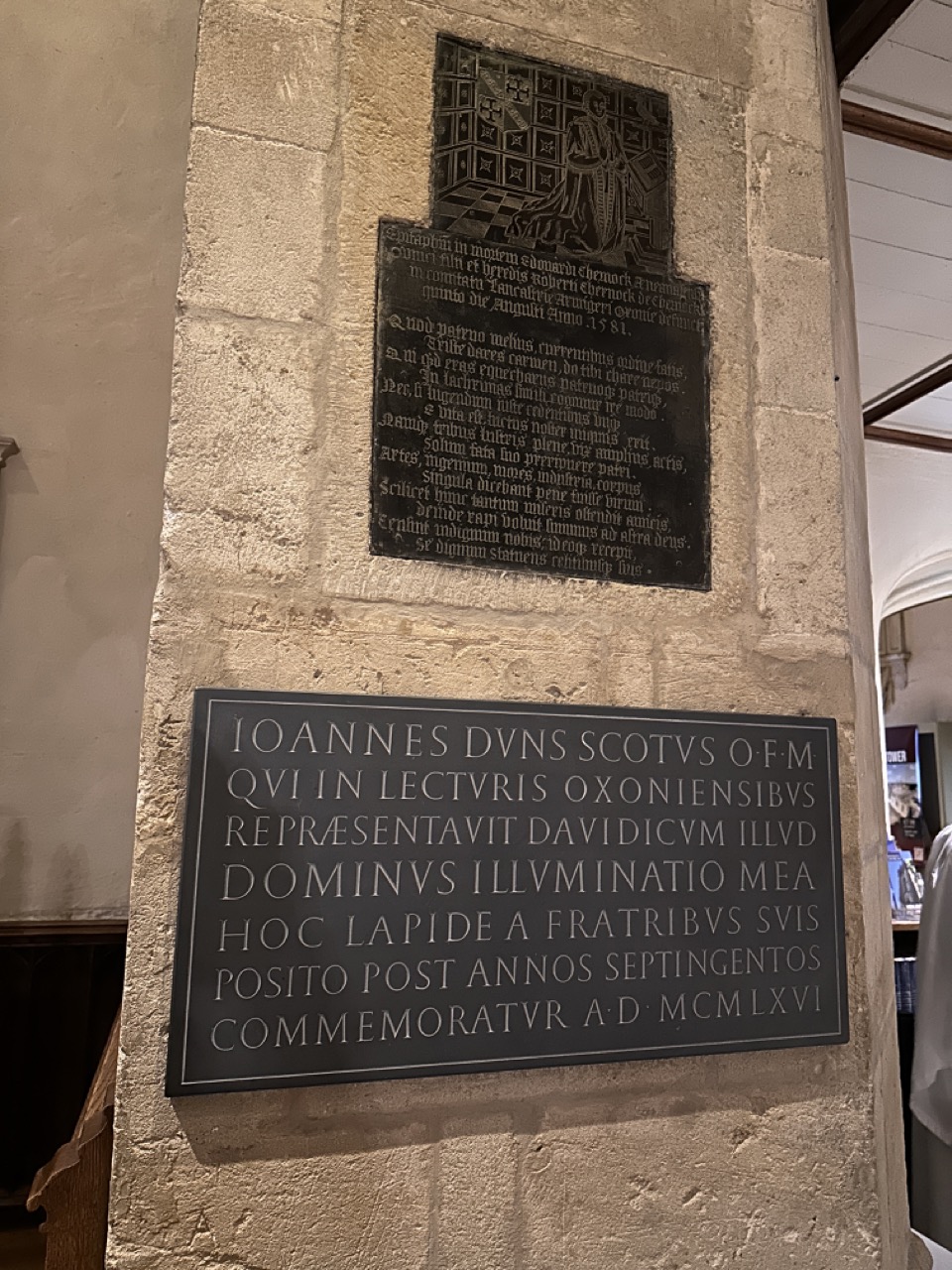
The Scotus inscription in Latin
IOANNES DVNS SCOTVS O·F·M
QVI IN LECTVRIS OXONIENSIBVS
REPRÆSENTAVIT DAVIDICVM ILLVD
DOMINVS ILLVMINATIO MEA
HOC LAPIDE A FRATRIBVS SVIS
POSITO POST ANNOS SEPTINGENTOS
COMMEMORATVR A·D·MCMLXVI
English translation
John Duns Scotus, of the Order of Friars Minor, who in his Oxford lectures gave expression to that saying of David, “The Lord is my light”, is commemorated by this stone, erected by his brothers after seven hundred years, in the year of our Lord 1966.
Repræsentavit can mean “represented”, “made present” or “gave expression to”; it need not imply that the inscription is identifying a lecture specifically devoted to this psalm. “His brothers” refers in context to his Franciscan brethren. The date belongs to the act of commemoration. The plaque itself should not be mistaken for a medieval document.
The first pillar led to the memorial of Johannes Duns Scotus, O.F.M. Lamb explained the initials as the Order of Friars Minor, identifying Scotus’s Franciscan tradition. He recalled the title “Subtle Doctor” and the intellectual subtlety it recognised. Against a presentation of medieval theology dominated by Aquinas and Thomism, he wanted Scotus’s importance to become visible. He associated the word “dunce” with the later opponents of Scotus and argued that the Reformers’ engagement with scholastic theology often centred on Scotus. That stronger generalisation requires qualification, but its place in the talk was to recover a less familiar intellectual inheritance.
Lamb associated Scotus’s memorial with his teaching in the church and described a career connecting Paris and Oxford. He placed him alongside Robert Grosseteste, whom he presented as a significant figure in scientific inquiry, a university chancellor and later Bishop of Lincoln. Together, they represented the intellectual flourishing through which the medieval university acquired its standing. This part of the tour matters for the later reflection because the relationship between religion and critical thought was already part of the vicar’s historical account. The move towards questions about theology and knowledge did not require treating the building as an incidental setting.
The inscription supports the vicar’s identification of Scotus’s Franciscan affiliation and association with Oxford teaching. Its wording is narrower than the claim that he taught in this particular building: it says “in his Oxford lectures”, without naming their room or location. Its seven-hundred-year interval points towards the conventional birth anniversary around 1266, rather than dating his Oxford lectures to that year. The conventional birth date is itself approximate; recent scholarship favours an earlier date around 1263–1264 (Williams, 2025, §1.1). The stone records a commemorative decision as well as an account of a medieval thinker.
A further distinction prevents the memorial’s language from becoming an inaccurate summary of Scotus’s philosophy. Its celebration of divine light does not establish his acceptance of a technical theory requiring special divine illumination for certain knowledge. Scotus criticised Henry of Ghent on precisely that issue and defended the capacity of natural intellectual powers to attain certainty (Williams, 2025, §4.3). Devotional praise and a philosophical account of knowing need separate interpretation. This gives the vicar’s emphasis on critical theological thought more substance: religious language can accompany a rigorous dispute about how knowledge is possible.
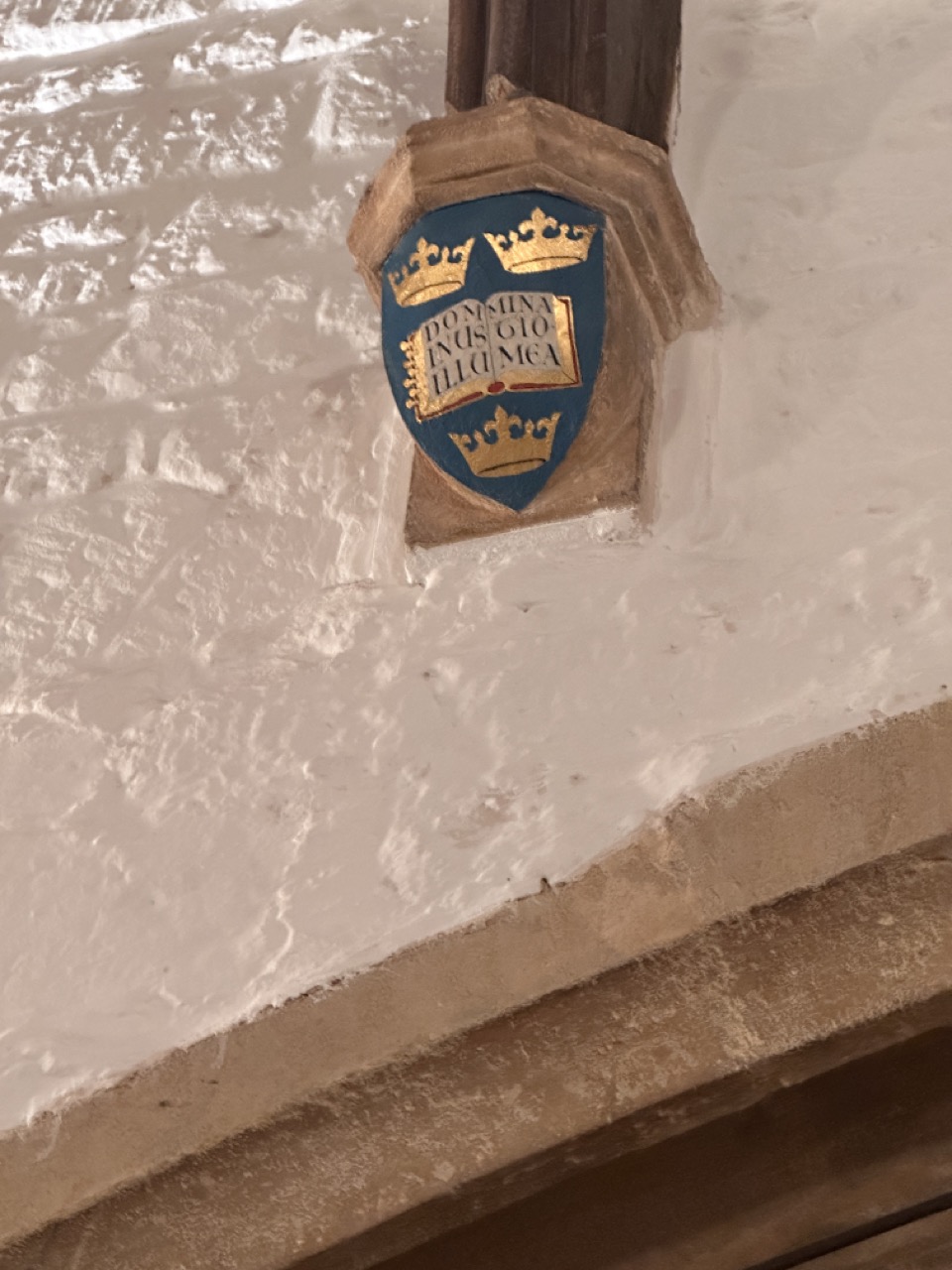
The lettering on the open book
| Left-hand page | Right-hand page |
|---|---|
| DOM | MINA |
| INVS | TIO |
| ILLV | MEA |
Read down the left page and then down the right, the lettering gives DOMINVS ILLVMINATIO MEA.
English translation: “The Lord is my light.”
The photograph gives the Scotus inscription a visible companion elsewhere in the church. The words are the opening of Psalm 27:1, numbered Psalm 26 in the Vulgate. The Bodleian’s account of the university arms dates their adoption to around 1400 and notes that this particular motto was in at least occasional use by the later sixteenth century. It also cautions that the origin of the three crowns is uncertain and that familiar explanations of the book’s clasps are unreliable (Bodleian Libraries, n.d.-b). I therefore do not assign a definite theological meaning to each crown or clasp.
The same words now appear in three settings: a biblical psalm, university heraldry and a twentieth-century memorial to a medieval theologian. Their recurrence is real, but it does not prove that each use performs the same function. The university’s later use of the motto also prevents a simple inference that Scotus’s Oxford lectures already carried the institution’s present heraldic identity. For the discussion of AI and theology, this is a concrete example of why matching words is only the beginning of interpretation: the speaker, setting, date and purpose still matter.
The older brass above Scotus
The upper memorial in Figure 3 belongs to Edward Chernock, not to Scotus. Its figure kneels before an open book, and the inscription combines a biographical heading with fourteen lines of verse. The reading below expands the blackletter abbreviations and regularises letter forms. Square brackets mark two difficult readings in the heading supplied from the older transcription preserved in Anthony Wood’s survey; the date and the poem’s substance can also be checked against that witness (Wood, 1899, pp. 119–120).
Latin reading transcription
Epitaphium in mortem [Edovardi] Chernock [Aeneanasensis]
unici filii et heredis Roberti Chernock de Chernock
in comitatu Lancastriae Armigeri Oxoniae defuncti
quinto die Augusti Anno 1581.
Quod patruo melius, currentibus ordine fatis,
Triste dares carmen, do tibi chare nepos.
Qui quod eras eque charus patruoque patrique,
In lachrymas simul cogimur ire modo.
Nec, si lugendum iuste cedentibus unquam
E vita est, luctus noster iniquus erit.
Namque tribus lustris plene vix amplius actis,
Solum fata suo preripuere patri.
Artes, ingenium, mores, industria, corpus,
Singula dicebant pene fuisse virum.
Scilicet hunc tantum miseris ostendit amicis,
Deinde rapi voluit summus ad astra deus.
Censuit indignum nobis, ideoque recepit,
Se dignum statuens coelitibusque suis.
English translation
An epitaph on the death of Edward Chernock of Brasenose, who died at Oxford on the fifth day of August in the year 1581. He was the only son and heir of Robert Chernock of Chernock in the county of Lancashire, esquire.
The sorrowful poem which, had the fates run in their proper order,
you would more fittingly have given your uncle, I give to you, dear nephew.
Because you were equally dear to uncle and father,
we are now driven together into tears.
Nor, if it is ever right to mourn those departing
from life, will our grief be unjustified.
For, when scarcely more than three full periods of five years had passed,
the fates snatched an only son from his father.
Learning, intellect, character, diligence and bodily form—
each declared that he had almost become a man.
God Most High only showed him briefly to his grieving friends,
then willed him to be carried away to the stars.
He judged that he did not belong among us, and therefore received him,
deeming him worthy of himself and his heavenly companions.
Aeneanasensis identifies Brasenose; patruus means a paternal uncle, which establishes the relationship of the poem’s speaking voice to the dead boy. A lustrum is five years, so the poem describes a death at scarcely more than fifteen. Its language combines classical fates and stars with a theological account of God receiving the dead. The final couplet is consolatory: the boy is represented as belonging with God and the heavenly community. That explains its sense without turning its assertion about divine intention into a historically demonstrated cause of death.
This is an additional reading prompted by the photograph, rather than a speech I can attribute to Lamb. Its proximity to Scotus nevertheless changes the memory palace available to me. Intellectual history here includes a young person whose learning, character and diligence were remembered as promise interrupted. The first couplet is especially particular: an uncle writes the poem he had expected his nephew, surviving him, might one day write for him. Preserving that reversal keeps a human relationship within the history. The memorial deserves attention for the bereavement it expresses, independently of the larger argument I might build around it.
Cranmer, Wesley and Newman
The second pillar introduced Cranmer through damage to its decoration, which Lamb associated with a wooden platform and the proceedings against the former Archbishop of Canterbury. He traced Cranmer’s role in the annulment of Henry VIII’s marriage to Catherine of Aragon, while distinguishing Henry’s break with Rome from wholehearted acceptance of Protestant reform. Henry’s earlier papal title, Defender of the Faith, made that difference memorable. Under Edward VI, the religious situation changed, and the vicar identified Cranmer with the successive editions of the Book of Common Prayer in 1549 and 1552.
Mary’s accession then reversed the political and religious circumstances. Lamb connected her Catholic commitments and her position as Catherine’s daughter with her hostility towards Cranmer. His account distinguished the treason proceedings, which he described as followed by a pardon, from prosecution for heresy. Cranmer, Latimer and Ridley became examples of Cambridge education ending in execution at Oxford. Lamb identified 21 March 1556 as the date of Cranmer’s final appearance at St Mary’s and execution, and directed attention to the cross in Broad Street near Balliol marking the place associated with the burnings. The compressed account needs chronological unpacking, but its central subject was unmistakable: theological controversy had become coercion and death.
The nearby memorial to Catholic and Protestant martyrs changed the perspective on that history. Lamb drew attention to Edmund Campion among the names and recalled the response of a visiting Jesuit Father General, whom he described as deeply moved by the commemoration of Campion and other Jesuits in this Anglican church. He also regretted the omission of a predecessor whom he particularly admired; the probable identification is considered below. The memorial represented a present willingness to honour witnesses across divisions that had once been grounds for persecution. Lamb connected this with Pope Francis’s language of an “ecumenism of blood”, in which Christians killed for their faith are recognised across denominational boundaries.
A different form of commemoration
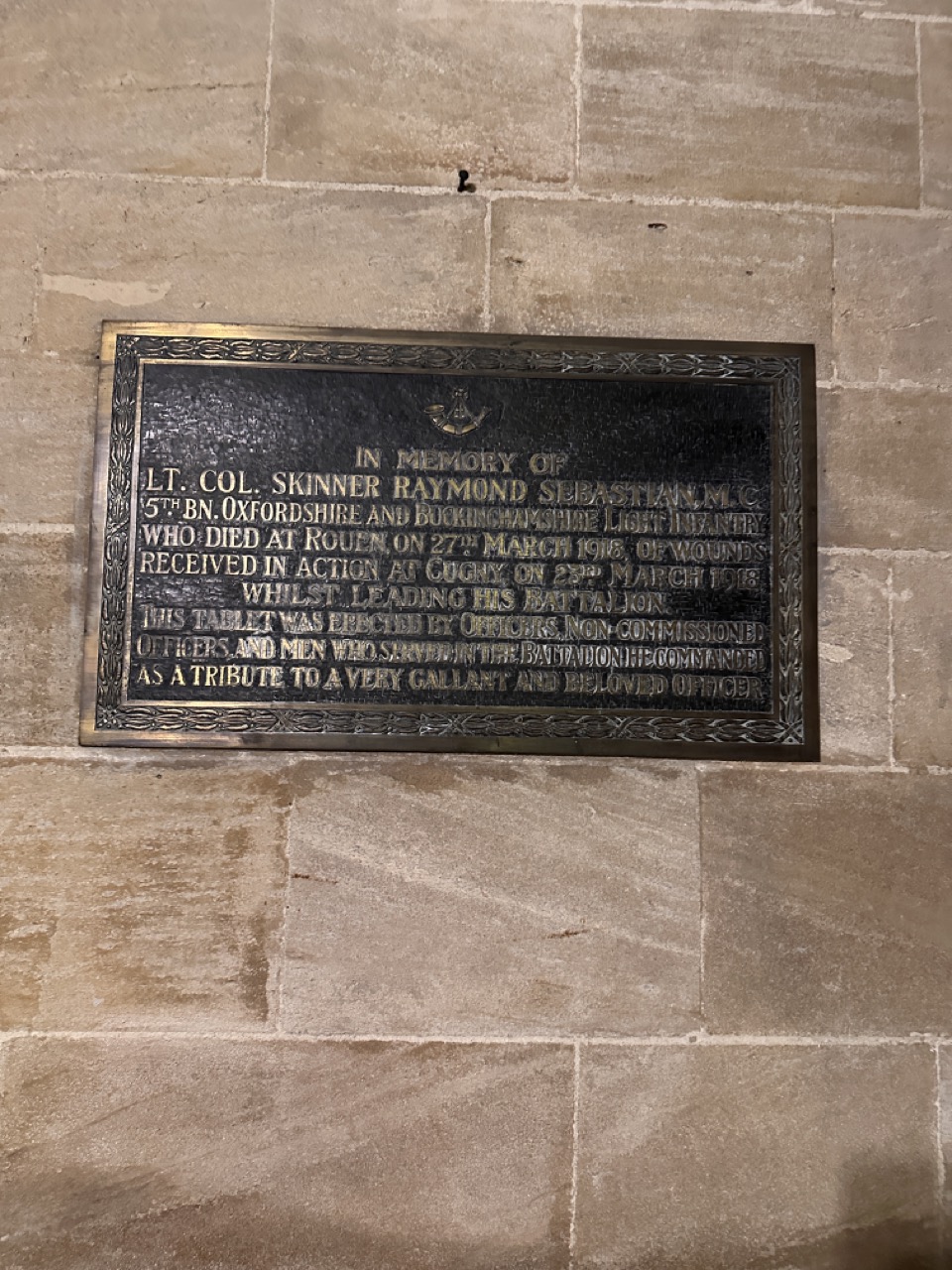
Original inscription in English
IN MEMORY OF
LT. COL. SKINNER RAYMOND SEBASTIAN M.C.
5TH BN. OXFORDSHIRE AND BUCKINGHAMSHIRE LIGHT INFANTRY
WHO DIED AT ROUEN ON 27TH MARCH 1918 OF WOUNDS
RECEIVED IN ACTION AT CUGNY ON 23RD MARCH 1918
WHILST LEADING HIS BATTALION.
THIS TABLET WAS ERECTED BY OFFICERS, NON-COMMISSIONED
OFFICERS AND MEN WHO SERVED IN THE BATTALION HE COMMANDED
AS A TRIBUTE TO A VERY GALLANT AND BELOVED OFFICER.
Expanded reading: Lieutenant Colonel Skinner Raymond Sebastian, Military Cross, of the 5th Battalion, Oxfordshire and Buckinghamshire Light Infantry, died at Rouen on 27 March 1918 from wounds received while leading his battalion at Cugny four days earlier. The memorial was erected by the officers, non-commissioned officers and men who had served under him. Since the original is English, an additional translation is unnecessary; the expansion makes its military abbreviations explicit.
The Imperial War Museums register identifies this tablet at St Mary’s and records substantially the same text. There is a small transcription difference: its online record gives “IS ERECTED”, while my photograph reads “WAS ERECTED”. I retain the photographed wording (Imperial War Museums, n.d.). This illustrates why an authoritative catalogue can be checked against an object without losing its value as a source. The tablet also distinguishes the place and date of wounding from those of death, a distinction that a compressed summary could easily erase.
The photograph nevertheless extends the section on commemoration by introducing another community’s voice. The soldiers speak of courage and affection; their relationship to their commanding officer is part of the memorial’s meaning. This differs from the shared martyrs’ memorial’s reconciliation across confessional divisions. The two can be considered together without treating military death, martyrdom and every other form of loss as interchangeable. What a community honours, and the grounds on which it does so, remain questions specific to each inscription.
The third pillar brought the account to John Wesley and evangelical revival. Lamb identified Wesley as the founder of Methodism while emphasising his Anglican priesthood, his fellowship at Lincoln College and his ordination at Christ Church Cathedral. The university sermons therefore belonged to an institutional life he knew from within. In Scriptural Christianity, Wesley criticised the university’s spiritual apathy and compared its Christian practice unfavourably with the life described in the Acts of the Apostles. Lamb presented the decision not to invite him to preach again as a consequence of that challenge. He then connected Wesley’s ministry with America and the industrial towns of Britain, locating the episode within the evangelical revivals of the eighteenth and nineteenth centuries. The American journey belongs earlier in the chronology, a correction that changes the sequence without removing the sermon’s force.
The pulpit brought the fourth figure into view. The present pulpit dates from 1827, while Wesley had preached from an earlier one; the evening’s account also mentions a pulpit wheeled into position for university sermons. John Henry Newman became vicar in 1828 and attracted students through the preaching later collected in his Parochial and Plain Sermons and University Sermons. With John Keble and Edward Bouverie Pusey, he was associated with the Oxford Movement and its effort to recover the Church of England’s Catholic inheritance. Lamb described the controversy this produced, including attempts by college authorities to prevent students from attending Newman’s preaching.
Newman’s ministry also changed the church’s material and pastoral life. Lamb recalled his work on the building, his introduction of gas lighting and his responsibility for the church at Littlemore. The gas lighting supplied a joke within a candlelit tour: a figure associated with the recovery of Catholic tradition had also introduced a practical technological improvement. Newman resigned as vicar in 1843, entered the Roman Catholic Church in 1845, became a Catholic priest, was made a cardinal in 1879 and died in 1890. The vicar’s account joined that religious journey to a continuing intellectual legacy in The Grammar of Assent, the development of doctrine, and the commissioning and editing of patristic texts.
The Idea of a University then shifted attention from Newman’s biography to the purpose of our own education. Lamb challenged an exclusively instrumental understanding of higher education and spoke of depth of learning and formation of character. He also connected Newman’s work at Oriel with the renewal of close tutorial teaching. The students listening to the tour were thus implicated in the history being described: tutorials and supervisions were practices with an intellectual and institutional inheritance. Whether the cultivation of intellect also produces moral or religious formation became a more precise question during the later examination of Newman’s text.
Edwin Hatch and the historical study of theology
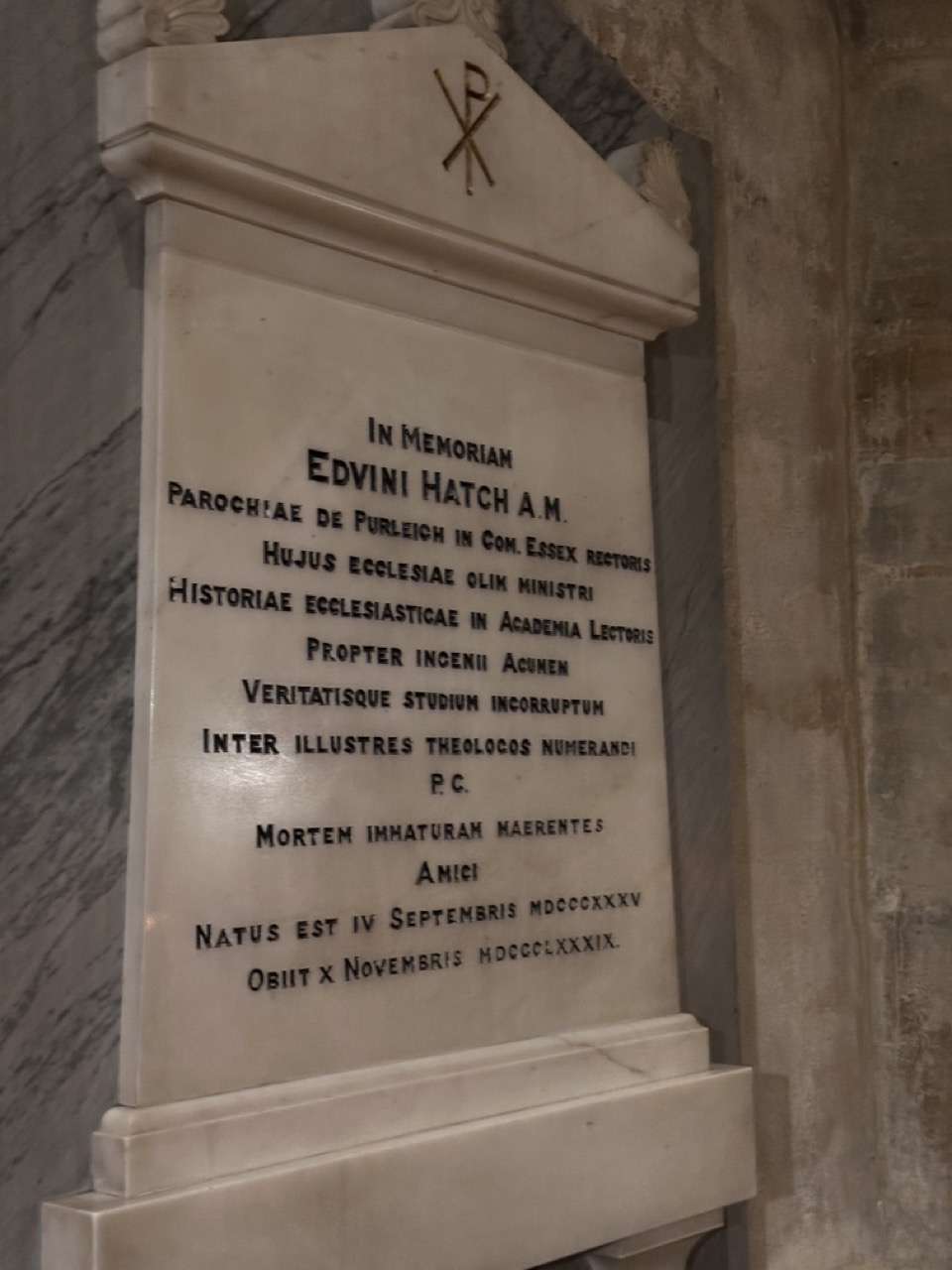
Original inscription in Latin
IN MEMORIAM
EDVINI HATCH A.M.
PAROCHIAE DE PURLEIGH IN COM. ESSEX RECTORIS
HUJUS ECCLESIAE OLIM MINISTRI
HISTORIAE ECCLESIASTICAE IN ACADEMIA LECTORIS
PROPTER INGENII ACUMEN
VERITATISQUE STUDIUM INCORRUPTUM
INTER ILLUSTRES THEOLOGOS NUMERANDI
P.C.
MORTEM IMMATURAM MAERENTES
AMICI
NATUS EST IV SEPTEMBRIS MDCCCXXXV
OBIIT X NOVEMBRIS MDCCCLXXXIX.
English translation
In memory of Edwin Hatch, Master of Arts, rector of the parish of Purleigh in the county of Essex, formerly a minister of this church, and Reader in Ecclesiastical History in the University, who, for his intellectual acuity and uncorrupted devotion to truth, is to be numbered among distinguished theologians. Friends mourning his untimely death caused this memorial to be erected. He was born on 4 September 1835 and died on 10 November 1889.
The Christogram above the inscription places its praise within a Christian setting. A.M. stands for Artium Magister, Master of Arts, and Com. abbreviates the county designation. The phrase hujus ecclesiae olim ministri says that Hatch had been a minister of this church; it does not by itself identify him as its vicar. Here, too, P.C. means that the commemorators arranged for the monument to be erected, and the following lines identify those commemorators as grieving friends. The inscription records an academic office and an evaluative judgment, as well as dates.
Hatch is another addition from the photographs whom I cannot identify as a subject of the recorded tour. His memorial belongs naturally beside the discussion of Newman because both bring historical inquiry into theology into view. Hatch’s 1888 Hibbert Lectures, published posthumously as The Influence of Greek Ideas and Usages upon the Christian Church, investigated the transformation of Christian thought and practice within Greek intellectual culture. He framed his opening problem through the distance between the Sermon on the Mount and the Nicene Creed (Hatch, 1914 [1890], Lecture I). This describes Hatch’s historical argument; it does not establish that his account is the final explanation of doctrinal development.
The connection with Newman is a question to pursue, rather than evidence that the two supplied the same theory. Newman’s work on development and Hatch’s inquiry into historical transformation ask us to examine how continuity is understood through change. For my interest in AI and theology, this gives a more demanding setting to the question of what happens when ideas move into new representational forms. An account of how a doctrine developed and a judgment about its theological truth require related but distinguishable arguments. Neither preservation nor alteration of wording settles that relationship.
The memorial’s own standard of distinction also matters. Intellectual sharpness is joined to an uncompromised pursuit of truth. The conjunction offers a useful question for assisted scholarship: what practices keep an impressive interpretation answerable to evidence? It does not certify that every conclusion Hatch reached was correct, just as the ability to produce an articulate theological explanation cannot by itself certify the explanation. Here the stone gives the later reflection a concrete historical vocabulary for an issue already raised by Newman and the vicar.
Saints, visitors and the living church
The vicar brought Newman’s ecclesiastical reception up to the present: beatification by Benedict XVI in 2010, canonisation by Francis in 2019, and proclamation as a Doctor of the Church by Leo XIV on 1 November 2025. The last date is confirmed by the Vatican’s record and meant that the tour took place just before its first anniversary (Leo XIV, 2025). Lamb’s joke about impostor syndrome placed this inheritance in a living person’s experience. Students might fear that the admissions office had made a mistake; he had to preach in a church where a saint and Doctor of the Church had been his predecessor. The joke belonged with his reminders that Newman’s pulpit was also a pulpit still in use.
He also connected Newman’s recognition with the unexpected significance of visitors. His recollection involved meeting Pope Leo in Rome and discovering a connection with an earlier visit to the University Church. A published diocesan account quoting Lamb confirms that he joined the Anglican delegation for Newman’s proclamation and that Leo told him he had attended Choral Vespers at St Mary’s before becoming pope (Diocese of Oxford, 2025). The evening’s reminiscence also included a papal rosary and a recollection of a student volunteer introducing the then Cardinal Prevost in 2023, followed by a conversation of about twenty minutes on the history of the Church of England. These more particular details remain unverified. The securely supported point is already substantial: keeping a church open creates encounters whose significance may only become apparent later. Lamb used that thought to welcome the people before him without presuming to know whom every visitor might be.
Compline and the Old Library
The group then moved into the chancel for Compline. Lamb pointed out the fifteenth-century stalls and encouraged their use, alongside the ordinary seating. The printed order of service provided the responses, and he invited people to join the congregational parts and plainchant while leaving the choral sections to the singers. The account of the service includes confession and absolution, the opening versicles, the hymn Before the Ending of the Day, Psalm 134, a reading from Matthew 11:28–30, the responsory Into Your Hands, O Lord, and the Nunc Dimittis with its antiphon Save Us, O Lord, While Waking, the evening prayers and the Lord’s Prayer, ending with the Latin Salve Regina. The evening’s engagement with Christian history consequently included the continuation of a Christian practice.
Before refreshments upstairs, Lamb asked that the candles be extinguished and left behind, linking the rule against naked flames with the commitments familiar to readers admitted to the Bodleian. In the Old Library, he drew attention to the room’s small scale and identified it with the university’s first library, dating its beginnings to around 1320. Narrow windows and the outlines of earlier openings in the stonework showed that the room had been altered, as had its ceiling. He described a building repaired and adapted over time, later used for teaching, with Congregation House below serving the university’s governing body.
The vicar connected the move towards Duke Humfrey’s Library above the Divinity School with the growth of the university and the limitations of the older room, including its darkness. He then pointed out an eighteenth-century table used when the choirboys of New College School were taught there. Their names and dates, scratched into the wood, had become historically valued marks. His request that current visitors should not add their own preserved the humour of the observation without making the table’s status mysterious: the traces of earlier use were now objects of care.
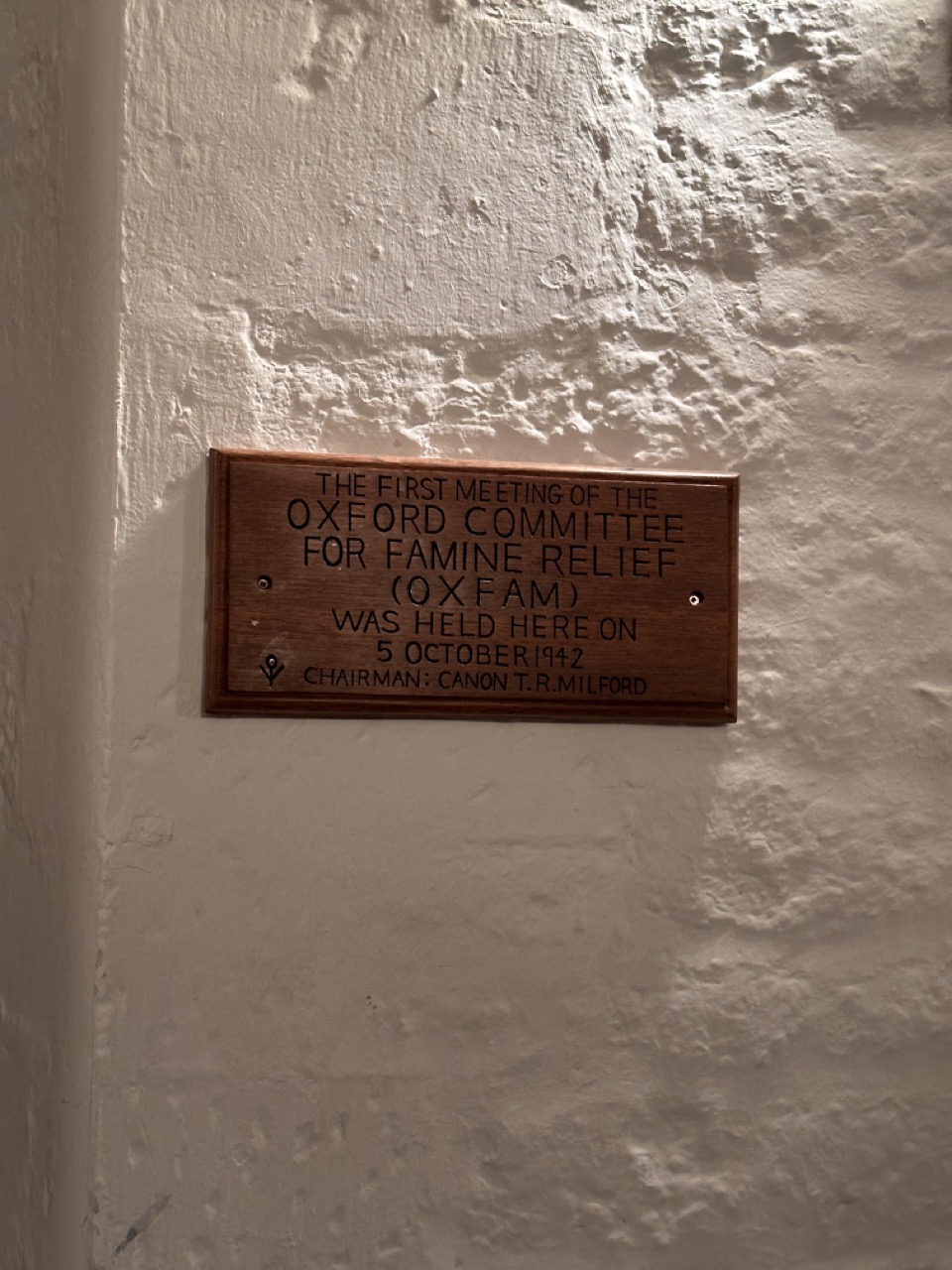
Original inscription in English
THE FIRST MEETING OF THE
OXFORD COMMITTEE
FOR FAMINE RELIEF
(OXFAM)
WAS HELD HERE ON
5 OCTOBER 1942
CHAIRMAN: CANON T. R. MILFORD
Reading: The plaque states that the committee’s first meeting took place in this room on 5 October 1942 under the chairmanship of Canon T. R. Milford. Its original language is English. The word “here” is essential to the claim: a transcription preserves it, but the photograph and its location identify the place to which it refers.
The room’s twentieth-century history supplied the final major connection. Pointing to a plaque on the wall, Lamb recalled the meeting of the Oxford Committee for Famine Relief there in October 1942 and the leadership of his predecessor Dick Milford, whom he described as its chairman from 1942 to 1967. That committee became Oxfam. He connected the history with the church’s continuing relationships with charities and its public programme, mentioning an event with local MP Anneliese Dodds in a couple of weeks’ time. He ended by welcoming both those newly arrived in Oxford and those who had been there longer, inviting them to consult the programme and enjoy the refreshments. The narrative had reached the present through a room in which learning, governance, schooling, relief work and hospitality had each found a place.
The photograph supports the vicar’s account and adds precision to it. Oxfam’s own seventy-fifth-anniversary history also dates the organisation’s foundation to 5 October 1942 and describes its campaign to relax the Allied blockade so that food could reach people starving in Greece and elsewhere in Europe (Oxfam Ireland, 2017). The plaque confirms the named chairman and location claimed in the talk; it does not establish the duration of Milford’s chairmanship, which remains a separate biographical claim. Nor does naming the chairman imply that the organisation was the work of one person alone.
The difference between this plaque and the personal memorials is instructive. It commemorates a meeting and the beginning of collective action. The room’s association with learning became connected with a response to suffering and a challenge to public policy. In relation to the vicar’s account of being a good neighbour, that history gives responsibility a specific form: people gathered, organised and sought a change in what could be done. The question for me is not answered by admiring the plaque. It remains what comparable responsibilities might follow from the knowledge, institutional access and technical capacities I am acquiring.
When checking history also means checking the correction
A historical account needs to retain the vicar’s emphases while distinguishing them from what further research establishes. A date can be wrong, a chronology compressed, a plausible story insufficiently documented, or a broad interpretation in need of qualification. The source may also correct the person proposing a correction. These possibilities matter differently. They should not be reduced to a general verdict on the speaker, and an illuminating interpretation cannot make an incorrect chronology true.
The inscriptions make this work more exact by showing that evidence can support different kinds of claim. The Oxfam plaque provides a date and a statement about a place; the Jones monument also offers praise from an identifiable community; the Chernock epitaph expresses grief and a belief about divine reception. Their presence in a church does not give all those statements the same evidential status. Nor does the modern Scotus plaque become contemporary evidence for a medieval lecture simply because its account is carved in stone. It is necessary to ask when a record was made, by whom, and what it can establish.
The Oriel and library passages illustrate the difference between a historical relationship and its compressed timescale. Oriel dates its first college chapel to about 1373, roughly forty-seven years after the 1326 foundation, rather than the approximate century suggested in the tour. The explanation about fellows avoiding a cold walk remains an anecdote, rather than an established cause of the building project (Oriel College, n.d.-a). Similarly, the Bodleian’s history places the beginnings of the university’s first purpose-built library around 1320 and its replacement by Duke Humfrey’s in 1488. That is a much longer interval than the expression “very quickly” might suggest (Bodleian Libraries, n.d.-a). Neither qualification removes the institutional connections the vicar was describing.
Cranmer’s story requires several episodes to be distinguished. The date 1554 was mentioned in connection with the platform at the pillar, but the Oxford disputations of April 1554, the heresy proceedings of 1555 and the final appearance and execution on 21 March 1556 should not become one event. Lambeth Palace Library’s research guide identifies contemporary material relating to the disputations and Cranmer’s final address; the latter records his repudiation of the recantations he had previously made. The Ashmolean’s account also distinguishes the execution of Latimer and Ridley in October 1555 from Cranmer’s death the following March (Lambeth Palace Library, n.d.); (Standley, 2012). These distinctions clarify what the pillar is being asked to recall without pretending that the date of every physical alteration has thereby been established.
The interpretation of Mary’s hostility needs similar care. Her relationship to Catherine of Aragon makes the personal dimension of the vicar’s account intelligible, but the persecution belonged to a wider restoration of Catholic religion and the use of ecclesiastical and royal authority against heresy. Explaining the proceedings entirely through personal retaliation would narrow that history too far. The distinction matters for the reflection as well: the institutional conditions under which religious disagreement became punishable are part of the subject, alongside the convictions and decisions of particular people (Standley, 2012).
The Wesley passage contains a clearer reversal. The account places his American missionary expedition after Scriptural Christianity, but he sailed for Georgia in 1735 and preached that sermon at St Mary’s on 24 August 1744. His departure for America therefore cannot be explained as a consequence of the sermon (Wesley Memorial Church Oxford, n.d.); (Wesley, 1744). The correction leaves the substantive confrontation intact: Wesley challenged the university’s Christian life. It changes the sequence through which that confrontation relates to his wider ministry.
This also clarifies what faithfulness to the evening requires. Reporting that a particular sequence was presented and establishing the historical sequence are separate tasks. A historical essay can preserve the former while explicitly correcting it through the latter. The same distinction applies to interpretation: I can record the vicar’s explanation of an event without treating that explanation as the only one the evidence permits. Historical fidelity involves making those relationships intelligible, rather than allowing either deference or correction to erase the account being examined.
The Gandhi passage requires qualification rather than reversal. Oxford historian Faisal Devji confirms Gandhi’s visit to Oxford in 1931 and discusses the ceiling boss, but describes a visit to St Mary’s as probable and unconfirmed (Devji, n.d.). The appropriate change is therefore in the confidence attached to the claim. The source does not establish that Gandhi stayed away from the church. Similarly, the reported orientation of the Sanskrit inscription should remain an observation attributed to the tour until it can be checked directly. A persuasive story can exceed its evidence through certainty even when its central possibility remains plausible.
The Scotus discussion exposed a danger in the checking process itself. The AI initially questioned whether the account of Paris before Oxford reversed his educational history. Such a suspicion fits a simplified sequence in which Scotus’s Oxford lectures precede his better-known Paris lectures. Yet the revised Stanford Encyclopedia of Philosophy entry, drawing on Stephen Dumont’s research, describes a probable period in the Franciscan lectorate at Paris before theological study at Oxford around 1290–1291, followed by a later return to Paris. The earlier Paris period matters. On this point, the vicar’s broad sequence is defensible, and the proposed correction had to be withdrawn or qualified (Williams, 2025). The source changed the AI’s assessment of the account it had been asked to scrutinise.
The claim about the Reformers’ engagement with Scotus needs a different response. Recovering the diversity of medieval theology is valuable, but a claim about what “most” Reformers chiefly engaged requires distinctions between authors, periods and the routes through which they encountered scholastic thought. David Luy’s study of Luther’s reception of Aquinas, for example, describes changing and frequently mediated encounters, including strong criticism of Aquinas by the late 1510s (Luy, 2021). This does not make Scotus unimportant. It makes a simple opposition between a modern fascination with Aquinas and a Reformation preoccupation with Scotus too broad to carry the whole history.
The predecessor missing from the martyrs’ memorial can probably be identified as Stephen Rowsham, although the name in the record of the evening is uncertain. Rowsham had ministered at the University Church before becoming a Catholic priest. The Catholic Encyclopedia records his imprisonment in the Tower and his later trial and execution at Gloucester in 1587. References to the Tower should therefore distinguish imprisonment from the place of execution (Whitfield, 1912). This remains a provisional identification of the person Lamb meant, rather than a secure restoration of his exact wording.
A smaller correction concerns the programme notice at the end. Anneliese Dodds’s former government office was Minister of State for Development, rather than Secretary of State for International Development, as the evening’s account renders it. The official record identifies the position and her service in 2024–2025 (Foreign, Commonwealth & Development Office, n.d.). Such a correction is peripheral to the tour’s argument, but retaining the announced event while giving the office accurately is part of treating the occasion as a historical record.
These cases show why scrutiny has to remain open in both directions. It can correct a sequence, reduce a claim’s certainty, distinguish episodes or withdraw an objection. The source-driven revisions concerning Scotus and, later, Newman belonged to the AI-assisted analysis; they should not become invented stories of objections I personally supplied. My contribution was to ask for historical scrutiny and then to ask what the results meant. Specific corrections deserve to be made specifically. They do not erase the vicar’s account or establish a general verdict on his scholarship.
Memory, education and the person doing the learning
The vicar’s reference to Mary Carruthers supplied a connection to my interest in AI that was already present in the tour. Carruthers describes medieval recollection as creative and inventive, particularly in practices of reading and composition. Remembered material could be arranged and worked with in making something further. Her account gives more substance to the memory palace than the idea of a storage device for retrieving isolated facts (Carruthers, 2008).
For my interest in the relation between AI and theology, this passage supplies a concrete starting point. The vicar had already placed memory and AI beside one another; the connection did not have to be imported from an unrelated technical project. In the reflection developed with AI, the question extended from how much information an aid retains to which activities of thought its use exercises. A transcript can preserve words; a search can locate a source; an AI response can propose a connection. These contributions may support understanding, but the availability of the result leaves open what I have learned to do with it. Can I explain the connection, recognise its limits, or reconsider it when the evidence changes? Those are questions to investigate in my own practice, rather than capacities that this article can simply declare I possess.
Newman complicated the educational issue further, and here too the AI’s criticism needed refinement. The vicar linked The Idea of a University with depth of learning and formation of character. The analysis initially pressed the distinction between intellectual cultivation and moral goodness in a way that could make his wording appear mistaken. Checking Discourse V limited that criticism: Newman does use the language of forming character. He also writes, “Knowledge is one thing, virtue is another,” and denies that intellectual cultivation guarantees holiness or conscientiousness (Newman, 1907 [1852], Discourse V, §§6, 9). The distinction survived, but a simple rejection of character formation did not. The more careful question became what kind of formation was being discussed and what further effects could reasonably be attributed to it.
The distinction gives the AI discussion several questions instead of one. Is the resulting work accurate? Has the person developed understanding? What kind of judgment does the work express? How is that judgment connected with conduct? A strong answer to one does not automatically settle the others. This is an application developed in our conversation, rather than a claim that Newman supplied a verdict on contemporary AI.
The additional memorials make those distinctions less abstract. Hatch is honoured for intellectual acuity and devotion to truth; Castle for trustworthy, skilful service; Chernock for qualities and possibilities remembered after a very young death. These are judgments made by particular commemorating communities, rather than a single scale on which lives or educational outcomes can be ranked. They give me reasons to keep asking which forms of learning and contribution I am attending to, and which a narrowly defined measure of success might overlook.
There is room here for more than anxiety about delegation. Working with an explanation, challenging it and revising it could be part of learning. Producing every sentence unaided would not by itself prove understanding either. The AI’s proposed distinction becomes clearer through a hypothetical comparison: two people might produce equally strong essays with assistance, while one can explain and defend the argument and the other cannot yet do so. The similar products would leave different educational situations unresolved. Further conversation, revision or application might supply more evidence, although none would give direct access to a person’s understanding. This is a conceptual example, not an experiment conducted during the evening. It helps specify the question: how can I investigate what collaboration develops in me, alongside what it enables me to produce?
The question also depends on the purpose of the activity. Evaluating a contribution to a public discussion and assessing what a student has learned are related tasks with different evidential needs. An account that matters to readers can be valuable even when its production involved extensive assistance; an educational assessment may still need evidence of particular capacities. The conversation did not establish one criterion that resolves authorship, learning and responsibility together. My own work with AI belongs inside this difficulty: it can help articulate an argument while leaving open what I have understood, what I can defend and what further inquiry is needed.
What theology adds to the inquiry
The shared martyrs’ memorial brought a different distinction into view. The vicar presented it as evidence that Catholics and Protestants can honour each other’s martyrs. Historical checking added that the memorial was installed in 2008 and commemorates twenty-three people from both traditions. Its establishment encountered opposition over the inclusion of Catholics convicted of treason (Museum of Oxford, n.d.). The published account of the church court’s decision then supplied a particularly relevant detail: the chancellor reconsidered his own earlier restrictive judgment about commemorating a Catholic priest executed for treason. Permission for the St Mary’s memorial followed a revision of the approach to such recognition (Arlow and Adam, 2009).
This evidence changed the interpretation available to us. The tour supplied an example of reconciliation; the later source revealed an identifiable process of institutional reconsideration. People had to decide whom the church could publicly honour, and an earlier judgment could itself become the subject of judgment. In our later discussion, AI proposed a further distinction: recognising suffering, courage or faithfulness does not settle every doctrinal disagreement. Shared commemoration can change how communities relate to one another while leaving substantial questions of truth unresolved. That proposal also limits the analogy. The history does not establish that every contested figure is vindicated by later recognition, or that disagreement becomes unimportant once people learn to honour one another.
Lamb’s reference to an “ecumenism of blood” gives this question a further theological context. A directly documented instance is Francis’s address to representatives of the Church of Scotland on 16 February 2015, when he spoke about the killing of Coptic Christians and treated their witness as belonging to Christians across confessional divisions (Francis, 2015). This confirms the substance of the phrase, while the more specific setting associated with it in the tour’s account—St Paul’s Outside the Walls and an encounter involving the Archbishop of Canterbury and the Moderator of the Church of Scotland—should not be treated as independently established here.
The analogy also has a limit that matters historically. The modern case concerns Christians persecuted by people who disregard their denominational differences. In the Reformation history recalled at St Mary’s, Christians were also involved in persecuting other Christians. Shared commemoration can therefore require acknowledgment of responsibility as well as solidarity with suffering. This is a qualification developed in the later analysis, rather than a rejection of the vicar’s ecumenical emphasis. It asks what reconciliation has to remember if it is to remain truthful.
This has a possible connection with computational theology, although the connection needs to remain precise. A system might find similarities between texts from different traditions. That result would not, by itself, establish agreement about what their terms mean, what their claims entail, or what their communities recognise as authoritative. The theological question concerns the adequacy of the representation: what has been preserved, and what has disappeared during comparison? This is a methodological proposal arising from the conversation, not an empirical result demonstrated by the tour.
Devji’s account of Gandhi offers a related difficulty. He describes liberal Anglicans interpreting Gandhi through a proto-Christian frame. That historical description raises a question about recognition: when does finding something familiar in another person help understanding, and when does it absorb their difference into our own categories (Devji, n.d.)? I would not attribute this question to the vicar without evidence. It emerged through the later encounter between his account, an external source and the AI-assisted interpretation.
Compline supplied another point of departure. The event moved from discussion about religious history into a practice of prayer. The later reflection with AI asked what makes words a religious act. The same wording might appear in a transcript, a classroom explanation, a quotation or a prayer. Its linguistic form alone does not settle everything about what is happening. Speaker, address, intention, participation and communal recognition may matter, with their significance understood differently across traditions.
Chernock’s epitaph sharpens that problem. Its final lines claim that God took the young man into heavenly company. A faithful translation must preserve the claim, while a historical commentary can identify its consolatory purpose without establishing divine intention as an observable cause. The words belong to a bereaved family’s act of remembrance. Reading them now involves a further act, and adopting them as my own theological judgment would require another. Their presence in the same text does not make those acts identical.
That question bears on AI-generated religious language without requiring an immediate conclusion about whether a machine can pray. Generating an appropriate text, assisting a person in prayer, participating in a religious practice and possessing religious intention are distinguishable issues. The AI’s contribution was to separate these questions before answering the larger one. A system’s success in producing suitable words would leave other questions untouched; a person’s use of those words could introduce another kind of participation. The evening did not resolve the theological or philosophical status of either. It supplied a concrete setting in which their difference became available for discussion.
A further connection returned the inquiry to responsibility beyond the text. The Old Library’s connection with the Oxford Committee for Famine Relief gave this question a particular institutional history. Oxfam’s own history describes relief work for people suffering in occupied Greece and opposition to policies that obstructed aid (Oxfam GB, n.d.). Alongside the account of town–gown tensions, this gave practical weight to the question of being a good neighbour. For me, studying and working between computing and theology, this leaves open whom the resulting knowledge should help and how that help would become concrete.
A recurring question in the AI’s analysis connects these cases: what may we infer from a successful representation? A historically accurate paragraph can still misreport a speaker. A well-written essay leaves questions about its author’s understanding. Shared commemoration does not establish complete doctrinal agreement. Religious wording alone leaves the character of an act unsettled. These are different problems, but each asks for reasons before moving from an observable result to a further judgment. That provides a possible focus for my interest in computation and theology without pretending that the evening demonstrated a general theory.
Making room for three contributions
The historical and theological account belongs first to the vicar’s contribution. His selection of monuments, figures and institutional memories gave the evening its shape. My questions concern what those materials mean for my own education and work between computing and theology. AI has contributed comparisons, distinctions, historical checking and possible formulations. These contributions meet in the reflection, but they do not make identical claims. A statement about what the vicar said, a judgment supported by historical sources and a proposal about AI-assisted understanding have different grounds (Reflective conversation, 2026).
The photographs also keep earlier contributors audible within that three-way collaboration. Oxford and Cambridge men in Calcutta, Castle’s commemorators, Hatch’s friends, a grieving uncle, Franciscan brothers and Sebastian’s fellow soldiers each speak through particular memorials. The Oxfam plaque records a collective beginning. Their words should not be silently assimilated into either the vicar’s voice or mine. AI can help read and compare them, but a compelling synthesis still has to preserve who is speaking and the grounds on which each statement is made.
My wish for something “my own and mine” concerns a positive possibility of collaboration as well as the problem of attribution. The presence of an AI contribution does not settle whether a reflection can become personally meaningful. Equally, an appealing formulation should not be attributed to my independent thought merely because it now appears in a first-person account. What I have clearly chosen is to preserve the questions and pursue their significance. That choice leaves room to test the interpretations, reject some of them, develop others and discover which claims I am actually prepared to defend.
Several distinctions help that inquiry remain honest. The historical account should stay connected to the evidence for it, including unresolved details. Commentary should identify what its sources support and how firmly. Personal reflection should distinguish an expressed judgment from a possibility still being considered. AI contributions should remain visible where they materially shape the argument. These distinctions do not require a label on every paragraph. They require enough clarity for a reader to recognise when a reported remark has become an interpretation and when an interpretation has become a question for further thought.
The boundary between the evening and its later interpretation is particularly important. Newman’s pulpit, the martyrs’ memorial and the service of Compline belonged to the encounter. The connections with AI-assisted education, computational representation and machine participation in religious acts developed through subsequent reflection. I cannot infer that I experienced all those connections while standing in the church. Preserving the difference allows the vicar’s contribution its own integrity and allows my reflection to develop without manufacturing an earlier moment of insight.
The record itself may also affect what I later remember. An account selects connections and gives some details more space than others. If it becomes the main way through which I revisit the evening, that arrangement can help shape the memory it was intended to preserve. The vicar’s theme of cultivated memory therefore bears on this inquiry as well as on medieval learning. Keeping the historical evidence available makes it possible to return to details that an interpretation has overlooked, and to question whether a convincing synthesis has become too selective.
The AI offered a possible account of intellectual ownership centred on judgment: choosing questions, evaluating suggestions, giving reasons, revising positions and accepting responsibility for what is asserted. That remains a proposal to examine. It supplies no simple percentage of authorship and cannot establish understanding by inspecting polished prose alone. My own contribution can include changing what deserves attention: in this case, insisting that the historical content of the evening remain substantial enough to question and constrain the interpretation. The seven questions below remain open rather than becoming conclusions through the act of writing them down.
What the historical account leaves open
The fuller history resists a simple story of continuous intellectual and moral progress. The same church is associated with university privilege, theological creativity, exclusion, persecution, reconciliation and relief work. Some of those relations changed through explicit reconsideration; others remain questions about how institutions should understand their inheritance. Wesley’s criticism of Christian practice and the later recognition of figures once treated as dangerous do not by themselves establish that every dissenter is right. They do make the grounds of institutional judgment a serious subject for inquiry.
The inscriptions also prevent the church’s history from becoming only a succession of famous thinkers. There are administrative services, friendships, a military community and a family’s interrupted expectations, alongside institutional emblems and theological arguments. Some of these voices praise fulfilled achievement; another preserves a young life whose possibilities remained unfinished. Reading them together deepens the account without making every memorial evidence for one predetermined lesson.
It would also be premature to turn the church’s memory palace into a direct model of an AI system. The useful connection lies in the questions the comparison exposes. What is preserved? What can be retrieved? What gets interpreted through the categories already available? Who can challenge an account, and on what evidence? These questions connect historical research with my interest in computational theology while leaving their differences intact. A building, a religious practice, a scholarly argument and a computational representation each organise material in particular ways; their resemblance does not establish that they do the same thing.
The account’s corrections belong within that openness. Scotus’s chronology shows a proposed criticism being revised by scholarship; Newman’s text requires a distinction to become more precise; the martyrs’ memorial records institutional judgment reconsidering its earlier limits. None provides a completed theory of understanding or authorship. Together, they give the questions a concrete history. I can recognise that history’s importance without claiming that the evening supplied answers to everything it made possible to ask.
The questions I am keeping open
These seven questions bring together the vicar’s historical and theological contribution, its importance for my own work and the interpretations developed with AI. I am leaving them open. Their value at this stage lies in making the inquiry more precise while keeping it connected with the particular evening from which it developed.
-
What do I want theological education to change in me? The vicar’s discussion of Newman connected education with depth of learning and formation. For me, the question concerns what I want to gain from studying theology beyond producing successful academic work. The AI’s contribution was to distinguish intellectual competence, habits of judgment, moral conduct and religious formation. Their relationships deserve investigation; they should not be assumed to develop together automatically.
-
Which capacities do I develop, transform or delegate when I think with AI? The vicar’s account of cultivated memory, alongside his remarks about search engines and AI, supplied the starting point. This matters because AI participates in the very process through which I am recording and examining the evening. The AI suggested looking beyond the quality of the resulting text to what I can subsequently explain, question and revise. That remains a possible way of investigating learning, rather than a complete measure of it.
-
Can I honour someone’s faithfulness while disagreeing with their beliefs? The shared martyrs’ memorial was the vicar’s concrete example of recognition across Christian divisions. The question matters for theological disagreement and for how I encounter people whose commitments differ from mine. The AI proposed separating recognition of witness and suffering from assent to every doctrinal claim. The difficult work is to determine how that distinction can sustain respect without making the disagreement disappear.
-
How should I decide when to trust, and when to challenge, an institution’s judgment? The tour’s accounts of controversy, exclusion and later commemoration placed changing institutional judgments alongside one another. For me, this bears on how I inhabit a university and engage with religious and academic authority. The AI’s caution was that the eventual recognition of some contested figures does not vindicate every dissenter. Reasons, evidence and opportunities for correction still have to be examined in each case.
-
What makes words become a religious act? Here the starting point was the move into Compline, rather than a general theory stated by the vicar. The question matters to my interest in theology and AI because generating religious language is easier to identify than determining what kind of act it performs. The AI suggested distinguishing textual form, intention, participation, address and communal recognition. I am keeping the relation between these elements open, including what their relevance might imply for machine participation.
-
Who should benefit from the knowledge and opportunities I acquire? The vicar’s account of being a good neighbour, together with the Old Library’s Oxfam connection, supplied this question’s practical setting. It asks how my education and technical work might matter to people beyond the institutions that recognise them. The AI proposed that knowledge’s intrinsic value and responsibilities towards others can be considered together. What that would require of my own choices still needs a concrete answer.
-
What am I prepared to stand behind as my own judgment, and how did I arrive at it? This question grew most directly from my wish to combine the evening’s record with personal reflection and AI insight. The vicar supplied the encounter; the later exchange exposed the problem of attribution and ownership. The AI proposed examining the questions, selections, objections and revisions through which a position develops. For me, the immediate task is to distinguish what I endorse from what I am still considering.
Writing these questions down preserves a stage of thought that could otherwise be lost between an interesting evening and a finished-looking account. The historical claims can be checked, the interpretations can be challenged, and the questions can acquire different answers over time. Their openness does not diminish the details that prompted them: the court in the former chapel, Cranmer’s pillar, the shared martyrs’ memorial, the pulpit, the stalls and the table upstairs each gives the reflection something concrete to return to.
I can therefore retain the evening as a historical encounter while allowing it to become part of a continuing inquiry. What the vicar said deserves a substantial account of its own. What historical research qualifies should remain visible. What I think in response, including what develops through collaboration with AI, still requires judgment. For now, the reflection remains unfinished because the questions remain mine to consider.
References
Arlow, R., and Adam, W. (2009). “Re St Mary the Virgin, Oxford.” Ecclesiastical Law Journal, 11(2), 234–235. Case note on the Oxford Consistory Court decision of June 2008. https://doi.org/10.1017/S0956618X09002129.
Bodleian Libraries (n.d.-a). “History of the Bodleian.” University of Oxford. Read the institutional history.
Bodleian Libraries (n.d.-b). “Guide to University arms.” Oxford University Archives. Read the archival guide.
Cambridge University Library (n.d.). “Opium—Captions.” Royal Commonwealth Society Collections, exhibition on the opium trade; biographical note on Charles Freer Andrews. Read the exhibition captions.
Carruthers, M. (2008). “Preface to the second edition.” In The Book of Memory: A Study of Memory in Medieval Culture, 2nd ed., pp. ix–xiv. Cambridge University Press. https://doi.org/10.1017/CBO9781107051126.001.
Devji, F. (n.d.). “Mahatma Gandhi in Oxford.” Oxford and Empire Network, University of Oxford. Read the article.
Diocese of Oxford (2025). “Revd Will joins Pope for Newman service.” 19 November. Includes Lamb’s account of his meeting with Leo XIV and the pope’s earlier visit to Choral Vespers at St Mary’s. Read the report.
Foreign, Commonwealth & Development Office (n.d.). “Minister of State (Minister for Development).” Official role description and previous holders, including Anneliese Dodds, 2024–2025. Read the government record.
Francis (2015). Address to the Moderator and Representatives of the Church of Scotland, 16 February. Vatican. Read the address.
Harris Manchester College (n.d.). “Dr William Lamb.” University of Oxford. Read the biography.
Hatch, E. (1914 [1890]). The Influence of Greek Ideas and Usages upon the Christian Church. The Hibbert Lectures, 1888. Edited by A. M. Fairbairn. Williams and Norgate. Read the 1914 edition.
Imperial War Museums (n.d.). “Lieutenant Colonel S R Sebastian.” War Memorials Register, record 32021, St Mary the Virgin Church, Oxford. The catalogue transcription is compared with the author’s photograph. Read the memorial record.
Lamb, W. (2026). Candlelit tour of the University Church of St Mary the Virgin, Oxford, 30 October, with subsequent remarks in the Old Library. Unpublished record of the evening; paraphrased in this article.
Lambeth Palace Library (n.d.). Thomas Cranmer, Archbishop of Canterbury. Research guide, especially the descriptions of MSS 1136, 2002 and 3152. Read the research guide.
Leo XIV (2025). Homily for All Saints’ Day and the proclamation of Saint John Henry Newman as a Doctor of the Church, 1 November. Vatican. Read the homily.
Luy, D. (2021). “Sixteenth-Century Reception of Aquinas by Luther and Lutheran Reformers.” In M. Levering and M. Plested (eds), The Oxford Handbook of the Reception of Aquinas. Oxford University Press. https://doi.org/10.1093/oxfordhb/9780198798026.013.8.
Museum of Oxford (n.d.). “Remembering all martyrs.” Oxford Re-Formed, Museum of Oxford Digital Exhibitions. Read the exhibition entry.
Newman, J. H. (1907 [1852]). “Discourse V: Knowledge Its Own End.” In The Idea of a University Defined and Illustrated. Longmans, Green, and Co. The discourses originated in 1852; the linked Newman Reader transcription reproduces the 1907 impression. Read Discourse V.
Oriel College (n.d.-a). “History of the Chapel.” University of Oxford. Read the chapel history.
Oriel College (n.d.-b). “Oriel’s historical figures and alumni.” Section on Adam de Brome. University of Oxford. Read the college history.
Oxfam GB (n.d.). “History of Oxfam.” Read the institutional history.
Oxfam Ireland (2017). “Oxfam marks 75 years of mobilising against poverty.” Read the anniversary history.
Pantheons research project (n.d.). “Monument to Sir William Jones (1796–1804).” Section on Jones’s life and career. University of York and St Paul’s Cathedral. Used here for biographical context, rather than verification of the St Mary’s inscription. Read the research entry.
Reflective conversation (2026). The author’s subsequent exchange with ChatGPT concerning the tour, historical verification, personal reflection, AI and theology. Unpublished working dialogue; primary material for the development of the inquiry described here.
Standley, E. (2012). “The Oxford Martyrs’ Material.” Ashmolean Museum, University of Oxford, February. Read the museum account.
Wesley, J. (1744). “Scriptural Christianity.” Sermon preached at St Mary’s, Oxford, 24 August. Reproduced from the 1872 sermon edition by the Wesley Center Online, Northwest Nazarene University. Read the sermon.
Wesley Memorial Church Oxford (n.d.). “The Wesleys in Oxford.” Read the historical account.
Whitfield, J. L. (1912). “Stephen Rowsham.” The Catholic Encyclopedia, vol. 13. Robert Appleton Company; reproduced by New Advent. Read the entry.
Williams, T. (2025). “John Duns Scotus.” Stanford Encyclopedia of Philosophy, substantive revision 15 December 2025, §§1.1 and 4.3. Read the entry.
Wood, A. (1899 [composed 1661–1666]). Survey of the Antiquities of the City of Oxford, vol. III, Addenda and Indexes, edited by A. Clark, pp. 119–120. Oxford Historical Society, Clarendon Press. Historical transcription of the Chernock epitaph, used alongside the photograph to assist reading. Read the digitised volume.
Yin, R. (2026). Photographs of inscriptions and memorials at the University Church of St Mary the Virgin, Oxford, 30 October: IMG_3850, IMG_3851, IMG_3852, IMG_3858, IMG_3860, IMG_3864 and IMG_3866. The seven photographs reproduced in this article are the primary visual sources for the transcriptions and translations.