
Mein vorheriger Essay, Building a Generative Artwork That Can Change Its Maker, endete mit dem Gedanken, dass das Kunstwerk geantwortet habe. Dieser Essay setzt dort ein, wo mir diese Formulierung nicht mehr ausreichte. „Antworten“ lässt noch immer zwei relativ stabile Partner vermuten: auf der einen Seite einen Schaffenden, auf der anderen ein vollendetes Werk. Was sich tatsächlich entwickelte, war weniger geordnet. Ein visuelles System erzeugte Formen; die Formen veränderten meine Fragen; die Reaktion eines anderen Menschen veränderte, wie ich…
Continue reading
Generative Art
Who Creates Whom? Art, AI, and the Transformation of the Maker
My previous essay, Building a Generative Artwork That Can Change Its Maker, ended with the thought that the artwork had answered back. This essay begins where that formulation became insufficient. “Answering back” still suggests two relatively stable partners: a maker on one side and a completed work on the other. What actually developed was less orderly. A visual system generated forms; the forms changed my questions; another person’s response changed how I understood the forms; an old theoretical vocabulary…
Continue reading
Eine generative Kunst schaffen, die ihren Schöpfer verändern kann: Von der Generierung zur Begegnung und wieder zurück
Drei Tage nachdem ich einen Artikel darüber veröffentlicht hatte, wie sich der Aktualisieren-Button meiner Website in eine künstlerische Geste der Komposition verwandeln lässt, lud mich Prof. Yvonne Dohna-Schlobitten unerwartet dazu ein, an ihrem sich entwickelnden internationalen Projekt als Künstler teilzunehmen – und beinahe im selben Atemzug auch in wissenschaftlicher Funktion. Dieses konkrete Werk hatte sie zu diesem Zeitpunkt noch nicht gesehen. Ich schickte es ihr, erklärte, dass jede Aktualisierung oder Navigation eine neue Komposition hervorbringen könne, und bat sie, es…
Continue reading
Building a Generative Artwork That Can Change Its Maker: From Generation to Encounter and Back Again
Three days after I published an article about turning the refresh button of my website into an artistic compositional gesture, Prof. Yvonne Dohna-Schlobitten unexpectedly invited me to participate in her developing international project as an artist—and, almost in the same breath, in a scientific capacity as well. She had not yet seen this particular work. I sent it to her, explained that every refresh or navigation could produce another composition, and asked her to try it. Her first response…
Continue reading
Refreshing the Webpage as an Act of (Artistic) Composition and Encounter
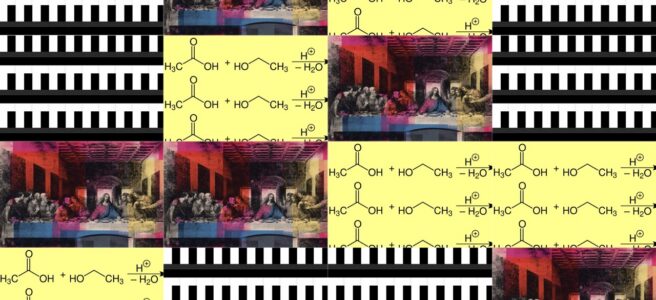
My Background Studio began as a practical website feature, but it gradually became a form of browser-native art. Technical writing, photography, animated animals, religious imagery, mathematical structures and Internet vernacular now coexist in compositions generated by twelve algorithms. The central page and its moving margins are complementary: each gives the other a context, rhythm and character that it could not produce alone.
A background that completes the foreground
It would be misleading to divide the website into “important content” and…
Continue reading
Turning a Theme-Bound Generative Art System into a Maintainable WordPress Plugin
I began this migration for a practical reason: a background feature that had started as a theme customization had grown into a modular browser-based geometry engine. It still worked, but the theme now owned administration, persistence, mosaics, twelve generators, rendering, and a public badge. I wanted a cleaner boundary without losing the behaviour already proven on the live site.
The result was a site-specific standalone WordPress plugin, a deliberately minimal theme fallback, and a workflow in which the current VPS…
Continue reading
Deploying a Modular Generative Geometry Generator (Browser-Based)
After completing the mosaic and scattered-collage stages of my WordPress Background Studio, I began asking a different question: could the system choose a mathematical composition method as well as choosing media? That question changed the project’s category. What began as background randomization became a modular browser-based generative-art engine with twelve algorithms, deterministic seeds, record-aware identity and a deployment process designed for a live, resource-constrained server.
I described the earlier evolution from a repeating background to mosaics and random collage in…
Continue reading
Rethinking Yin’s Background Studio with Agentic AI (When the Harness Joins the Project)
I built Yin’s Background Studio through a semi-automated conversation: AI proposed bounded changes, I ran them on a live WordPress server, and the resulting logs and screenshots determined the next move. The system eventually grew from one repeating background into classic mosaics, scattered collage, persistence, density and colour controls. Now I want to try the next workflow seriously: let an agent inspect, edit, run, see and verify the project itself.
The existing method is my evidence base, not the method…
Continue reading
Incremental Development of a WordPress GIF-WebP Mosaic Background Engine
Yin’s Background Studio (as shown in the background of this website) began as a small WordPress theme enhancement for selecting one repeating background and evolved into a validated composition engine supporting static, random, weighted, persistent, reduced-motion, mosaic and scattered-collage modes. The project demonstrates how to extend a mature theme safely while preserving existing media, limiting animation costs, avoiding layout shift and making every production change recoverable.
The original problem
The website originally displayed one selected background at a time. An…
Continue reading