Sharing Port 8080 Between qBittorrent and V2Ray with Nginx (One Public Port, Two Applications)

Introduction

I recently faced a network configuration problem that initially looked simple:

How can I install V2Ray on a VPS when the only usable general-purpose public port is already occupied by qBittorrent?

The server was an Oracle Cloud Ubuntu VPS running qbittorrent-nox. Its WebUI was publicly accessible on TCP port 8080, while BitTorrent peer traffic used TCP and UDP port 47374.

Other candidate ports, including 80, 443, and 56894, were locally unused. However, external testing showed that they were not reachable through the Oracle Cloud network configuration. I did not want to modify the Oracle Virtual Cloud Network rules again, interrupt qBittorrent whenever I needed V2Ray, or expose unnecessary additional ports.

Continue reading →

File Share authentication issue in MacOS (including SMB and AFP) in an unusual circumstance

*updated on September 19, 2022

I tried the MacOS native File Share feature since I need to share data between the two Macs via LAN. Naturally, this function, which by default is based on SMB, also supports AFP.

An accidental irreversible event happened during the attempt to authenticate, and the error form seemed to have the incorrect user name or password. However, I am confident that the login credentials are correct. Even after reinstalling the system from High Sierra to…
Continue reading →

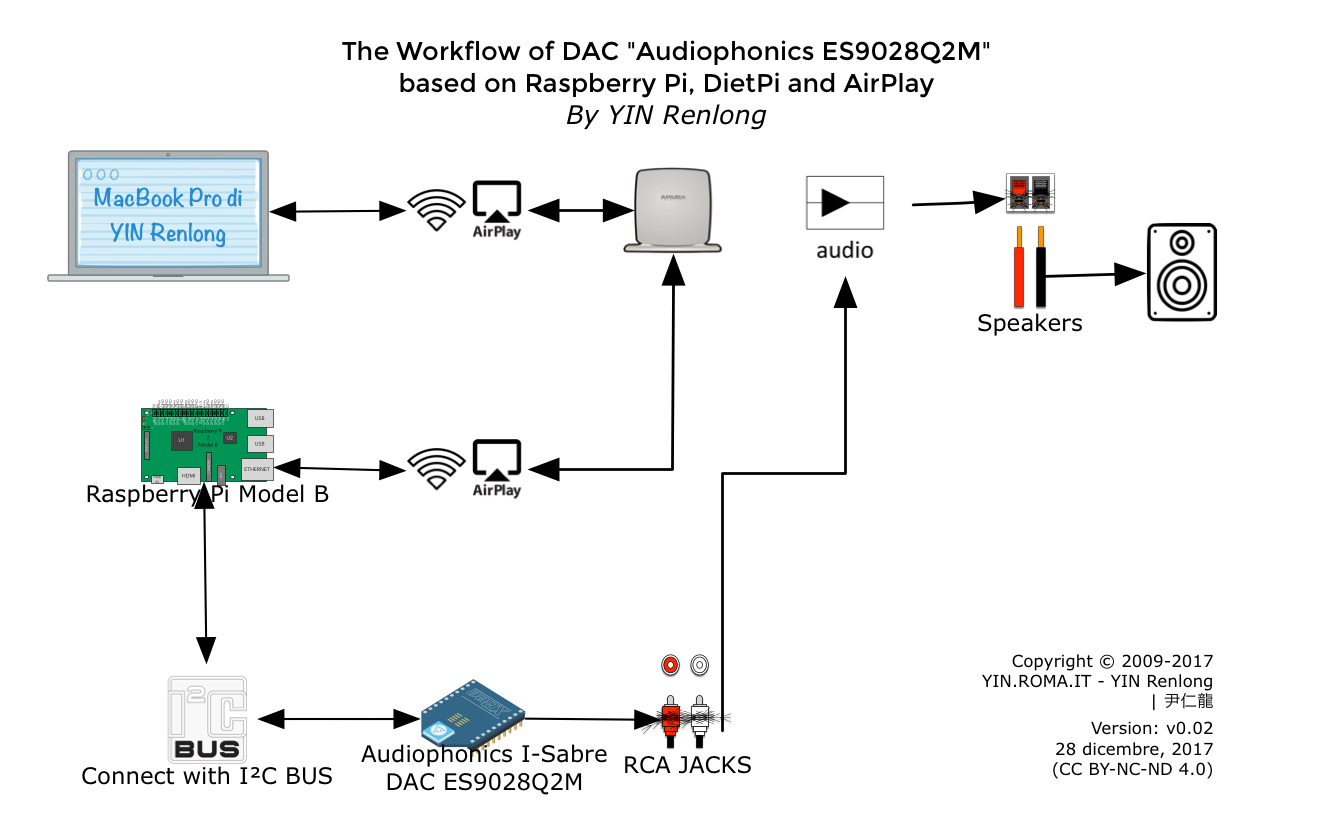
Installation and optimization of “Audiophonics ES9028Q2M”

*updated on December 24, 2017

Preface


I really shouldn’t say much about the desire to have a wireless PC-Hifi setup. Despite having a large collection of CDs and LPs, I feel that digitizing my music library would be beneficial in some circumstances.

Though Audiophonics’ official website shows compatibility with Volumio (a multi-platform music player), I have spent a great deal of time in the last several days and, honestly, had quite a terrible experience when piecing together Audiophonics and Volumio.1 Even so, I am really pleased with the sound from DietPi, which is more distinct and pure, as well as the efficient start time and UI design, and, ultimately, the stability when compared to Volumio.

As a result, the purpose of this article is to serve as a resource for serious philharmonicgeeks who have a limited budget but a need for “adequate” high fidelity quality.

The General Workflow


The Workflow of Signal Connection

Continue reading →