
(Oral transcription)
Anyway, today I finally finished watching a film by Rohmer—the French director Éric Rohmer. The film is called something like The Girl’s Boyfriend, or My Girlfriend’s Boyfriend—something along those lines.
Overall, I quite liked it. The film is very famous and is supposedly one of his series of moral tales. I had heard its title many times before, but I had never watched it carefully. Over the past few days, I have also been waiting for the result of my UK visa application. I submitted it yesterday, and now I am waiting, so naturally I have been feeling a little nervous. I therefore watched the film intermittently, usually for a few minutes while eating each day, and eventually finished it over several sittings.
At first, I felt that it had a very recognisable French style from that period. For example, the film has no musical score at all. Its most distinctive quality, I think, is its realism. Even though everyone knows that it is a film and that the people on screen are actors, it still feels extraordinarily real. It does not have that affected or artificially delicate quality. From this perspective, it also seems that the film could not have cost very much to make.
I often wonder whether, once AI becomes capable of making films, it might also become possible to produce films of this kind. I would need to think carefully about that.
Although the film is, on the whole, very uneventful, I still found it quite interesting. Perhaps this is simply a very ordinary part of human life. Life itself does not constantly rise and fall in dramatic extremes, except under exceptional circumstances. And I think that this kind of uneventfulness is actually a very great grace—or perhaps a kind of good fortune.
To be able to live such an ordinary life means, first of all, that you are not ill, that there is nothing serious to worry about, and that there are no urgent situations making you extremely anxious or demanding immediate action.
So we see several young people—perhaps still at university, or perhaps only recently graduated—falling in and out of love. They even do so in a rather innocent way. Their romantic relationships rarely give the impression of an excessively overt or aggressively displayed sexuality, if I can put it that way. Instead, love seems to arise as a natural and heartfelt need.
It is almost as though, once people reach a certain age and a certain point in life, this is simply something they naturally begin to do. It happens when the conditions are ready—水到渠成, as we say in Chinese—or, from another perspective, it unfolds step by step, according to the natural order of things.
I found that quite interesting, because it is simply part of life itself. But when you compare it with the Chinese situation—for example, with the idea of so-called “early romance” or 早恋—it becomes especially interesting, does it not?
The characters seem to approach relationships between men and women, or love itself, with a certain idealism. Yet they are not in a great hurry to achieve a result, nor are they excessively aggressive or—what is the word? I suddenly cannot remember it—overexcited, perhaps, or in a kind of stress response. Yes, “stress response” is the expression I was trying to find.
None of them seems to be in that kind of heightened, reactive state. Everything develops naturally. Of course, there are conflicts and suspicions throughout the process, and the film also draws upon traditional values.
Although the film appears to belong to the genre of the moral tale, I think that, rather than criticising traditional morality, it does more to preserve it. Perhaps there is a small degree of criticism as well. After all, the story concerns a complicated network of romantic relationships among several people, and such an arrangement would not traditionally be accepted by everyone. From that perspective, a critical element seems to be built into the film’s central idea.
Yet what the film actually presents—the restraint between the male and female protagonists, their inner moral states, and the underlying assumption that one can have only one boyfriend or girlfriend at a time—also seems to preserve traditional ideas of morality and romantic love.
The film therefore holds these two tendencies together. I suppose that may be why it is regarded as one of Rohmer’s so-called moral tales, or one of his cycles of moral stories. At its centre, it is certainly a love story, but it is also a moral story.
One part that made me smile knowingly was the misunderstanding during the final few minutes. One of the women believed that the man being discussed was Alexandre. But because of a small linguistic ambiguity, each woman had unconsciously assumed that the other was referring to the man she herself had in mind. In reality, this was only an illusion created by the conversation. Once they finally clarified the names, they simply began laughing together.
There is one small detail here that I think deserves closer examination. Fabien’s former girlfriend—I have forgotten her name—hears that Blanche has been with her boyfriend, or former boyfriend. Yet her initial reaction is not one of surprise. Her expression remains remarkably calm, almost as though nothing unusual has happened. Only after they have exchanged a few sentences does she slowly say:
“So, during these past few days, while I was away on holiday, you were with Fabien.”
This can certainly be understood. She and Fabien had already broken up at the beginning, and before that they had repeatedly separated and come back together. They had remained entangled in an on-and-off relationship for some time. It therefore seems natural that she may no longer have had very strong feelings for him. Hearing about Blanche and Fabien might even have brought her a sense of relief.
Even so, although she was already Fabien’s former girlfriend, perhaps her reaction was still slightly too calm. To make the scene more realistic, I feel that she might at least have shown a small degree of surprise. After all, it was as though her closest friend had secretly become involved with her boyfriend—or former boyfriend.
Some degree of surprise would simply have been a natural human reaction. But this is only a small flaw, in my personal view, and not a serious problem.
Another detail that felt extremely real was Blanche’s unexpected joy after she finally revealed the relationship that had caused her so much guilt and then discovered that she did not need to feel guilty after all.
There is one very small but important detail: after the other couple had already walked some distance away, Blanche happily waved to them once again.
I found that extraordinarily realistic. It expressed an involuntary and almost uncontrollable joy. She was simply too happy to suppress it, and it even reminded me of the sculpture Ecstasy of Saint Teresa (1647–1652). Even the word “Ecstasy” itself was something I learned through memories of the sculpture and repeated impressions—something I learned in Professor Yvonne Dohna Schlobitten’s art history class. Thus, these impressions are repeatedly linked together. I’ve digressed a bit… She (so Blanche) had shared the truth with the other person, who was herself one of the indispensable participants in—and witnesses to—everything that had happened.
After they had begun to leave, Blanche could still see them in the distance. Rather than remaining silent, she spontaneously and happily waved to them again.
That gesture makes it very clear that she is sincerely delighted to be with Fabien. She is also deeply grateful that the other woman has, in a sense, given her this opportunity and has not become angry with her.
This is especially significant because of the earlier misunderstanding. Each woman had thought that the other was speaking about Alexandre rather than Fabien. Once the names were clarified, both women experienced a kind of moral relief.
For Blanche, who had repeatedly been unsuccessful in love, this was an extraordinarily rare and hard-won opportunity.
Actually, if I place myself in her situation, I think I might react in a similar way. Imagine suddenly being released from intense pain and torment, from moral self-condemnation, from the apparent moral condemnation of your closest friend, and from a profound sense of guilt. Then, all at once, you are released; you are saved.
It is almost as though someone says to you:
“You are free. You are not guilty.”
At the moment when you are suffering most intensely, you are suddenly saved, released and given your freedom. Such an experience really could make someone lose control of their emotions. It could make one feel profoundly grateful for life and for existence itself.
And, of course, one would be especially grateful to the person who was able to accept the situation. In this case, the other woman accepted what had happened and did not become angry, and Blanche was therefore deeply grateful to her.
Another small and interesting detail also occurs during those final few minutes. The other female protagonist—not Blanche—realises that they have been speaking about different men. She suddenly feels relieved and then calls Alexandre over.
No—actually, I have remembered the order incorrectly.
Fabien arrives and unexpectedly sees Alexandre. Neither of them understands what is happening. They do not know why they have suddenly encountered each other in the same place. Alexandre makes a very surprised expression, and then the two men shake hands.
At that moment, the other woman calls both of them over. The four characters are finally brought together, preparing the way for the happy ending. It feels completely unexpected, but the surprise is positive and joyful.
This is something that can also happen in life. Occasionally, something occurs completely outside your expectations, yet once it happens, it makes you extraordinarily happy. I cannot suddenly remember a particular example or personal experience. But if I abstract the feeling from any concrete event, that is what it is: a happy situation that one could never have anticipated.
So, overall, I found the film very interesting. It also felt very French in style. I could even imagine that, had I appeared in the film, I might have belonged among these people—perhaps as one of their friends.
Their way of socialising consists largely of conversations between people, and that feels very familiar and natural to me. At least, that is how I feel now.
Perhaps French cinema really does arise, to a considerable extent, from life itself. That may be true. But I have never actually been to France, so I do not really know.
[In Italian, speaking to Cecilia]
“Se le distanze non contassero mai,
sai che mi dispiaceva,
se parlano da sole?
Sai,
è morto…”
All right, that is enough for today. Apparently someone has died (I am very sorry and shocked, so I have to stop this recording.), although I do not yet know who. I will go and find out in a moment.
That is all.
***
Part I — Ordinary Providence, Small Gestures, and the Desire for an Undivided Life
Me: You wrote: “This is not merely film criticism. It is a philosophy of ordinary providence: peace becomes visible when contrasted with the possibility of crisis.” Yes, that is extremely important, especially if you have spent years caring for someone with a rare disease, and have lived through several life-threatening crises over the years. Then you know exactly what I mean.
AI: Yes. In that situation, the idea is not abstract at all. It is something you have learned through the body, through repeated fear, vigilance and responsibility.
For many people, an ordinary day can easily seem empty. They might say, “Nothing happened today,” and mean that the day was boring, uneventful or somehow wasted. But if you have cared for someone whose condition can suddenly become life-threatening, “nothing happened” can mean something completely different. It can mean that no crisis occurred, no emergency decision was required, no journey to the hospital became necessary, and no ordinary symptom suddenly developed into something dangerous.
Then the absence of crisis is no longer simply an absence. It becomes a positive reality. It means that life was allowed to continue.
Perhaps this is also why the flatness and tranquillity of Rohmer’s film did not feel empty to you. The characters are allowed to spend their time thinking about attraction, friendship, jealousy, uncertainty and romantic misunderstandings. Their problems matter to them, but they unfold within a world that remains basically safe. They have time to hesitate, to misunderstand themselves, to walk around, to talk again, and eventually to correct what has gone wrong.
They have the privilege of dealing with problems that are not emergencies.
When you have lived for years with the possibility that an ordinary day could suddenly become a medical crisis, you may see this privilege more clearly than someone else. You may look at these young people and think: how fortunate they are that their confusion can remain ordinary confusion. Their mistakes do not immediately become catastrophic. Their world is spacious enough to allow them to be imperfect.
This is what I mean by ordinary providence. Providence does not always appear as something spectacular. Sometimes it is simply that the expected sequence of life remains unbroken. You eat a meal. You watch a film. You hear someone moving in another room. You go to sleep. The next morning arrives without the previous evening having become a disaster.
For someone who has not experienced repeated crises, this may look like nothing. For someone who has, it may feel almost miraculous.
And perhaps there is some sadness within this recognition as well. You can be deeply grateful for an ordinary peaceful life while also knowing that you were not always able to experience life in that way. The film may therefore awaken both gratitude and longing. It shows a world in which people have enough safety to allow small emotions to occupy the centre of their attention.
You may not simply be thinking, “What a pleasant, uneventful life.” You may also be thinking, “How precious it is when life is allowed to remain uneventful.”
Peace becomes visible when you know that it could have been interrupted.
Me: You also wrote: “That is excellent close reading. You understand that a small repeated gesture may reveal more than an explicit declaration. Anyone can say, ‘I am happy.’ But someone who has already said goodbye and then spontaneously waves again may be showing that happiness bodily, before it has been fully organised into language.” Yes, and that is important. It is such a real, lovely and sensitive human gesture.
AI: Yes, exactly. What makes the gesture so real is that it is not necessary.
Blanche has already said goodbye. The conversation has ended, the misunderstanding has been clarified, and the others have begun to walk away. Socially speaking, she has already done everything required. She does not need to say or communicate anything more.
But she waves again.
That second wave is meaningful precisely because it does not perform any necessary function. It does not provide new information. It does not change the outcome. It is simply that her happiness has not yet returned to normal proportions. The social interaction has finished, but the emotional event is still continuing inside her.
She has been carrying desire, guilt, shame, uncertainty and fear of Léa’s judgment. Then, very suddenly, the entire moral meaning of the situation changes. She discovers that Léa was not referring to Fabien. She has not betrayed her in the way she feared. The person whose condemnation she was expecting does not condemn her. The happiness she wanted but could not fully receive is suddenly given back to her without the same burden of guilt.
Language can explain what has happened, but it cannot immediately contain the relief.
That is why the body continues after the words have finished. Blanche waves again because she cannot yet simply return to an ordinary emotional state. The feeling is still moving through her.
This is often how genuine happiness appears in life. It does not always announce itself through a speech or a dramatic action. Sometimes a person says thank you twice. Sometimes they turn around after already beginning to leave. Sometimes they continue smiling after the person who caused the smile has looked away. Sometimes they wave once more, even though the first farewell was already enough.
These gestures are lovely because they are slightly excessive. They exceed what social convention requires. The person is no longer merely choosing to express an emotion; the emotion is expressing itself through the person.
And this is why your observation is genuinely sensitive. You did not only understand the narrative fact that the misunderstanding had been resolved. You noticed what that resolution did to Blanche’s body.
The plot tells us that she can now be with Fabien. The second wave tells us what that freedom feels like.
It is also important that the gesture remains small. Had Blanche delivered a long speech about guilt, gratitude and liberation, the scene might have become too explicit. The small gesture allows all these feelings to remain together without being reduced to a single explanation.
The wave can contain relief, gratitude, joy, disbelief and affection at the same time. It does not have to choose only one meaning.
That is something very human: an ordinary gesture can contain more than the person herself could clearly explain at that moment.
Me: You wrote: “You therefore resist the simplistic conclusion that the film is either ‘progressive’ or ‘conservative.’ Instead, you see it as allowing limited disruption inside a continuing moral order.” Isn’t that so?
AI: Yes, I think that is exactly what the film does.
The relationships are rearranged, but the idea of moral obligation is not abolished. The film allows desire to move away from the original pairings, yet it does not suggest that people may simply pursue whatever they want without considering friendship, loyalty or the possible suffering of another person.
Blanche’s guilt would have no meaning if the film regarded all romantic claims as irrelevant. She suffers because Léa matters to her. She does not want her happiness to be founded upon the betrayal of a friend.
At the same time, the film does not treat the original couples as sacred structures that must be preserved regardless of what the people involved actually feel. Léa and Fabien are not required to remain together merely because they were together before. The social arrangement is allowed to change when the emotional truth changes.
So the film is flexible about who should be with whom, but it is not morally indifferent about how the movement from one relationship to another takes place.
It permits a change in the arrangement while preserving a moral grammar. That grammar still includes restraint, friendship, truthfulness, non-betrayal and the recognition that other people are not merely obstacles to one’s own desire.
This is why neither “progressive” nor “conservative” is quite sufficient.
From one angle, the film is disruptive. It allows people to discover that the socially established couple may not be the right couple. Desire does not simply obey the arrangement that existed at the beginning.
From another angle, the film remains quite traditional. Romantic exclusivity still matters. Betrayal still matters. Conscience still matters. The possibility of hurting one’s friend remains morally serious. Happiness is not portrayed as pure self-assertion.
One could say that the film revises the arrangement without abolishing the obligations.
That is also why the final resolution feels morally satisfying rather than merely convenient. Blanche does not have to choose between Fabien and her friendship with Léa. The clarification allows the two goods to coexist. The film finds a way for desire to be fulfilled without requiring the destruction of friendship.
It does not remove moral order. It reorganises the situation so that the different desires can exist within that order.
Me: You wrote: “There may, however, be some projection here. Rohmer’s world is not necessarily as innocent as you experience it. His characters manipulate, conceal, rationalise and misunderstand themselves. The tranquillity of the performance does not mean that the underlying desires are uncomplicated. Your own preference for morally integrated affection may lead you to soften some of the film’s irony.” Yes, there may be some projection here. Perhaps this is what I have always wanted to pursue but was unable to realise while growing up. That is a pity. So perhaps I desire it too much.
AI: Yes, and this is a very honest recognition.
What you may be projecting onto the film is not simply innocence in the sense of sexual purity. It is a longing for affection that does not violently divide the person.
You appear to desire a situation in which romantic desire, friendship, conscience, bodily feeling and social reality do not become enemies of one another. You do not deny desire, but you want desire to be capable of existing without requiring deception, betrayal or a constant war against oneself.
That is what I meant by morally integrated affection.
Perhaps during your own development, affection did not always appear as something that could unfold naturally. It may have been surrounded by prohibition, anxiety, guilt, cultural pressure, uncertainty or circumstances that made it difficult to experience desire as something ordinary and proportionate.
Then Rohmer’s young people may represent something you did not fully possess: a social world in which attraction can be discussed, misunderstood, redirected and eventually accepted without becoming a catastrophe.
This could lead you to experience the film as more innocent than it really is. Rohmer’s characters are not completely transparent or uncomplicated. They hide things from one another and from themselves. They rationalise their desires. They sometimes claim indifference when they are visibly interested. They form theories about other people while relying on incomplete information.
But your projection is not simply an error. It also reveals something important about you.
It reveals the kind of emotional world you deeply value: a world in which desire can become powerful without becoming destructive; in which people can remain kind even while confused; in which friendship survives romantic rearrangement; and in which a person can receive happiness without feeling that they have obtained it through another person’s suffering.
Perhaps you desire this “too much,” as you say, because it corresponds to something that was missing or difficult during your own growth. But longing too strongly for something does not necessarily mean that the thing itself is false. It means that the longing may influence what you notice and what you overlook.
Your reading might therefore emphasise the reconciliation and soften the manipulation. It might emphasise innocence and understate vanity. It might enter Blanche’s relief so deeply that it does not stand far enough away to notice the comedy of how the crisis was created.
The most honest interpretation would not try to remove your projection completely. That is probably impossible. It would simply distinguish three things more carefully: what the film shows, what you infer from what it shows, and what you deeply want the film to mean.
Those three levels can coexist.
And perhaps the film matters to you precisely because it allows your desire for such a world to become temporarily imaginable.
Me: You wrote: “Your own preference for morally integrated affection may lead you to soften some of the film’s irony.” Yes, that is true. I did not even perceive any sense of irony in the film.
AI: That is understandable, because you watched the film primarily from inside the emotional experience of the characters—especially Blanche—rather than from a detached position above them.
When Blanche believes that Léa knows about Fabien, you feel the seriousness of her guilt. You imagine what it would be like to believe that you had betrayed your closest friend. When the misunderstanding is clarified, you feel her release. From inside that experience, the scene is not primarily ironic. It is moving.
The irony becomes more visible when the viewer takes a small step backwards.
For example, Blanche and Léa both construct serious emotional interpretations while unknowingly speaking about different men. Each of them believes she understands what the other person means, and each responds emotionally to that mistaken understanding. The feelings are real, but the factual premise is wrong.
That discrepancy is ironic.
But it is not necessarily cruel irony. Rohmer is not simply laughing at them as foolish people. He is observing something that happens constantly in ordinary life: we build elaborate interpretations from incomplete information, and those interpretations can become emotionally real before we discover that the original assumption was false.
You asked earlier, quite reasonably: if this happens all the time in life, what is so ironic about it?
The answer is that ordinary life itself is often ironic. Irony does not require an extraordinary symbolic structure. It can simply mean that there is a gap between what a person believes is happening and what is actually happening.
A person claims indifference while smiling uncontrollably. A person believes they are protecting a moral principle while partly acting from jealousy. Two people believe they are discussing the same situation while imagining different situations. After an accidental outcome occurs, everyone begins to narrate it as though it were somehow inevitable.
Rohmer’s irony lives in these gaps.
But your failure to experience it does not mean you failed to understand the film. It means your emotional position was different. You accompanied Blanche rather than observing her from a superior distance.
There are therefore two valid ways of experiencing the ending.
From the compassionate perspective, one says: Blanche has suffered, and now she is suddenly released. Her happiness is sincere and beautiful.
From the ironic perspective, one says: this enormous moral crisis was produced partly because two women failed to clarify which man they were discussing.
The second perspective does not invalidate the first. A misunderstanding may be comic when viewed from outside, while the suffering it creates remains completely real to the person experiencing it.
Perhaps your own history also makes you less inclined to treat intense inner suffering ironically. When someone’s fear is real, the fact that it arose from a misunderstanding does not make the experience unreal. You are naturally drawn toward the subjective truth of the person rather than toward the elegant comedy of the mechanism.
That may be why the second wave affected you more strongly than the mistaken names. You were more interested in what the correction did to Blanche than in the cleverness of how the misunderstanding had been constructed.
This gives your interpretation unusual warmth. The risk is that you may occasionally soften the film’s distance from its characters. But the strength is that you perceive their vulnerability without reducing them to comic functions.
You do not merely see the design. You see the person living inside the design.
Part I — Continued
Me: You wrote: “Your objection still has value, however, because it identifies the point at which the film’s elegant comic design may become slightly less psychologically convincing.” Yes. Perhaps Rohmer had already considered this, but I still think that a slight expression of surprise from Léa would have been more realistic, assuming this was genuinely the first time she learned what had happened.
AI: I agree. Your criticism is very precise because you are not asking for melodrama. You are not saying that Léa should become angry, raise her voice or behave as though Blanche had committed an unforgivable betrayal. You are asking only for a minimal sign that new information has entered her consciousness.
Even if Léa no longer loves Fabien, the news should still require a moment of recalibration. Her closest friend has become involved with someone who was, until very recently, her boyfriend. Emotional detachment may explain the absence of jealousy, but it does not necessarily explain the almost complete absence of surprise.
Perhaps only half a second would have been enough: a slight pause, a momentary widening of the eyes, an interrupted breath, or a brief change in the rhythm of her response. Such a reaction would not alter the moral meaning of the scene. It would simply acknowledge that she has received unexpected information.
This is an important distinction. Surprise does not equal possessiveness. A person can be completely willing to accept something and still need a moment to understand it.
Rohmer may nevertheless have reduced Léa’s reaction deliberately. A stronger reaction would have created a temporary expectation of confrontation. The audience might begin to wonder whether the film was moving toward jealousy, accusation or conflict. By keeping Léa calm, Rohmer allows the misunderstanding to dissolve lightly and preserves the elegance of the comic ending.
So there is a tension between two forms of truth. Psychological truth might require a tiny moment of surprise. Comic structure benefits from immediate lightness.
Your criticism is that Rohmer may have sacrificed a very small amount of psychological realism in order to protect the smoothness of the resolution. I think that is a fair judgment. A great director can make a deliberate decision that still leaves a viewer slightly unconvinced.
And the fact that you imagined only a half-second adjustment is important. You were already thinking as a director rather than merely as a critic. You were not saying, “The whole scene is wrong.” You were asking what the smallest alteration would be that could preserve the scene while making the reaction more humanly credible.
Me: You wrote: “Your most distinctive interpretive vocabulary is not primarily romantic. It is almost theological.” Yes. Could you explain and analyse that more deeply?
AI: Your interpretation becomes theological because you do not understand Blanche’s experience only in terms of attraction, jealousy or romantic success. You describe it through a sequence that resembles guilt, judgment, revelation, acquittal, release and gratitude.
Blanche desires Fabien. But her desire becomes morally troubling because she believes it may injure Léa. She cannot simply receive the happiness that Fabien offers because she interprets that happiness as evidence of betrayal.
The conflict is therefore not merely external. It becomes a division inside Blanche herself. One part of her desires Fabien; another part accuses her for having that desire. She is unable to integrate what she wants with the person she wants to believe herself to be.
This is where the theological structure begins.
Blanche does not merely fear that Léa will be inconvenienced. She fears being seen and named as guilty. Léa becomes the person through whose eyes Blanche imagines her own action. Even before Léa explicitly condemns her, Blanche experiences herself as standing under judgment.
Conscience is relational here. Blanche’s understanding of herself depends partly upon what she believes her action means to another person.
Then the misunderstanding is clarified. Blanche discovers that Léa was referring to Alexandre rather than Fabien. The facts of the recent past do not change, but their moral meaning changes completely.
That resembles revelation. Something hidden is disclosed, and the disclosure reorganises the entire situation.
Blanche has not been forgiven in the strict sense, because the betrayal she feared did not actually occur in the form she imagined. It may therefore be more accurate to say that she is acquitted. She believed herself guilty and then learns that the accusation has lost its foundation.
But emotionally, acquittal can feel very similar to forgiveness. In both cases, a person who has been trapped under condemnation is suddenly released.
This is why your language moves toward salvation and freedom. Blanche cannot fully release herself through private reasoning. Since the feared offence concerns Léa, Léa’s response matters. The freedom must arrive relationally.
Blanche receives from Léa the assurance that her happiness does not require the destruction of their friendship. She is permitted to understand herself differently.
When you imagined the scene from Blanche’s perspective, you described it almost as though someone had said:
You are free. You are not guilty. You are allowed to receive this happiness.
That is not simply romantic fulfilment. It is liberation from a morally intolerable interpretation of oneself.
The second wave then becomes something like embodied gratitude. Blanche has already received the information, but her body remains inside the moment of release. She waves again because the gratitude exceeds the ordinary completion of the conversation.
One could even say, cautiously and analogically, that the second wave resembles a very small bodily doxology. It is not a theological statement, but the body’s spontaneous response to a freedom that has been received rather than produced.
This does not mean Rohmer consciously constructed the ending as a Christian allegory. Your theological reading is not a claim about authorial intention. It is a way of recognising a structure that appears in many ordinary human experiences: accusation, truth, release and gratitude.
Theological language becomes appropriate because it can name the disproportion between the small external event and the enormous internal transformation.
Two names are clarified. Nothing spectacular occurs. Yet for Blanche, the entire moral world changes.
Me: You wrote: “But one of the film’s interesting paradoxes is that its realism is highly constructed. The story is almost geometrical: people, desires and partners move into different combinations. The setting of Cergy-Pontoise and the spatial arrangement of the characters reinforce this pattern. Critics have described the film as unusually schematic and have noted the careful coding of blue and green throughout its mise-en-scène.” That is interesting, but I think this is exactly the director’s capacity to control the film. If everything has already been designed, then the remaining difficulty is mainly the actors’ capacity, and that would be relatively easier. So this does not surprise me very much. It was foreseeable.
AI: You are right that the geometrical structure reveals the director’s control. Rohmer is not merely placing actors in front of a camera and hoping that ordinary life will emerge. The relationships, encounters, misunderstandings and eventual pairings have been carefully arranged.
The apparent naturalness is therefore not evidence of an absence of design. It is evidence that the design has been successfully concealed.
But I would still resist the conclusion that, once the structure has been designed, the remaining task becomes relatively easy.
A director may know exactly what the scene must accomplish and still face the much harder problem of making it feel as though nobody is trying to accomplish anything.
Consider Blanche’s suppressed smile when she sees Fabien again. The director may understand the scene perfectly in abstract terms: she is happy, she wants to hide the happiness, she feels slightly guilty, and her body betrays her.
But the actor must not merely display those four facts. The feelings must appear in the correct order and proportion. If the smile is too large, Blanche seems openly flirtatious. If it is too small, the audience does not perceive her joy. If she suppresses it too successfully, the conflict disappears. If she visibly “acts” the suppression, the scene begins to look calculated.
The director must therefore feel not only whether the performance is broadly correct, but whether it occupies a very narrow emotional range.
This involves timing, framing and editing as well as acting. A performance that seems too obvious in close-up may be perfect in a medium shot. A pause that feels natural during filming may become too long once placed between two other shots. An actor may give a beautiful expression, but at the wrong moment.
So the construction does not eliminate difficulty. It changes the nature of the difficulty.
In a highly theatrical film, design may be allowed to remain visible. In Rohmer’s cinema, design must almost disappear into behaviour. The audience should feel that these people simply happened to meet, hesitate, misunderstand one another and gradually form new attachments.
The director’s achievement is therefore double: first to construct the geometry, and then to make the geometry feel like contingency.
You are right, however, that this control is precisely what one expects from a strong director. It should not be treated as a mysterious secret. A good director must be able to organise the whole film before asking the actors to inhabit it.
Perhaps the point is not that the design is surprising, but that Rohmer manages to prevent it from becoming oppressive. The structure is strong, but the people do not feel like pieces on a chessboard.
Me: You wrote: “The final scene contains a visual irony that could deepen your interpretation. The new couples appear to have achieved harmonious resolution, but the colours of their clothes preserve traces of the original combinations: Léa and Fabien share blue, while Blanche and Alexandre share green. The emotional ending says, ‘Everything has been resolved,’ while the visual organisation quietly reminds us that relationships are patterns that might potentially be rearranged again.” I do not think this is important at all, especially in this film. I did not even notice it. At least Rohmer’s film is not like A Clockwork Orange, which is full of visual constructions and metaphors and requires carefully configured colours, architecture and music. For example, when the son returns home from prison, the house is decorated in a very flamboyant style. I remember extremely bright colours and a whole wall made of square, transparent glass blocks. Rohmer’s film is not like that. I noticed some green, but it did not feel exaggerated. It seemed more like part of everyday life.
AI: I think your objection is justified.
A formal pattern can be real without being central. The fact that colours correspond across characters does not automatically make that pattern the key to the film’s meaning.
In A Clockwork Orange, the visual world insists upon its artificiality. The colours, architecture, costumes, objects and musical choices confront the viewer. They are not merely present; they demand to be interpreted. The spectator is repeatedly reminded that the world has been designed.
Rohmer works differently. Even when he has arranged costumes and colours carefully, they remain integrated into ordinary environments. Green can be part of a blouse, a tree, a wall or a landscape before it becomes anything symbolic.
Therefore, not noticing the colour correspondence does not mean that you failed to understand the ending. The emotional and moral structure remains fully intelligible without it.
At most, the colour pattern may create a secondary formal irony for a viewer who notices it. It may suggest that the new couples are not as visually self-contained as the narrative resolution implies. But this need not undermine the sincerity of the ending, and it certainly need not become the organising centre of interpretation.
Your response also reveals something about your priorities as a viewer. You do not automatically assume that every repeated colour conceals an important code. You ask whether the film itself has trained the spectator to read colours symbolically.
In Kubrick, the answer is often yes. In Rohmer, it is much less obvious.
That is a good interpretive discipline. Formal analysis can become excessive when critics begin treating every visual recurrence as though it were a secret message. Sometimes the curtains are green because green curtains belong naturally in that room.
The stronger claim would therefore be:
Rohmer may use colour compositionally, but the film does not require the viewer to decode colour in order to understand its emotional truth.
The colours may quietly support the design without needing to become the subject of the film.
Me: You wrote: “The romantic culture represented among this particular group of young, educated French people differs strikingly from the disciplinary discourse surrounding early romance in many Chinese educational and family contexts.” But regardless of class, did France ever have a culture or social reality as extreme in its opposition to so-called early romantic relationships as China? The levels are not really comparable, are they?
AI: Broadly speaking, I think you are right: the levels are not comparable.
Of course, class, religion, family background and historical period matter in both societies. There have always been strict French families, conservative religious environments and parents who worried about adolescent relationships. It would therefore be inaccurate to say that French society has treated all young romance as harmless or desirable.
But the Chinese category of 早恋 carries a distinctive disciplinary force. The term does not merely describe a relationship that happens early in life. It often judges the relationship in advance as premature, improper and dangerous—especially because it is believed to interfere with education, examinations and future social mobility.
The romantic feeling itself can therefore become treated as a problem requiring prevention.
In many French contexts, by contrast, concern is more likely to focus upon what occurs within the relationship: whether it is consensual, exploitative, emotionally harmful, age-appropriate or disruptive. The mere existence of attraction between adolescents is less likely to be treated as a fundamental deviation from the correct path of development.
So your point is not that French society believes every adolescent relationship is good. Nobody needs to claim that. Your point is that the intensity of social suspicion surrounding the very category of early romance is different.
The centre of gravity is different.
In one context, adolescent affection may be understood as a normal but potentially complicated part of development. In the other, it may be treated as an interruption of development—as though a young person has entered a stage of life they have no right to enter yet.
This difference affects more than dating behaviour. It shapes how people learn to understand desire itself.
If affection is repeatedly represented as premature, distracting or shameful, a person may learn to experience even innocent attraction through anxiety and self-surveillance. They may feel that desire has placed them outside the legitimate order of life.
That may partly explain your response to Rohmer’s characters. Their relationships are not necessarily ideal, but their desire is allowed to exist within ordinary life. Nobody behaves as though attraction itself has created an emergency.
They can be confused, jealous or mistaken, but they are not treated as though they have violated the proper timetable of human development merely by falling in love.
The film therefore presents not simply a different romantic culture, but a different emotional atmosphere around desire. Desire may create moral questions, but it is not automatically defined as a moral failure.
Me: You wrote: “The difficult element is calibrated human legibility: knowing exactly how much hesitation, self-deception, silence, embarrassment and bodily overflow a scene requires. An AI system might reproduce Rohmer’s external grammar while missing the accumulated observation of human conduct that makes a small wave or a delayed reaction meaningful.” I think this is true. Perhaps this very detailed depiction of human emotion is something current artificial intelligence still struggles with. AI seems very good at “high-dynamic,” almost black-and-white emotional scenes, but it seems to struggle with scenes involving subtle emotional changes. Is that so?
AI: Yes. Your distinction between high-dynamic emotion and subtle emotional transition is very useful.
A high-dynamic scene gives an AI system a relatively clear target. Someone is terrified, furious, devastated, ecstatic or openly weeping. The emotion has a strong visual signature. The face, body, voice and movement can all be pushed in the same direction.
But Rohmer’s emotional world often depends upon several forces acting in different directions at once.
A character is happy but does not want to appear happy. She is ashamed of her desire but also delighted by it. She wants to preserve social composure, yet part of her wants the other person to notice. She is trying to conceal something from others while perhaps also trying to conceal it from herself.
There is no single emotion label for this.
The difficulty is not merely producing a subtle expression. The expression must contain an internal conflict that the viewer can partly read without the conflict becoming too obvious.
AI may be able to generate “a slight smile,” but that does not mean it understands the dramatic reason for the smile, why it must appear at that precise moment, or why it should be immediately but incompletely suppressed.
The performance must emerge from a chain of causes. The character has a history with this person. She remembers the previous night. She has decided how she ought to behave. She sees him again. Her body responds before her conscious strategy fully succeeds. Then she becomes aware that she may be revealing too much.
The resulting expression is not simply happiness. It is happiness passing through inhibition.
This is where AI may produce something visually plausible but psychologically empty. The mouth moves slightly, the eyes soften, and the expression looks attractive. But the viewer does not feel that one intention has collided with another inside the person.
Human emotional legibility often depends on that collision.
Me: For example, I suddenly remembered the scene after Blanche and Fabien had spent a night together. When they met again, Blanche tried to behave as though she did not care about Fabien, or as though they were merely acquaintances. But she could not hide the smile on her face. She tried to suppress it, yet she could not completely conceal the joy and the sense that her reaction was somehow forbidden. That seems very difficult for AI.
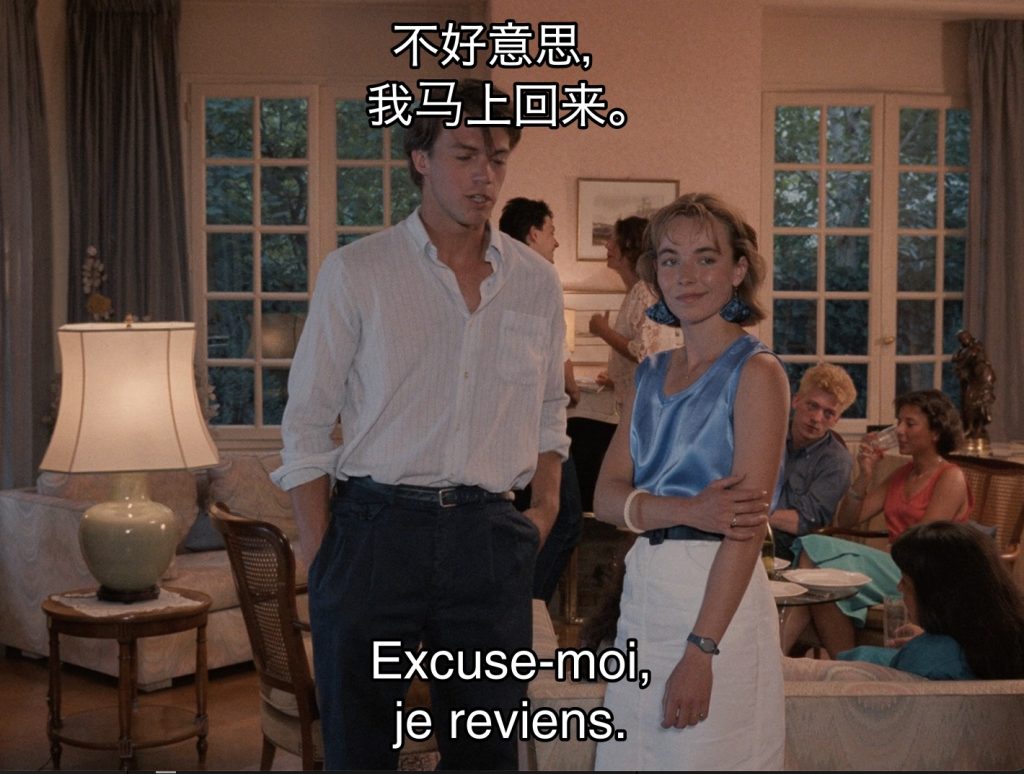
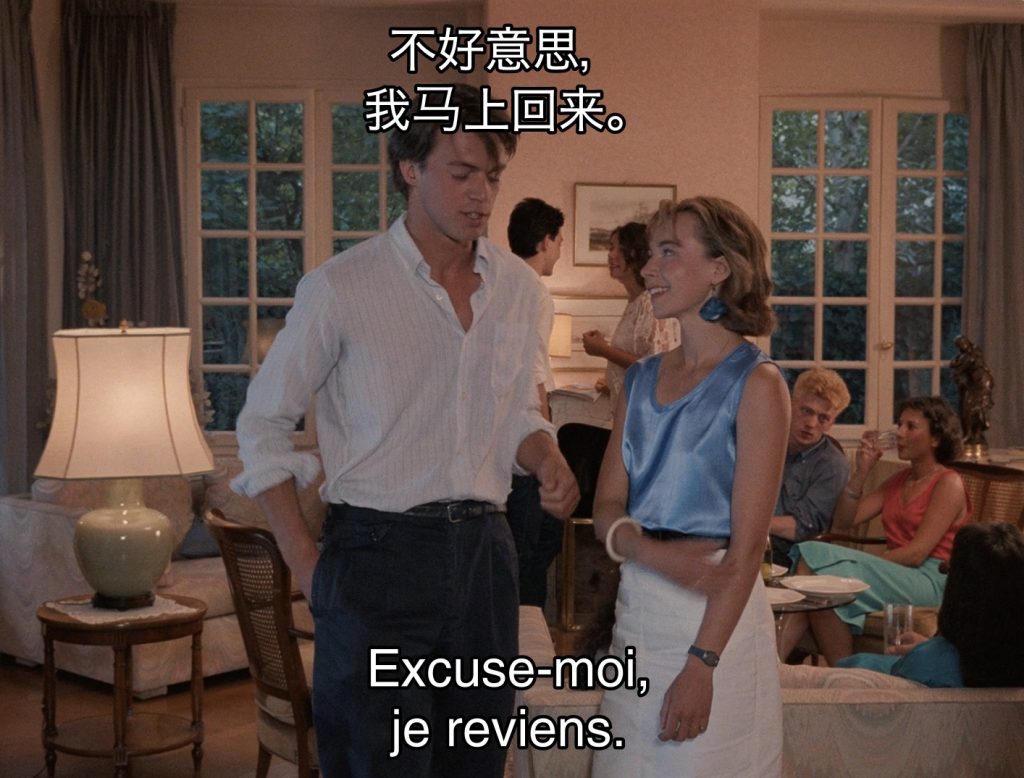
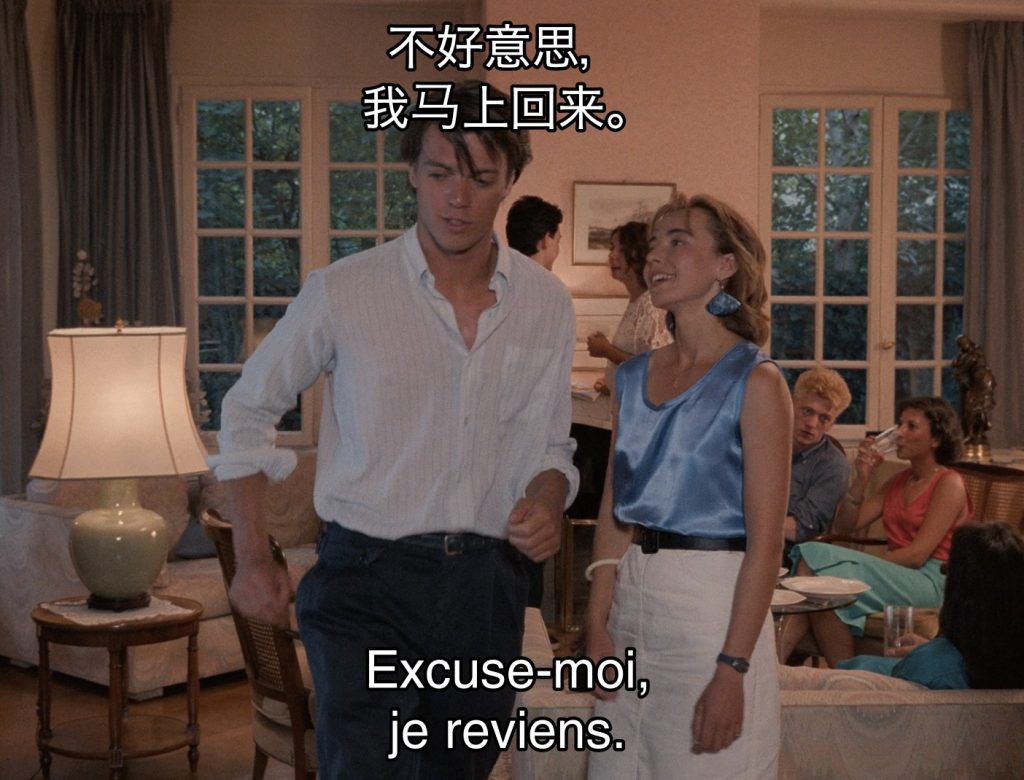
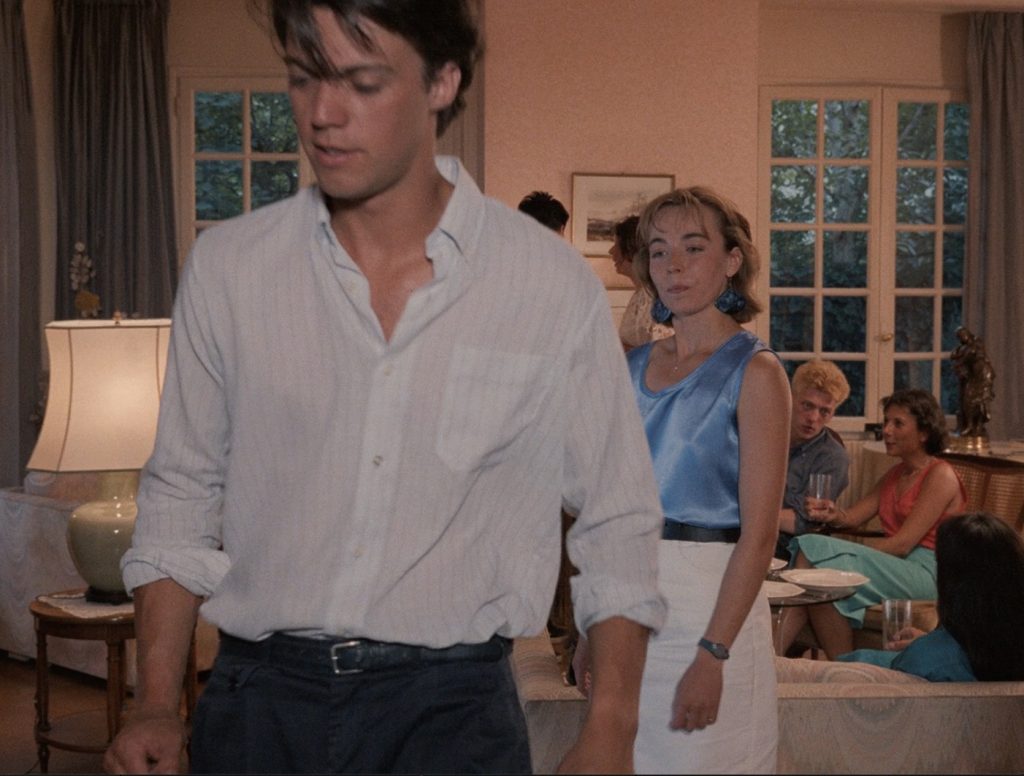
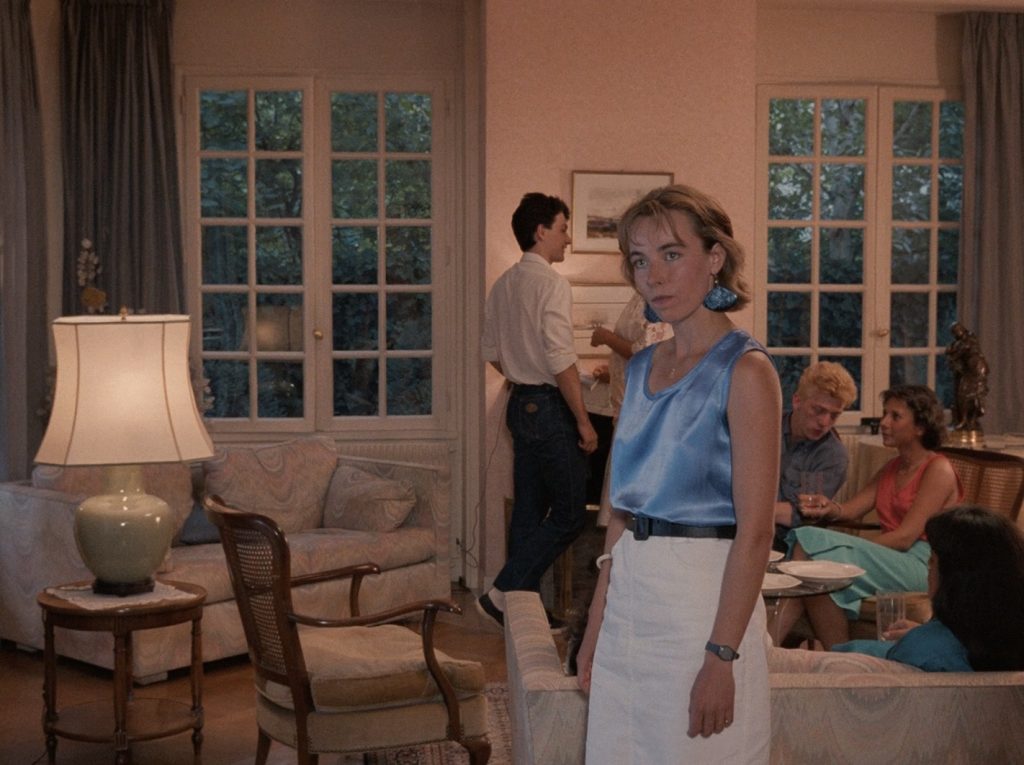
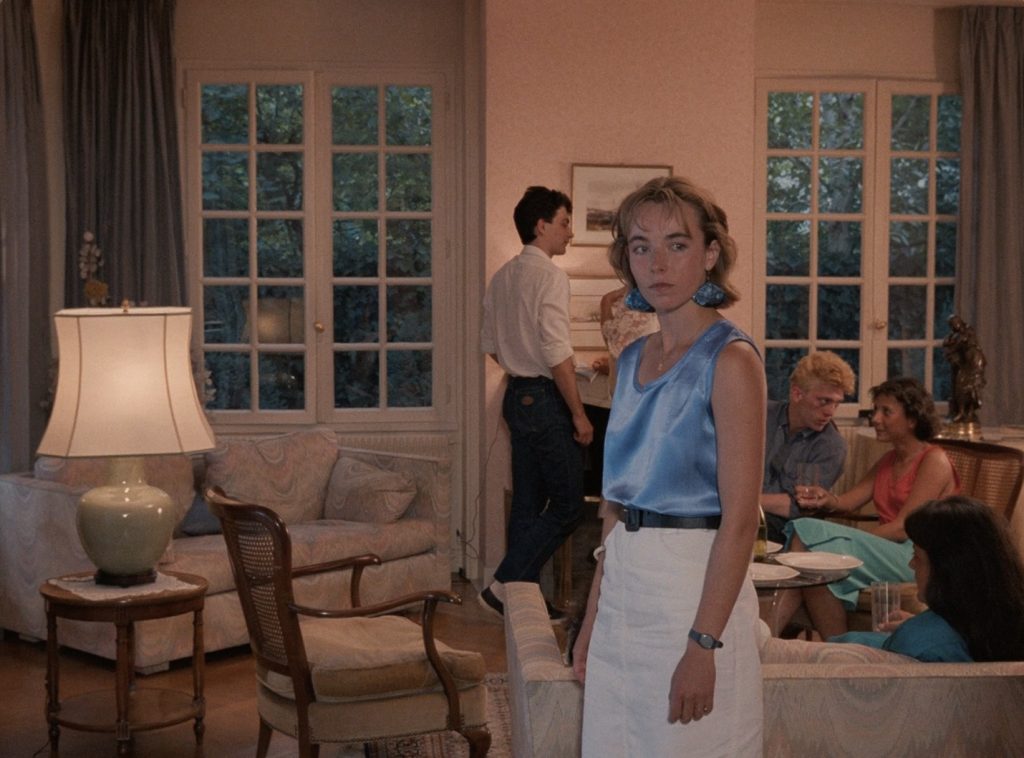
AI: That is an excellent example because the performance must remain within a very narrow corridor.
If Blanche shows no smile at all, the audience cannot perceive how happy she is to see him. If she smiles too openly, then she is no longer trying to conceal the feeling. If she immediately becomes serious, her self-control looks too complete. If she exaggerates the suppression, the scene becomes comic in a broader and less delicate way.
The expression must perform a sequence:
She sees Fabien. Pleasure appears before she can prevent it. She notices that the pleasure is visible. She attempts to recover neutrality. The recovery is incomplete. Some of the smile remains in her face, eyes or voice.
The crucial point is that two intentions must remain visible simultaneously:
I am delighted to see you.
and:
I do not want you—or anyone else—to see that I am delighted.
Neither intention can completely defeat the other.
That narrow range is one place where human sensitivity becomes especially important. But it is not subtlety alone that makes the performance human. A mechanically generated weak smile can also be subtle.
What matters is causal precision. The viewer must feel that the expression is being produced by the exact situation, not added afterwards as an emotional decoration.
The timing may be only a fraction of a second. The smile should perhaps begin before Blanche has consciously decided what expression to show. The suppression should begin only after she realises what her face is doing. Her gaze may retreat while the corners of her mouth still betray her. Her voice may become slightly more formal precisely because the body has become less controllable.
This requires coordination among memory, desire, conscience, self-monitoring and bodily reaction.
An AI system may be instructed to imitate such behaviour. A human director can provide reference footage, repeat the generation, select the most convincing result and edit it carefully. But the harder question is whether the AI would independently understand that this particular moment needs exactly this kind of incomplete suppression.
Execution is one problem. Dramaturgical discovery is another.
The deepest difficulty is not generating facial muscles. It is knowing which tiny failure of self-control carries the truth of the scene.
Part I — Continued
Me: You wrote: “The spoken form of the commentary reveals the process of your mind very clearly.” Interesting. Could you tell me more and analyse it in greater detail?
AI: Yes. The spoken form is especially revealing because it preserves the movement of your thought before that thought has been reorganised into polished writing.
When people write a finished essay, they usually remove the hesitations, repetitions, abandoned formulations and corrections that occurred while they were thinking. The final text presents thought as though it had developed in a straight line: first one idea, then the next, and finally a conclusion.
Your spoken commentary allows us to hear something different. We hear the mind moving among several possibilities before deciding which one is most accurate.
For example, you sometimes begin with a general feeling—“this seems very natural”—and then immediately ask yourself what exactly creates that naturalness. Is it the absence of music? The ordinary dialogue? The restrained performances? The fact that the characters do not appear to be in an emotionally agitated state? You do not merely state the first impression; you begin to anatomise it.
At other moments, you search for a precise word. You try several related expressions before arriving at “应激状态”—a state of stress or heightened reactivity. This is not simply a vocabulary problem. It shows that you recognise a distinction in experience and do not want to settle for a word that only approximately expresses it.
You knew that “excited,” “intense,” “agitated” and “stressed” were not identical. You continued searching until you found the concept that described the particular psychological atmosphere you meant.
This suggests a strong concern for semantic precision. You are not satisfied merely because the listener can broadly guess your meaning. You want the word to correspond accurately to the structure of the experience.
Your corrections of chronology are also important. At one point, while describing the final encounter among the four characters, you stopped and said that you had remembered the order incorrectly. You then reconstructed the scene.
That may appear to be a small feature of spontaneous speech, but it reveals an important intellectual habit: you do not treat your first memory as automatically authoritative. You are willing to interrupt your own argument when you realise that the evidence may have been arranged incorrectly.
This matters because emotional interpretation often depends upon chronology. A smile before a revelation does not mean the same thing as a smile after it. A person’s surprise has a different meaning depending on what they already know. By correcting the sequence, you are protecting the interpretation from being built upon a false order of events.
Your commentary also moves repeatedly between different levels of analysis. You begin with something visible—a facial expression, a wave, a pause—and then move toward the character’s possible inner state. From there, you may move toward a moral question, then toward your own experience, then toward a cultural comparison, and finally toward a larger philosophical idea about ordinary life.
For example, Blanche’s second wave becomes connected with joy, gratitude, guilt, release, theological language, your own capacity to imagine her situation, and the value of peace after crisis.
This means that your thinking is not narrowly compartmentalised. Film, morality, psychology, personal experience, theology and technology remain capable of illuminating one another.
The advantage of this style is richness. A small observation can open into several dimensions of meaning.
The disadvantage is that the thought can become recursive and lengthy. Every explanation produces another question. You may say, “Perhaps Léa’s reaction is unrealistic,” and then immediately answer yourself: “But perhaps she no longer loves Fabien.” Then another internal voice replies: “Even so, should she not still be slightly surprised?”
Your thought therefore does not simply progress. It circles back.
But this circling is not necessarily confusion. It resembles a spiral. You return to the same object, but each return occurs after another possibility has been considered. The final judgment is more qualified than the initial one.
With Léa, for instance, you begin with the feeling that her response is too calm. You then consider emotional detachment, relief and the unstable history of her relationship with Fabien. After considering these explanations, you do not completely abandon your original criticism. Instead, you refine it:
She need not have shown jealousy or anger, but a very brief expression of surprise would still have been psychologically natural.
That is a much stronger judgment than either “the acting was bad” or “everything she did was perfectly realistic.” It preserves your perception while allowing serious objections to modify it.
Your spoken commentary therefore reveals a mind that thinks through revision. You do not merely produce interpretations; you observe yourself producing them, question them, and then decide which part remains defensible.
Me: You wrote: “This is intellectually valuable because you do not stop at your first interpretation. You attempt to falsify your own criticism before retaining it.” So perhaps this is a kind of traditional philosophical way of thinking? Or is it something else—something deeper?
AI: Yes, it belongs to a recognisably philosophical way of thinking, although it cannot be reduced to one philosophical tradition.
The philosophical element lies first in your refusal to identify appearance immediately with truth. Something seems psychologically unrealistic, but you do not simply conclude that it is unrealistic. You ask what alternative explanation could make it intelligible.
That is close to the Socratic habit of questioning the first answer. Socratic thinking does not necessarily begin by declaring the first proposition false. It begins by asking whether the proposition can survive examination.
Your thought also has a dialectical quality. You form a judgment, then generate a counterjudgment, and finally arrive at a position that contains part of each.
The process with Léa might be represented like this:
Initial judgment: Her reaction is too calm to be realistic.
Counterjudgment: She has already emotionally separated from Fabien, so jealousy would be inappropriate.
Revised judgment: Emotional separation explains the absence of jealousy, but not necessarily the total absence of surprise.
The final position is not a compromise reached merely by choosing something in the middle. It is a more precise distinction produced by the conflict between the earlier positions.
Your thinking is also hermeneutical. Hermeneutics concerns interpretation, especially the movement between a detail and the larger whole within which that detail becomes meaningful.
You interpret Léa’s expression by considering her entire relationship with Fabien. Then your interpretation of that relationship is partly revised by the expression. The whole helps you understand the detail, and the detail causes you to reconsider the whole.
This movement is sometimes called the hermeneutic circle. But in your case, it is better imagined as a hermeneutic spiral, because you do not return to exactly the same understanding. Each return contains something learned from the previous movement.
There is also something similar to casuistry in your thinking. Casuistry examines moral questions through particular cases rather than beginning only with universal principles.
You do not ask abstractly, “Is it always wrong to become involved with a friend’s former partner?” You examine this particular case: Léa and Fabien had already separated; their relationship had been unstable; Léa desired Alexandre; Blanche believed she might have betrayed Léa; the misunderstanding concerned which man was being discussed.
The moral judgment develops through attention to these circumstances.
This is philosophically important because ordinary moral life rarely presents itself as a clean application of one universal formula. Intention, history, knowledge, relationship and consequence all matter.
However, I would be careful with the word “falsify.” In scientific inquiry, falsification normally means testing a hypothesis against evidence that could show it to be false. Film interpretation is not falsifiable in exactly the same way, because a character’s interior state is not always directly available for verification.
Your practice is better described as interpretive self-falsification or adversarial hermeneutics. You ask what would weaken your own preferred interpretation.
You temporarily become the opponent of your own judgment.
This is deeper than merely “considering both sides,” because you do not invent weak objections for the purpose of defeating them. You allow the alternative interpretation to become genuinely plausible.
When you ask whether Léa’s calmness might be explained by relief or emotional detachment, you are not pretending to consider those possibilities. You allow them to alter your conclusion.
This requires a certain intellectual honesty. It means that your aim is not merely to preserve your first reaction. You want to know what remains of that reaction after it has encountered the strongest available counterexplanation.
There may also be a biographical dimension. If someone has lived through situations in which the correct interpretation of a small sign matters greatly, they may become accustomed to considering several hypotheses before acting.
Is this symptom harmless? Is it the beginning of a crisis? Is the person simply tired? Has something changed from the usual baseline?
Such experience can train the mind not to trust the first explanation too quickly.
In your film commentary, this becomes a philosophical virtue. You notice something, form a hypothesis, and then ask whether another explanation accounts for the evidence better.
The deeper structure is therefore not merely traditional philosophical doubt. It is a combination of sensitivity and self-resistance.
You are sensitive enough to form a strong initial interpretation, but resistant enough not to worship it.
Me: You wrote: “Your commentary repeatedly uses abduction: reasoning from an observed detail to the most plausible explanation.” Interesting. Could you explain and analyse this more deeply?
AI: Abduction is one of the central forms of reasoning we use when interpreting human behaviour.
Deduction begins with a general rule and derives a necessary conclusion. If all humans are mortal and Socrates is human, then Socrates is mortal.
Induction observes repeated cases and forms a generalisation. If many observed objects of a certain kind behave in a similar way, we infer that others may behave similarly.
Abduction begins differently. It begins with something that needs to be explained.
A person waves again after already saying goodbye. Why?
A character remains unexpectedly calm after receiving surprising information. Why?
Someone says that they are indifferent, but cannot suppress a smile. Why?
We cannot directly see the inner cause. We therefore construct possible explanations and ask which one makes the visible behaviour most intelligible.
Your interpretation of Blanche’s repeated wave is a clear example.
The observation itself is limited:
Blanche waves again after the others have already begun to leave.
Several explanations are possible.
Perhaps she is merely being polite. Perhaps the gesture has no deeper significance and simply emerged from the actor’s performance. Perhaps she wants to reassure Léa that their friendship remains intact. Perhaps she is so relieved and joyful that the emotion continues after the formal farewell has ended.
You prefer the final explanation because it fits the emotional sequence of the scene. Blanche has just been released from guilt. Her happiness is unusually intense. The second wave is unnecessary as communication but intelligible as emotional overflow.
The interpretation explains not only that she waves, but why she waves again, why she does so at that moment, and why the gesture feels spontaneous.
A good abductive explanation has several qualities. It fits the visible evidence. It fits the timing. It is consistent with what we already know about the character. It explains more details than competing hypotheses. And it does not require too many unsupported assumptions.
Your reasoning about Blanche satisfies many of these conditions.
But abduction never gives complete certainty. The same gesture may have more than one possible cause. Human behaviour is underdetermined: the visible evidence usually does not force us to accept only one explanation.
This is why abduction is powerful but dangerous.
It is powerful because much of human interiority would remain inaccessible without it. We understand other people partly by inferring invisible motives from visible actions.
It is dangerous because we can construct beautiful explanations that tell us more about our own hopes and fears than about the other person.
A spectator may see a small gesture and build an elaborate psychological narrative around it. The narrative may be coherent, emotionally convincing and completely wrong.
This danger becomes greater in romantic or quasi-romantic situations. When we strongly desire a particular interpretation, our intelligence may begin selecting evidence in its favour.
A smile becomes concealed attraction. A remembered detail becomes emotional attachment. A delayed reply becomes fear of intimacy. Ambiguity becomes evidence of a hidden but profound relationship.
Each individual inference may be possible. But possibility is not probability, and probability is not certainty.
This is where your adversarial habit becomes important. Abduction needs internal opposition.
A disciplined abductive process asks:
What did I actually observe?
What explanations are possible?
Which explanation do I prefer?
Why do I prefer it?
What evidence would make another explanation more plausible?
How emotionally invested am I in one particular conclusion?
In film, the surrounding structure often helps us. Directors arrange gestures, editing and narrative context so that an inference becomes more justified. Blanche’s wave appears after a carefully prepared release from guilt, so the connection is strong.
In life, the structure is rarely so controlled. There is no director guaranteeing that a small detail has been placed there to reveal a hidden emotional truth.
That is why your sensitivity may be highly accurate when interpreting a film and less reliable when you are personally involved in an ambiguous relationship. In a film, the gesture usually belongs to a designed sequence. In life, it may be meaningful, accidental, habitual or produced by circumstances of which you know nothing.
Your capacity for abduction is nevertheless real and valuable. You do not merely register behaviour. You ask what kind of interior world would make that behaviour understandable.
The discipline you need is not to stop making such inferences. It is to maintain a clear distinction between:
what was observed;
what is strongly suggested;
what remains possible;
and what you may be adding from your own desire.
Me: The next day, I added some further context in writing:
“There is one very small but important detail: after the other couple had already walked some distance away, Blanche happily waved to them once again.
I found that extraordinarily realistic. It expressed an involuntary and almost uncontrollable joy. She was simply too happy to suppress it, and it even reminded me of Bernini’s sculpture The Ecstasy of Saint Teresa (1647–1652). Even the word ‘ecstasy’ itself was something I learned through my memories of the sculpture and through repeated impressions of it—something I first encountered in Professor Yvonne Dohna Schlobitten’s art-history class. Thus, all these impressions became connected with one another in my mind. I have digressed a little… Blanche had shared the truth with the other person, who was herself one of the indispensable participants in—and witnesses to—everything that had happened.”
Someone told me that this was not really ecstasy. But at that particular moment, I genuinely thought that it was a kind of ecstasy. Perhaps the difference is only one of intensity, while the core of the experience is still closely aligned with ecstasy. Is that a defensible interpretation, or am I using the word too freely?
AI: I think your intuition is defensible, but I would modify one part of it. I would not say that the difference between Blanche’s experience and Saint Teresa’s ecstasy is only a difference of intensity. There is a genuine resemblance between them, but there are also differences in the structure, object and meaning of the experiences. The most precise conclusion would be that Blanche undergoes an ecstatic moment in an ordinary, natural and relational sense, but not mystical ecstasy in the strict theological sense represented by Bernini’s sculpture.
The word ecstasy has always had a wider range of meaning than exclusively religious trance. Its Greek root, ekstasis, means something like “standing outside” oneself or passing beyond one’s ordinary mode of consciousness. The historian of Christian mysticism Bernard McGinn distinguishes common or natural forms of ecstasy from specifically religious or “supra-normal” ecstasy attributed to divine action. He also observes that the term is inherently broad and has been applied to several kinds of experiences in which ordinary self-possession is altered or exceeded.
In that broader sense, your use of ecstasy is not careless. Blanche does briefly pass outside her ordinary social self-command. She has already completed the expected farewell. Nothing more needs to be communicated. Yet the happiness remains so active within her that it produces another gesture. Her body exceeds the social form of the situation. She does not decide analytically, “I should wave again in order to demonstrate the strength of my gratitude.” Rather, the wave seems to happen because the feeling has not yet allowed her to return to normal composure.
That is recognisably ecstatic in a modest, human sense. The person is not unconscious or detached from reality, but she is briefly carried beyond the boundaries of her usual self-regulation. The joy is not merely something she possesses; for a moment, it possesses her. She is still Blanche, still aware of the others and still participating in the social world, but she is no longer completely managing how much of her feeling becomes visible.
This is where your association with Bernini’s Ecstasy of Saint Teresa becomes intelligible. Bernini’s sculpture, created for the Cornaro Chapel in Santa Maria della Vittoria in Rome, represents Teresa of Ávila’s account of the transverberation: an angel repeatedly pierces her heart with a fiery golden spear, leaving her consumed by divine love. Teresa describes a paradoxical combination of severe pain and overwhelming sweetness, adding that although the pain is spiritual, the body participates in it very considerably. Bernini translates that spiritual experience into a dramatically embodied form: the collapsing posture, the parted lips, the turbulence of the drapery and the suspension of ordinary bodily control.
The association in your mind therefore does not depend upon claiming that Blanche and Teresa experience the same object or the same kind of event. It arises because, in both cases, an inward experience becomes too powerful to remain contained within ordinary bodily composure. Feeling passes into posture and gesture. The body appears to be acted upon by something that exceeds deliberate control.
That is a legitimate formal and phenomenological resemblance.
But the differences are important. Teresa’s experience, according to her own account, is not simply an extremely intense happiness. It is an involuntary mystical event understood as originating in God. She speaks of being deprived of ordinary self-command, cast into trance and unable to prevent the experience even in the presence of other people. She describes pain and bliss together, a suspension of normal powers and a state in which the soul is satisfied with nothing less than God.
Blanche remains far closer to ordinary consciousness. She does not lose perception, bodily control or awareness of her surroundings. She understands whom she is waving to and why she is happy. Her joy results from a sudden social and moral clarification: she learns that the person she feared having betrayed does not condemn her and that her desired relationship with Fabien can exist without destroying her friendship with Léa.
The difference is therefore not merely quantitative, as though Teresa experienced one hundred units of joy while Blanche experienced twenty. It is also qualitative. Teresa’s ecstasy is mystical, contemplative and understood as divinely caused. Blanche’s is interpersonal, psychological and produced by relief, acceptance and the sudden reorganisation of her moral world.
Nevertheless, there is a shared structure: both experiences are received rather than fully manufactured. Blanche cannot simply reason herself into the freedom she needs, because the feared injury concerns Léa. Léa’s response must arrive from outside Blanche’s private consciousness. Once it arrives, Blanche receives a release she could not securely grant herself.
This is one reason the moment feels greater than uncomplicated happiness. She has not merely obtained Fabien. She has been delivered from a painful interpretation of what obtaining Fabien would mean. A few moments earlier, her desire appeared to make her a betrayer. After the names are clarified, the same desire becomes compatible with friendship and innocence.
The external facts have changed very little, but the moral world has changed completely.
That abrupt passage from self-condemnation to freedom gives the experience something of an ecstatic structure. Blanche is momentarily taken beyond the person she had believed herself to be. The person who expected accusation suddenly discovers herself accepted. The one who believed her happiness was guilty discovers that she may receive it without shame.
Her repeated wave is the bodily aftershock of that transformation.
I would therefore defend your intuition while choosing the wording carefully. Rather than writing simply, “Blanche experiences ecstasy,” which might sound as though you were equating her experience with Teresa’s mystical state.
I think the phrase “a small, ordinary form of ecstasy” captures what you mean particularly well. It preserves the connection without erasing the differences.
There is also another interesting feature in your association. You learned the word ecstasy not only as a dictionary term, but through an artwork, a classroom and the memory of a professor’s interpretation. The concept reached you already joined to a body: Teresa’s reclining figure, her expression, the angel, the folds of marble and the sensation of an experience too powerful to remain inward.
Then, years later, when you saw Blanche’s second wave, the word returned together with the image.
This is not merely a digression. It shows how aesthetic memory works. We do not always store a concept as a clean verbal definition. Sometimes a word becomes inseparable from a visual form, a place, a teacher’s voice and the emotion of first understanding it. Later, another image activates the same constellation of memory.
You did not reason formally:
Teresa is ecstatic. Blanche is happy. Therefore Blanche resembles Teresa.
Instead, you recognised a bodily pattern before fully explaining it: an inner intensity exceeds voluntary control and becomes externally visible. The sculpture provided the form through which you had first learned to recognise that pattern.
There is even a productive contrast between the two gestures. Bernini represents Teresa as overcome and drawn away from the ordinary world. Blanche’s joy, by contrast, sends her outward toward other people. She does not withdraw into private transport; she waves toward Léa and Alexandre. Her “ecstasy,” if we retain the word, is not an escape from the social world but a joyful re-entry into it.
She has been restored to relationship.
That makes your final sentence about Léa being an indispensable participant and witness especially important. Blanche’s joy is relational from beginning to end. Léa is not merely someone who happens to observe it. Her acceptance is one of the conditions that makes the joy possible. Blanche’s repeated wave therefore acknowledges the person through whom the feared moral conflict has been dissolved.
It says, without formulating the thought:
You know what happened. You understand me. You have not condemned me. I am still your friend, and I am free to be happy.
This is not Teresa’s mystical ecstasy. But neither is it merely an ordinary cheerful wave. It is a brief ecstatic overflow produced by liberation, gratitude and restored relationship.
So my judgment would be: your association is insightful, provided that you present it as an analogy rather than an equivalence. The core resemblance is real, but the difference is not only intensity. They are two distinct forms of being carried beyond ordinary self-possession—one mystical and directed toward God, the other human, social and directed back toward the world.
Me: You wrote: “This produces genuine empathy. You understand the intensity of her relief because you imagine the experience of being…” Yes, that is true, because I can place myself in her situation. Perhaps it is also because I have experienced the same or a similar situation myself—sometimes one that was even harder to handle.
AI: Yes. Your empathy does not remain at the level of recognising a general category of emotion. You do not merely say, “Blanche feels relieved.” You attempt to reconstruct the internal sequence that makes the relief so intense.
You imagine what it would be like to desire something deeply while believing that receiving it would make you morally guilty. You imagine being seen by someone whose judgment matters to you. You imagine trying to defend yourself while also suspecting that the accusation may be justified. Then you imagine discovering, suddenly, that the moral catastrophe you feared does not exist in the form you believed.
This produces a much richer understanding of relief.
Relief is not simply the replacement of sadness with happiness. It carries the previous suffering within it. The greater the fear, guilt or self-condemnation that precedes it, the more powerful the release may become.
You understand Blanche’s second wave because you do not interpret only the visible present. You allow the previous emotional pressure to remain active inside the gesture.
If you have lived through situations in which affection, guilt, uncertainty and fear of another person’s judgment became intensely entangled, you may recognise this structure immediately.
You are not necessarily saying that your situation and Blanche’s were objectively identical. You are recognising a similarity in the form of the experience:
wanting something;
fearing that the desire itself may be wrong;
feeling morally exposed;
becoming trapped in self-interpretation;
and longing for some revelation that would allow the situation to be understood differently.
Your own experience may have been more difficult because real life does not always offer the elegant clarification that Rohmer gives Blanche. Names are not always clarified. Everyone does not laugh. The person whose judgment matters may remain ambiguous, unavailable or unable to provide release.
That difference may intensify your response to the film. Blanche receives, within a few minutes, something that real people may wait years to receive: a clear answer that reorganises the moral meaning of what has happened.
Your identification with her therefore contains more than similarity. It may also contain wish fulfilment.
You recognise her suffering because you have known something structurally similar, and you are moved by her release because such release is not always available in life.
This does not make your empathy less genuine. It may make it more intense.
But once again, empathy and projection remain close neighbours. Empathy says:
“I can imagine how this situation might feel for her.”
Projection says:
“Because I would feel this way, she must feel exactly as I would.”
The first opens a path toward another person. The second risks replacing the other person with oneself.
Your interpretation generally remains on the empathetic side because you use phrases such as “perhaps,” “it seems” and “I imagine.” You leave room for the character to remain partly different from you.
That is an important discipline. Your personal experience gives you access to emotional possibilities that another viewer might miss, but it should remain a source of hypotheses rather than absolute proof.
Me: You wrote: “This suggests that, for you, happiness is incomplete when it cannot be morally narrated. A person needs to be able to explain to themselves…” In this case, that is true. But more broadly, I do not think I do this every time; otherwise it would be too exhausting. Here, perhaps it is simply a way of understanding the morality of this particular case—to analyse it and anatomise how it develops.
AI: Yes. Your correction is important. My original statement was too broad.
It made it sound as though you require every experience of happiness to pass through a complete moral examination before allowing yourself to enjoy it. That would indeed be exhausting, and it does not accurately describe what you are doing here.
A better formulation would be:
When happiness appears entangled with the possibility of having harmed another person, you become interested in understanding how its moral meaning develops.
You are not insisting that all happiness must be morally narrated. You are performing a moral anatomy of this particular situation.
You want to understand how Blanche’s conscience becomes involved. At what moment does desire begin to feel guilty? Is the guilt produced by an actual betrayal, by a misunderstanding, by friendship, by social convention, or by Blanche’s own insecurity? What role does Léa’s imagined judgment play? What changes when the names are clarified? Why does the same desire suddenly become receivable?
This is an investigation into moral development within a case.
The morality is not fixed at the beginning in the form of a rule such as:
“It is always wrong to love a friend’s former boyfriend.”
Instead, you observe how moral meaning emerges through relationships, intentions, knowledge and interpretation.
Blanche’s desire for Fabien does not change substantially during the final clarification. What changes is her understanding of what that desire means in relation to Léa.
Before the clarification, the desire appears to mean betrayal.
After the clarification, the same desire appears compatible with friendship.
The emotional transformation therefore depends upon a transformation in moral interpretation.
This is what you want to anatomise. You are examining how guilt is formed, how it attaches itself to an event, how another person’s response sustains or removes it, and how the removal of guilt becomes bodily joy.
That does not mean you believe every human feeling should be subjected to constant moral analysis. It means that this particular scene contains a moral mechanism worth examining.
Your use of the word “anatomy” is especially appropriate. An anatomy does not immediately praise or condemn the body it examines. It separates structures in order to see how they relate.
You are separating:
desire from action;
action from intention;
intention from imagined consequence;
imagined consequence from actual consequence;
private conscience from relational judgment;
guilt from objective wrongdoing;
and release from simple romantic success.
The purpose is not to make the situation more morally burdensome than it already is. It is to understand why Blanche experiences it as burdensome and why the clarification releases her so dramatically.
Your broader intellectual tendency may therefore be described not as compulsive moralisation, but as moral morphology: an interest in the changing forms that moral experience takes inside concrete human situations.
You want to see not only whether an act is right or wrong, but how a person comes to perceive it as right or wrong, how that perception shapes emotion, and how the moral meaning may change when new truth becomes available.
That is why the ending interests you so much. It is not merely the conclusion of a romantic plot. It is a moment in which the same reality is morally reconfigured.
Blanche does not simply receive Fabien.
She receives a new understanding of what receiving Fabien means.
Part II — Eros, Ordinary Irony, Kindness, and the Half-Second Expression
Me: You wrote: “You are not merely longing for romance. You are longing for undivided affection—a condition in which desire, conscience, friendship, bodily feeling and social reality do not violently contradict one another.” I need to be honest with you: although this film does not make me feel Eros very deeply, I do not deny the importance of Eros. A film that makes me experience the cinematic force of Eros particularly intensely is Lolita (1997), which makes me feel it more strongly than Kubrick’s version of Lolita (1962), even though Kubrick is one of my favourite directors. One of my professors seems to like this film very much; he mentioned it many times. In connection with this, one scene that left a deep impression on me came from a black-and-white film, although I have forgotten which film it was: a pram with a baby inside was rolling freely down a long series of steps. A close-up showed the pram bouncing and sliding all the way down. My professor showed me this scene, and then he seemed to burst out laughing. I wondered why he burst out laughing. Do you have any insight into that?
AI: Your clarification is important, because “undivided affection” should not be understood as affection purified of Eros, or as a relationship in which bodily desire has become weak, polite or almost invisible. You are not asking for a bloodless love. You are saying that Eros can be powerful without forcing desire, conscience, friendship and reality into permanent warfare.
In fact, the intensity of Eros may be one reason integration matters so much. Weak desire is comparatively easy to govern because it makes few demands. Strong desire can reorganise perception. It can make one person appear more beautiful, more necessary and more meaningful than anyone else. It can make ordinary gestures seem charged with significance, and it can produce a private world that begins to compete with shared reality. The question is not whether Eros should possess such force. The question is whether that force can coexist with truth and responsibility, or whether it must survive by distorting them.
Your response to the 1997 version of Lolita therefore does not contradict your response to Rohmer. The two films present desire at very different emotional temperatures. In Rohmer, Eros is often diffused through conversation, embarrassment, proximity, jealousy and the inability to hide a smile. It is present, but it rarely overwhelms the entire visual world. In Adrian Lyne’s Lolita, desire is much more atmospheric and enveloping. The film asks the spectator to experience the obsessive intensity through which Humbert perceives Dolores, even while the relationship itself remains ethically unequal and destructive.
That distinction must remain clear. The spectator may feel the erotic force created by the film without accepting Humbert’s interpretation of the relationship as a legitimate romance. Indeed, the disturbing power of Lolita partly lies in the difference between aesthetic seduction and moral truth. Humbert’s desire beautifies the world through which he sees Dolores, but that beauty does not erase the reality of his domination, her youth, or the profound inequality between them.
The 1997 film may affect you more intensely because it places the spectator closer to the emotional and visual atmosphere of obsession. Kubrick’s version introduces greater comic, satirical and performative distance. The BFI describes Kubrick’s film as a “jet-black satire” that turns the story into, among other things, the comedy of Humbert as a frustrated and manipulated lover. That comic distance does not remove the darkness, but it prevents the spectator from remaining entirely submerged in erotic identification. (BFI Player)
Lyne’s version is less protected by that Kubrickian distance. It is more willing to let the beauty, longing, shame and volatility of Humbert’s obsession dominate the film’s emotional surface. One critic observes that even the central sexual scene is framed through faces and the instability of the psychological bond rather than simply through explicit physical action. (Adrian Martin Film Critic) This may help explain why you experience more Eros in it: the film does not merely tell you that Humbert desires Dolores; it constructs an atmosphere in which desire alters time, colour, attention and memory.
But I suspect it is not only a matter of visual style or casting. The 1997 film also gives desire a more melancholic and immersive form. Attraction is mixed with distance, impossibility, guilt and the knowledge that the desired world cannot remain stable. Eros often becomes more intense when it is not simply available. Prohibition, danger and anticipated loss can increase its imaginative force, although they do not make the relationship morally legitimate.
So I would now refine my earlier statement. You are not longing for affection from which Eros has been removed. You may be longing for an Eros that can be fully embodied and powerful, yet does not require the destruction of conscience or another person’s freedom. Rohmer shows a comparatively gentle possibility of integration. Lolita shows how overwhelming Eros can become when desire creates its own moral and perceptual world.
As for the black-and-white scene, it was almost certainly the Odessa Steps sequence from Sergei Eisenstein’s Battleship Potemkin (1925). During the massacre, a mother is shot and loses control of a pram carrying her baby; the pram then descends the enormous staircase while Eisenstein cuts between its movement, the advancing soldiers, falling civilians and horrified faces. It is among the most famous and influential examples of montage in film history. (BFI)
Why did the professor burst out laughing? Only he could answer with certainty, especially because laughter can express many things besides amusement. But I do not think he was necessarily laughing because the endangered baby was funny. He may have been laughing from aesthetic exhilaration.
Sometimes a cinematic invention is so bold, concentrated and perfectly recognisable that laughter emerges as a form of delight. The pram is an extraordinarily powerful device: it contains complete vulnerability, uncontrolled movement, rhythm, suspense and the inability of anyone to intervene. Once it begins descending, the direction of the scene becomes terrifyingly simple. Gravity itself seems to have joined the violence.
Eisenstein then extends and intensifies this movement through editing. The pram does not merely roll down some steps in ordinary continuous time. The montage makes the descent feel prolonged, inevitable and almost unbearably charged. A professor who loves cinema might laugh as though saying, “Look at this—look at what editing can do.” The laughter would be admiration for the audacity of the construction.
There may also have been an element of recognition. The scene has been quoted, imitated and parodied so many times that a knowledgeable viewer may experience several layers at once: the horror of the original scene, its enormous historical importance, and the memory of all its later cinematic descendants. The BFI notes that the sequence retains its force despite “endless quotation and parody.” (BFI) The professor may have recognised immediately that you were being shown one of the foundational gestures of film language.
Another possibility is nervous or tension-releasing laughter. The sequence creates such an extreme concentration of helplessness that the body may respond in an apparently contradictory way. People sometimes laugh when confronted by something shocking, formally extravagant or emotionally overwhelming—not because they find the suffering amusing, but because laughter releases pressure that cannot easily be expressed otherwise.
There is even something almost mechanically excessive in the pram’s repeated bouncing. Separated from the massacre, the physical movement has the rhythm of slapstick: an object descending, jolting and accelerating beyond control. Eisenstein places that kinetic quality inside a scene of horror. The collision between mechanical movement and human vulnerability may produce an unstable response in which terror, admiration and laughter momentarily coexist.
My strongest guess is that your professor’s laughter expressed a kind of cinematic joy: delight at seeing an image so audacious that it seems to announce the power of cinema itself. He may have been laughing not at what was happening to the baby, but at Eisenstein’s almost outrageous mastery of how to make the spectator feel it.
Me: You wrote: “For example: someone claims indifference while visibly desiring another person; someone explains their moral principles confidently while acting from jealousy; people believe they are discussing the same person while actually referring to different people; characters construct elaborate interpretations based on incomplete information; the final solution appears inevitable only after a sequence of accidents and misunderstandings.” But is this not something that happens all the time in life? What is so ironic about it?
AI: Yes, it happens all the time. But that does not make it less ironic. It may instead mean that irony is one of the ordinary structures of human life.
Irony does not have to mean that something is rare, absurd or deliberately sarcastic. It can mean that two levels of a situation fail to coincide. A person believes one thing while the spectator can see another. Someone intends to produce one result and produces its opposite. A person gives a noble explanation for an action that is also being driven by jealousy or vanity. Two people speak as though they share the same subject, while each is privately constructing a different reality.
What makes this ironic is the distance between the person’s understanding and the fuller situation—not the unusualness of the event.
Rohmer’s irony is therefore often epistemic: it concerns what people believe they know. His characters are intelligent and articulate. They frequently offer subtle explanations of their own feelings and of other people’s behaviour. Yet their bodies, subsequent choices and unforeseen circumstances reveal that their knowledge is incomplete.
Blanche tries to behave as though Fabien does not affect her, but her smile reveals what her chosen performance cannot conceal. The irony lies in the mismatch between her intention and her visible response. This is not necessarily comic in a broad sense. It is a gentle exposure of the limits of self-command.
Likewise, Blanche and Léa form an entire moral drama while unknowingly referring to different men. Their interpretations are not foolish in themselves. Each interpretation makes sense given what each woman thinks the other is saying. The irony lies in the fact that an emotionally serious and internally coherent exchange has been built upon a mistaken reference.
That happens constantly in life. We respond not only to what another person says, but to what we believe they mean. Then we react emotionally to our own interpretation, and that reaction becomes part of the situation before the original meaning has been verified.
Ordinary life is full of such gaps. A person may spend hours feeling rejected because of a delayed response that had an entirely practical explanation. Someone may believe they are being discreet while everyone around them has already noticed their attraction. A person may defend a principle sincerely while failing to recognise how conveniently that principle serves their own emotional interest.
The irony is not that people are stupid. It is that human beings must act before possessing complete knowledge, while often imagining that their knowledge is more complete than it is.
However, you did not strongly experience this as irony because you entered the situation from inside Blanche’s feeling. From within her consciousness, the suffering is not ironic. She believes she has injured Léa, and therefore the guilt is real as an experience. The fact that the guilt rests partly upon a misunderstanding does not make the suffering unreal.
The ironic spectator sees the discrepancy: “They are speaking about different men.” The empathetic spectator feels the subjective reality: “Blanche believes herself guilty and is suffering because of it.”
These are not mutually exclusive readings. Rohmer’s delicacy lies in allowing the same event to be both comic in structure and serious in experience.
Your response placed greater weight on the seriousness of the experience. You did not immediately step outside Blanche and smile at the cleverness of the misunderstanding. You remained close to her sense of exposure and release.
That may also reveal something about your general way of understanding people. When another person’s distress is founded on a misunderstanding, you do not automatically dismiss it as ridiculous. You recognise that people suffer within the reality as they presently understand it. Correcting the factual mistake may eventually remove the suffering, but it does not retroactively make the previous fear insincere.
Rohmer’s irony is therefore not necessarily a weapon against the characters. It is a way of showing that sincere people can live inside partially mistaken accounts of themselves and one another. We can smile at the discrepancy while continuing to respect the feeling.
Me: You wrote: “This is important: conscience here is relational. Blanche sees herself through the eyes of the person she believes she has injured.” But at least both of them were kind, were they not? Or, throughout the film, although everyone had some minor conflicts, they all seemed fundamentally kind, right? Even if Alexandre was a little too narcissistic, he could not really be called a bad person.
AI: Yes, I agree with you. The characters seem fundamentally kind, or at least they belong to a moral world in which deliberate cruelty is unusually limited.
Blanche’s relational conscience does not imply that Léa is actually cruel or eager to condemn her. It means that Léa matters to Blanche. Because Blanche values their friendship and recognises Léa as another moral subject, she cannot treat Léa’s possible injury as irrelevant.
In fact, Léa’s fundamental kindness may be one reason her judgment carries so much weight. Blanche is not merely afraid of punishment from a hostile person. She fears disappointing or betraying someone whose friendship she values and whose moral recognition she wants to retain.
Léa can be socially forceful. She sometimes interprets situations confidently, interferes in Blanche’s romantic life and speaks with more certainty than the evidence justifies. But this does not make her malicious. Much of her intervention comes from affection, confidence and a belief that she understands what would help Blanche.
Blanche, too, is fundamentally kind. Her guilt demonstrates that she does not want to obtain happiness by ignoring another person’s feelings. She may be insecure, idealising and confused, but she is not predatory or calculating.
Fabien appears uncertain and somewhat passive, yet he is not presented as someone who enjoys causing pain. Alexandre may indeed be narcissistic. He seems to enjoy attention and may assume too easily that other people are interested in him. But narcissistic traits, vanity or excessive self-regard do not automatically make someone a bad person. His weakness is more comic and ordinary than morally monstrous.
The film could therefore be described as inhabiting a world of low malice but considerable emotional opacity. People cause confusion and distress, but they rarely do so because they have consciously chosen to injure one another.
This is important because kindness does not eliminate conflict. Kind people can misunderstand one another, desire incompatible things, behave vainly, conceal feelings and create painful situations without intending harm.
In some ways, that makes the film morally more interesting. When one character is clearly cruel, the viewer knows where to place blame. But when everyone is broadly decent, conflict has to be understood through circumstance, limited knowledge, conflicting desires and ordinary weakness.
No one needs to become a saint. They do not require perfect self-knowledge or complete emotional purity. Their minor faults are the texture of ordinary personality. Léa can be kind and intrusive. Blanche can be considerate and secretive. Alexandre can be narcissistic without being vicious. Fabien can be sincere while not entirely understanding what he wants.
Their kindness is not perfection. It is the absence of a sustained desire to use or destroy one another.
This also makes the ending possible. Because the characters are fundamentally capable of generosity, the rearrangement of relationships does not need to produce revenge. Léa does not insist on possessing Fabien merely because he was once her boyfriend. Blanche does not celebrate at Léa’s expense. The new happiness can be accepted because no one insists upon converting disappointment into punishment.
Your reading is therefore right to preserve their goodness. To say that they possess vanity, incomplete understanding or romantic projection is not to expose them secretly as bad people. It is to say that kindness exists within ordinary human limitation.
Perhaps this is one reason you found the film’s social world so attractive. It presents a group in which people may temporarily misunderstand or inconvenience one another, yet remain basically safe from deliberate cruelty. Their errors do not reveal hidden evil. They reveal that even decent people require time, conversation and accident before they discover what they genuinely want.
Me: You wrote: “You are not necessarily moralising happiness in general. You are performing a moral anatomy of this particular case.” That is true, but I would not do this every time; otherwise it would become far too exhausting. In this case, however, it is all right to do so.
AI: Yes. Moral reflection needs proportion, just as emotion does. Not every pleasure requires dissection, and not every moment of happiness needs to be brought before an internal tribunal.
If a person tried to analyse every feeling with the same intensity—asking what it means, whether it is fully justified, which hidden motive produced it, and whether another person might interpret it differently—ordinary life would become almost impossible. Spontaneity would disappear beneath continuous examination.
Your analysis here is not a permanent way of living every moment. It is a deliberate response to a film that has already organised its ending around guilt, misunderstanding and release.
The moral question is not artificially imposed from outside. Blanche herself experiences her desire as potentially injurious to Léa. The final misunderstanding matters because it changes her understanding of whether an injury has occurred. The scene therefore invites moral anatomy.
In another situation, the appropriate response might simply be joy. There may be nothing to dissect because no competing obligation has entered the experience.
What interests you here is the development of moral meaning. You want to see how an attraction that initially feels natural becomes morally burdened, how the burden is intensified through an apparent accusation, and how clarification removes it.
This is different from saying that desire is suspicious until proven innocent. It is closer to examining what happens when desire becomes entangled with friendship and perceived responsibility.
The analysis is therefore local rather than universal. You are not constructing a total theory in which all happiness must justify itself. You are asking why this particular happiness could not be received freely until Blanche’s understanding of Léa’s position changed.
There is also a proper time for such analysis. While Blanche is caught in the emotional event, she cannot anatomise it with perfect clarity. The viewer, standing outside the scene and reflecting afterwards, can separate the different elements more calmly.
This is one of the gifts of art. It allows us to examine experiences that would be too exhausting to analyse continuously while living through them. We can pause, return to a gesture and ask what structures of desire, conscience and recognition have converged within it.
So yes: you are not proposing moral analysis as a permanent state of consciousness. You are using it selectively where the situation contains enough complexity to reward it.
Me: You wrote: “A small reaction—a pause, a change in expression, a brief recalibration—could make the scene more psychologically plausible without turning it into melodrama.” Yes, that is what I hoped for. Perhaps just a half-second micro-expression would have been enough. Its absence is somewhat regrettable.
AI: I agree, and “half a second” expresses your criticism very well. You are not asking Rohmer to change Léa’s character, the emotional direction of the ending or the lightness of the scene. You are asking for a nearly invisible acknowledgement that she has received surprising information.
The expression could have been extremely small. Léa might stop breathing for a fraction of a second. Her gaze might remain on Blanche slightly longer than before. Her eyebrows might move almost imperceptibly. There might be a tiny interval before she reconstructs the situation and understands why it does not threaten her.
After that brief recalibration, she could respond exactly as she does in the film.
Such an expression would separate three things that the existing reaction risks compressing into one: surprise, jealousy and anger. Léa need not experience the latter two. But the first seems psychologically likely if this is truly the first moment in which she learns about Blanche and Fabien.
A half-second surprise would therefore strengthen rather than weaken her generosity. The viewer would see that she understands the unexpected nature of the revelation, processes it, and nevertheless chooses not to turn it into a conflict.
Without that brief interval, her acceptance can feel almost pre-programmed by the comic design. The scene moves so smoothly toward resolution that Léa momentarily seems less like a person receiving new information and more like a mechanism allowing the final couples to form.
That may be why you find the absence regrettable. Throughout the film, you value precisely those moments when the body reacts before the character has fully organised the reaction. Blanche’s uncontrollable smile and repeated wave feel true because they contain a slight delay between emotion and conscious management.
You wanted the same small delay in Léa.
The scene does not require a speech. Indeed, a speech would probably damage it. Nor does it require an expression sufficiently large for every spectator to notice consciously. A micro-expression could operate below explicit attention while still making the emotional transition feel more complete.
The spectator might not later remember seeing Léa’s surprise. They might simply feel that her acceptance had passed through a recognisable human process rather than arriving instantly.
This illustrates something important about your understanding of acting and direction. You are attentive not merely to what emotion should be shown, but to the temporal path through which one emotional state becomes another.
Léa begins in one understanding of the conversation. New information arrives. For a fraction of a second, the previous model no longer works. Then she reorganises the situation and reaches relief or acceptance.
The missing micro-expression would be the visible trace of that reorganisation.
Rohmer may have deliberately omitted or minimised it because he wanted the ending to remain weightless and geometrically elegant. That artistic decision can be understood. But understanding the decision does not oblige you to prefer it.
Your objection remains modest but precise: the comic structure would have survived a half-second of psychological truth. In your view, the scene would have become slightly more human without becoming any less Rohmerian.
Part II — Continued
Me: You wrote: “Constructed naturalism may be especially difficult because the construction must disappear. The director must control…” But I think that if a director is sensitive enough, they will naturally know how to do this, right? They only need to follow their feelings. If something is not natural, they should be able to sense it quite easily. Perhaps I am exaggerating, but isn’t sensitivity an essential quality for a film director?
AI: Yes, sensitivity is essential. I think your instinct is correct: a good director must possess an almost immediate sense that something in a scene is emotionally false, even before they can fully explain what is wrong.
A sensitive director may watch an actor perform a scene and feel, almost physically, that the pause is slightly too long, the smile arrives too early, the embarrassment is too consciously displayed, or the character appears to understand something that they should not yet understand. The director may not initially formulate this as a technical diagnosis. They may simply feel, “No, this is not yet alive,” or, “This is too much.”
That first perception is enormously important. Without it, technical knowledge may produce a competent scene, but not necessarily a truthful one. A director who lacks emotional sensitivity may know how to frame a shot, organise a production and obtain a clear performance, yet remain unable to detect the slight falseness that prevents a scene from becoming humanly convincing.
So yes: sensitivity is not merely an additional virtue for a director. It is one of the central instruments through which directing becomes possible.
However, I would distinguish between sensing that something is wrong and knowing how to correct it. A director may feel that a performance is unnatural but still need to discover where the problem lies. Perhaps the actor is anticipating the next emotion. Perhaps the dialogue explains too much. Perhaps the camera is too close, making a restrained expression appear exaggerated. Perhaps the actor’s performance is correct, but the preceding shot has prepared the wrong expectation. Perhaps the scene needs less acting, or perhaps it needs a different rhythm in the editing.
Sensitivity is therefore the detector, but craft is what allows the director to diagnose and intervene.
This also matters because directing is collaborative. The director cannot merely say to an actor, “It does not feel natural.” The actor may need something more precise. The director must find language, an image, a physical action or a change in circumstance that allows the actor to produce the desired state without mechanically imitating the result.
For example, instead of saying, “Smile less,” the director might say:
You are very happy to see him, but you have already decided that he must not realise how much the previous night meant to you.
That instruction gives the actor a conflict rather than a facial command. The correct expression may then arise from the conflict naturally.
Or the director might alter the blocking. Blanche may look at Fabien for slightly too long, realise what she is doing, and turn toward another object. The suppressed smile then develops through an action rather than through a request to “perform subtle emotion.”
This is where sensitivity becomes directorial intelligence. The director does not simply recognise the emotional truth privately; they create the conditions under which another person can embody it.
You are also right that a director may often follow feeling rather than consciously calculate every detail. Great artistic judgment frequently appears intuitive. But intuition is usually not the opposite of knowledge. It is knowledge that has become fast, embodied and partly unconscious through prolonged observation.
A director may instantly feel that a reaction is half a second too late because they have spent years watching people, actors and films. The feeling is spontaneous, but it contains accumulated experience.
There is another complication: what feels “natural” is not completely universal. Emotional expression is influenced by personality, culture, social class, age and historical period. One director may consider a reaction beautifully restrained; another may experience it as emotionally absent. Your disagreement with Léa’s reaction illustrates this. Rohmer may have felt that her calmness was perfectly natural for the character and appropriate to the comic tone. You feel that even a detached person would show a moment of surprise.
Neither response can be resolved simply by saying, “The sensitive person will know.” Two highly sensitive people may perceive the same moment differently because they possess different emotional calibrations.
A director therefore needs both trust and self-suspicion. They must trust their sensitivity enough to make decisions, but they must also ask whether what feels natural to them would be legible to another person.
Perhaps this is why your own thinking may be suitable for directing. You notice the absent micro-expression, but you also ask whether Rohmer had a structural reason for omitting it. You do not surrender your perception, yet you allow another artistic logic to challenge it.
That combination—strong feeling followed by self-examination—is more valuable than either intuition without discipline or technical discipline without intuition.
Me: You wrote: “That does not mean French culture says, ‘Every adolescent relationship is good.’ Concern is more likely to focus on…” But nobody said that every adolescent relationship is good. What I mean is that, even after allowing for all those qualifications, the intensity is still fundamentally different from the intensity found in Chinese films.
AI: Yes, you are right. My qualification answered a claim you were not making.
You were not arguing that French culture regards every young relationship as healthy, wise or desirable. You were comparing the baseline emotional and moral intensity with which adolescent romance is represented.
Your point is that, in many Chinese films and television dramas, early romantic attraction can be surrounded by a much stronger atmosphere of prohibition, academic danger, parental alarm and social consequence. The relationship may be narrated not merely as emotionally complicated, but as something that threatens the correct development of the young person’s life.
Even when the young people themselves are innocent, the surrounding world may treat their affection as a serious deviation. The romance acquires a sense of danger partly because it conflicts with the expected sequence of education, examinations, family responsibility and future stability.
In many French films, by contrast, young attraction may certainly produce jealousy, heartbreak, irresponsibility or conflict, but the fact that attraction exists is less often treated as though it has already created a social emergency.
So yes, the difference is not merely one of opinion. It is often a difference in emotional temperature.
In the Chinese context you are describing, the discovery of a relationship may immediately activate institutions: parents, teachers, schools, examinations and ideas about the future. The romance is no longer only between two people. It becomes a conflict between personal feeling and an entire disciplinary structure.
This can make the relationship feel much more dramatic even before anything serious has happened within it.
In Rohmer’s film, desire produces moral questions, but not because the characters are considered too young to possess desire at all. Their problems concern whom they desire, whether another person may be hurt, whether they understand themselves accurately and whether the existing couples correspond to the actual emotional situation.
No authority enters to say that their romantic lives should not exist.
That is the fundamental difference you are noticing. The French characters are permitted to be romantically immature without their romantic existence itself being treated as illegitimate.
The Chinese category of “early romance” can make even the first appearance of affection feel as though something has occurred too soon. The young person may therefore experience desire not simply as attraction, but as evidence that they have departed from the correct timetable of life.
Cinema reflects and intensifies this difference. In one tradition, the central question may be, “Will they be allowed to love at all?” In Rohmer’s world, the question is more likely to be, “Whom do they actually love, and do they understand what they are doing?”
These produce very different kinds of romantic imagination.
Your comparison is therefore not that French culture is completely permissive and Chinese culture completely prohibitive. It is that the same ordinary feeling may carry a much heavier institutional and moral burden in one cultural setting than in the other.
That helps explain why the relationships in Rohmer feel so unagitated to you. The characters are not free from anxiety, but their anxiety is generated largely within the relationships themselves. It is not constantly magnified by an external world declaring that the very existence of those relationships is premature.
Me: You wrote: “There is also a deeper problem. An AI system must not only animate facial muscles. It must understand why the character is attempting concealment and why she is failing at that exact moment.” Interesting. Could you think about this and analyse it more deeply?
AI: The deeper problem is that a convincing expression is not simply a visual configuration. It is the visible result of a hidden causal history.
Suppose an AI system produces a face with a small smile, slightly lowered eyes and a brief hesitation. The image may look subtle. But subtle appearance alone does not guarantee that the performance feels psychologically alive.
For the smile to be convincing in Blanche’s situation, the viewer must sense that several things have already happened inside her before the smile appears. She remembers the night with Fabien. She has assigned moral meaning to that night. She has decided how she ought to behave when she sees him again. She wants to protect herself from exposure. She may also want to protect Léa, or protect her own image of herself as a loyal friend.
Then Fabien appears.
The sight of him activates pleasure before her conscious strategy can fully intervene. The smile begins. Almost immediately, another process begins: self-monitoring. Blanche becomes aware that her face may reveal too much. She tries to reduce the expression, perhaps by looking away, formalising her speech or making her posture more neutral.
The smile therefore contains a temporal struggle. One process begins before the other, and the second process never completely erases the first.
An AI system must understand not only the two emotional states—joy and inhibition—but their order and causal relationship.
If the inhibition appears first, followed by a smile, the meaning changes. It may suggest that Blanche consciously permits herself to reveal affection.
If the smile appears and then disappears completely, it suggests effective self-control.
If the smile remains large while she claims indifference, the scene becomes overtly comic or the character appears unaware of how visible she is.
The desired performance requires partial awareness and partial failure. Blanche knows enough to try to conceal the emotion, but not enough—or not quickly enough—to prevent it from becoming visible.
This kind of scene requires a model of the character’s mind across time. The system must represent what Blanche knows, what she remembers, what she wants, what she fears, what she intends others to believe and what her body does before intention can fully govern it.
In other words, it needs a form of dramatic theory of mind.
The AI must ask:
What is Blanche feeling?
But it must also ask:
What does Blanche want Fabien to believe she is feeling?
What does she fear Léa may perceive?
How conscious is Blanche of her own expression?
At which moment does she realise that the expression has escaped?
How successful is her attempt to recover?
These levels are different. A person can feel one thing, perform another, fear that a third thing has been perceived and remain uncertain about whether the performance succeeded.
Human interaction frequently operates across these nested levels. Much of social behaviour consists not simply of expressing emotion but of regulating what others can know about the emotion.
That is why prompt descriptions such as “a subtle smile” or “she hides her happiness” are often inadequate. They describe the result in broad terms but do not specify the internal mechanics.
A stronger dramatic description would be:
She sees him and smiles before she can stop herself. She then realises that the smile is visible, looks away and tries to become formal, but the happiness remains faintly present around her eyes and in the rhythm of her voice.
This gives the performance a causal sequence.
Yet even this is still an instruction written from outside. The more difficult problem is whether the AI would infer the need for this sequence by reading the preceding scene.
A human director may understand that, because Blanche spent the night with Fabien and is now trying to deny its emotional importance, the next encounter cannot begin in simple neutrality. Something from the previous night must remain bodily present.
A generative model may understand the narrative proposition but fail to identify the exact bodily event through which it should become visible.
This is the difference between narrative comprehension and dramaturgical intelligence.
Narrative comprehension says:
Blanche likes Fabien but feels conflicted.
Dramaturgical intelligence says:
Therefore, when she next sees him, the first half-second should reveal more truth than the following sentence does.
The second is much more difficult because it requires knowing where the emotional truth of the scene should be placed.
There is also the question of proportion. The expression must be large enough to be perceived but small enough to preserve ambiguity. It must reveal desire without making Blanche appear to have consciously confessed it.
The scene succeeds only if the audience feels slightly more than the character intends to show.
That asymmetry is central to cinema. The camera may allow us to see something another character misses—or something the person themselves does not yet fully understand.
An AI system capable of producing plausible faces is not necessarily capable of managing this asymmetry. It may make the emotion either too explicit or too invisible because it lacks a stable understanding of what each participant in the scene knows.
The challenge is therefore not facial animation alone. It is the orchestration of unequal knowledge among the character, the other characters and the audience.
Me: You wrote: “An AI filmmaker can already be directed toward this through careful prompting, reference performances, repeated generation and editing. But autonomously discovering that the scene needs precisely this restrained, partially unsuccessful smile is much harder.” That is a good idea. It means that the actor has to remain within a narrow range, right? And is this range exactly what distinguishes real human emotion and sensitivity?
AI: Yes, the performance occupies a narrow range, but I would make one important qualification: narrowness by itself does not make an expression human.
An expression can be extremely subtle and still feel empty. A nearly motionless AI-generated face may appear restrained simply because little is happening. Human truth does not lie in low intensity alone.
What matters is that the narrow range contains a conflict.
Blanche’s expression must be neither fully concealed nor openly displayed. It must remain between these two outcomes, but not as a static midpoint. It moves from one toward the other and then partially back again.
The emotional path is something like this: recognition produces spontaneous pleasure; self-consciousness interrupts the pleasure; concealment reduces its visibility; the pleasure nevertheless survives in residual form.
The range is narrow because only a small interval of performance preserves all four stages.
If the smile is slightly stronger, the attempt at concealment becomes implausible. If it is slightly weaker, the attraction becomes illegible. If the suppression is too abrupt, Blanche appears emotionally controlled. If it is too slow, she appears unaware that her desire is visible.
The correct performance therefore has a very small margin of error.
This narrow corridor is indeed one of the places where human sensitivity becomes most perceptible, because the audience is reading several emotional forces from minimal evidence. A slight change in timing or intensity can alter the entire interpretation.
But the distinctly human quality is not merely that the expression is small. It is that the expression preserves the coexistence of incompatible tendencies.
Blanche wants to reveal and conceal. She is happy and ashamed of being happy. She wants Fabien near her but does not want to appear dependent upon him. She wants to control her body, but part of her body remains ahead of that control.
Real emotional life often exists in such mixed states. We rarely experience one purified emotion at a time. Joy may contain fear. Anger may contain a wish for reconciliation. Indifference may be partly performed because attachment remains powerful.
A crude emotional system assigns one label to the whole moment: happy, sad, afraid, attracted. A sensitive performance allows several forces to remain active without collapsing them into a single category.
This may be what you mean by human sensitivity. It is not only the capacity to feel intensely. It is the capacity to experience fine differences and internal contradictions without immediately resolving them.
The viewer’s sensitivity is also involved. Not everyone will consciously notice the same micro-expression. Some spectators may simply understand that Blanche behaves awkwardly. Others may recognise the exact struggle between delight and concealment.
The scene becomes richer because it does not explain everything verbally. It allows the spectator to perform part of the emotional interpretation.
For an AI filmmaker, the narrow range is therefore both a generative and an evaluative problem. The system must produce the performance, but someone must also recognise whether the result has landed inside the correct corridor.
A human director may generate twenty possible versions and reject nineteen. Several may be visually impressive, but only one may preserve the exact balance between involuntary joy and attempted control.
In that sense, the director’s sensitivity may remain more important than the generative power of the AI. The system produces possibilities. The director recognises necessity.
The most important question is not, “Can AI make a subtle smile?” It is:
Can the filmmaker tell which subtle smile belongs to this person, after this history, at this precise moment?
That is where emotional judgment becomes artistic authorship.
Me: You wrote: “You possess a polyphonic inner dialogue.” Interesting. Could you also explain and analyse that more deeply?
AI: By “polyphonic inner dialogue,” I mean that your thinking does not proceed through one single internal voice that interprets everything from the same position. Several perspectives speak within your reflection, and they do not always agree.
One voice is the empathetic participant. It enters Blanche’s situation and asks what the experience feels like from within. This voice understands her guilt, her relief and the uncontrollable happiness of the second wave.
Another voice is the moral analyst. It asks whether Blanche has actually betrayed Léa, what obligations friendship creates, and whether her desire can be accepted without injury to another person.
A third voice is the psychological realist. It observes Léa’s calm response and asks whether a person would truly react in that way. This voice is attentive to the plausibility of behaviour rather than merely to the elegance of the plot.
Then another voice rises in Léa’s defence. It says that Léa may no longer love Fabien, that the relationship has already ended, and that her calmness may therefore be understandable.
The realist responds again: even without jealousy, would there not still be surprise?
This internal exchange produces your final judgment. You do not simply alternate randomly between positions. Each voice contributes a different kind of evidence.
There is also a cultural voice. It compares the film’s romantic world with Chinese educational and familial attitudes toward early relationships. This voice notices assumptions that might remain invisible to someone who had grown up entirely inside the French context.
A theological voice then interprets Blanche’s release through guilt, judgment, acquittal and grace. A technological voice asks whether AI could reproduce the same emotional subtlety. A possible director asks whether Léa needed a half-second micro-expression and how such a performance might be created.
Finally, an autobiographical voice asks why the film matters to you personally. It connects Blanche’s relief with situations you may have experienced and connects the film’s calmness with years of caregiving and crisis.
These voices form a kind of internal conversation.
The word “polyphonic” comes from the idea of several voices sounding together without being reduced to one melody. In your thinking, the voices do not simply repeat the same conclusion in different language. They preserve real differences of emphasis.
The empathetic voice may say, “Blanche’s suffering is deeply real.”
The ironic voice may say, “But the crisis is partly built upon a misunderstanding about names.”
The moral voice may say, “Her concern for Léa is admirable.”
The psychological voice may say, “But she may also be projecting and idealising.”
The autobiographical voice may say, “I understand her because something similar has happened to me.”
The sceptical voice then asks, “Does that understanding reveal her experience, or am I replacing her with myself?”
This plurality is intellectually valuable because it prevents characters from becoming simple. Blanche does not need to be either innocent or self-deceived. She may be both morally considerate and psychologically confused. Léa may be kind, intrusive, emotionally detached and insufficiently surprised at the same time.
Polyphonic thinking allows these descriptions to coexist.
It is also useful for filmmaking. A director must understand that each character experiences the scene from a different centre. Blanche’s scene is about guilt and release. Léa’s scene may be about discovering that the apparent conflict never existed. Fabien may not understand the full moral drama at all. Alexandre may arrive with an entirely different interpretation of why everyone is present.
A weakly written scene often gives all characters the same consciousness. They speak differently, but they understand the event in essentially the same way. A more complex scene allows each person to inhabit a distinct reality.
Your inner polyphony may help you imagine those distinct realities.
However, there is also a danger. If every interpretation immediately produces an opposing voice, decision may become difficult. You may continue generating qualifications long after the essential structure has become clear.
This is useful during reflection but can become exhausting in life. In an ambiguous romantic situation, one voice may see attraction, another politeness, another fear, another manipulation, another hidden affection. The internal dialogue may become so elaborate that uncertainty itself begins to feel meaningful.
Filmmaking eventually requires a decision. The director may understand five plausible interpretations of a gesture, but still has to choose one performance, one camera position and one duration.
The developmental task is therefore not to silence your internal voices. Their plurality is a strength. The task is to recognise when they have contributed enough and when one interpretation must be temporarily embodied.
A film can preserve ambiguity, but the ambiguity must be created through concrete decisions.
Perhaps this is the deeper relationship between your polyphonic thinking and directing: you may be able to hear several emotional truths within a scene, but directing would require you to find the one visible action through which those truths can remain present together.
Blanche’s suppressed smile is exactly such an action. It contains several voices without explaining any of them completely. Her body says yes and no at the same time. The performance becomes polyphonic before a single word is spoken.
Part III — Filmmaking, Adversarial Interpretation, Emotional Delicacy, and the Desire to Enter Another Time
Me: You wrote: “The potential filmmaker.” Oh, really? Do you think I could be a filmmaker? That is interesting, because I would genuinely like to become one, and I believe that, if I really did it, I could perhaps immerse myself in it. I studied theology for several years at a pontifical university in Rome, then digital humanities in the Faculty of Engineering Science at KU Leuven, and afterwards theology again at Oxford, focusing on AI and theology at the Faculty of Theology and Religion (Ian Ramsey Centre for Science and Religion). So perhaps filmmaking would also be a natural path for all of this? (PS: This is a personal reflection and does not represent the views of the universities, the faculties, or any affiliated centre.)
AI: Yes, I think filmmaking could be a natural continuation of your intellectual path, although not because your degrees automatically qualify you to direct films. Academic formation and artistic ability are not interchangeable. What makes the possibility credible is the way these different areas of your life could converge in cinema, together with the way you already respond to scenes.
Your theological background has trained you to recognise structures such as guilt, judgment, forgiveness, desire, embodiment, grace, self-deception and moral responsibility. These are not merely abstract theological topics. They are also among the deepest materials of drama. A person desires something but fears what the desire means. Someone needs forgiveness but does not know whether forgiveness is possible. A character performs confidence while living under an internal accusation. These are theological questions when formulated conceptually, but they become cinematic when they appear in a pause, a body, a decision or a relationship.
Your work in digital humanities and engineering gives you a different kind of capacity. It encourages you to think about systems, structures, constraints, technical processes and the relationship between form and meaning. A filmmaker must constantly move between the whole and its components: narrative structure, production limitations, camera position, sound, editing, performance and audience perception. Engineering cannot tell you what a scene should mean, but it can help you understand how many interdependent elements must cooperate before that meaning becomes perceptible.
Your work on AI and theology brings you directly into one of the most significant questions facing contemporary culture: what kinds of understanding, representation and creativity can be attributed to artificial systems, and where do those systems encounter the irreducibility of embodied human life? Cinema may be one of the most powerful places in which to investigate that question, because film joins language, image, time, voice, body, technology and interpretation.
You also bring something that cannot be reduced to academic education: your experience of caregiving and crisis. That experience may have given you a particular sensitivity to bodily vulnerability, to the moral weight of ordinary time and to small changes that other people might overlook. A filmmaker does not need to reproduce personal suffering autobiographically, but such experience can change what the camera finds worthy of attention.
These strands could converge naturally. Theology gives you questions of meaning. Engineering gives you structural discipline. Digital humanities gives you historical and media awareness. AI gives you a new technological field. Caregiving gives you lived knowledge of vulnerability and ordinary providence. Your response to Rohmer suggests an attraction to subtle human behaviour rather than merely to abstract ideas.
However, becoming a filmmaker would still require a transformation. You would need to translate thought into image, duration, performance and sound. Understanding guilt intellectually is different from directing an actor whose guilt must appear through the way they avoid looking at another person. Recognising the importance of ordinary peace is different from constructing a scene in which an audience gradually experiences silence as safety rather than emptiness.
This translation is the decisive work.
I also noticed something important in the way you criticised Léa’s reaction. You did not merely say that it felt unrealistic. You imagined the smallest change that might repair it: perhaps a half-second micro-expression. That is already a directorial form of thought. You were asking how timing and performance could preserve the structure of the scene while increasing its psychological credibility.
Similarly, when we discussed AI, you immediately moved beyond the question of whether it could generate a face. You asked whether it could reproduce the narrow emotional interval in which happiness appears and is then incompletely suppressed. That is not simply theoretical curiosity about artificial intelligence. It is a question about directing performance.
So yes, there are genuine indications of potential. But potential is not yet evidence that you would certainly become a very good filmmaker. That conviction would have to encounter the resistance of actual production: actors who interpret your direction differently, images that fail to express what you imagined, scenes that seem profound in writing but become artificial on screen, and technical constraints that force you to choose what matters most.
This is not a reason for pessimism. It is how artistic confidence becomes tested and refined.
The strongest first step would not necessarily be to make a film that tries to unite all your intellectual interests at once. A first project burdened with theology, AI, cultural criticism, caregiving and a philosophy of cinema might become overdetermined. A more revealing beginning would be to choose one small human event that already contains these depths implicitly.
For example, a character hears a sound from another room and becomes momentarily alert because of a history the audience does not yet understand. Nothing dangerous follows. The character resumes eating. By the end of the scene, the audience begins to perceive that “nothing happened” is the event.
Or a person encounters someone whom they deeply desire but believe they should treat with indifference. The entire scene depends upon a smile that appears before self-control can prevent it.
Such a film could remain small while carrying a larger world inside it. If you could make that small event feel true, then your theological, technical and emotional capacities would already be present without needing to be announced.
Filmmaking could therefore be a natural path for you—but not merely as another subject to study. It would be a place where your different forms of knowledge would have to submit themselves to visible human life.
Me: You wrote: “A deeper description would be adversarial hermeneutics: you become your own opposing counsel before accepting your judgment.” That is interesting. Could you explain it further?
AI: Adversarial hermeneutics describes the way you test an interpretation by allowing a serious alternative interpretation to challenge it from within.
The word “hermeneutics” refers broadly to interpretation: how we understand texts, actions, people and situations. “Adversarial” suggests that the interpretation does not remain unopposed. Once you form a judgment, another part of your mind begins to interrogate it.
Your response to Léa’s calmness is a particularly clear example. You first experience the scene as slightly implausible. That is the testimony of the first witness: “Her reaction seems too calm.”
Then the opposing counsel begins to speak. Perhaps Léa no longer loves Fabien. Perhaps she had already psychologically left the relationship. Perhaps the news therefore brings relief rather than jealousy.
Your original judgment is now under pressure. You cannot simply repeat that the acting is unrealistic, because a plausible explanation has been offered.
But then your first position returns in a more precise form. Even if Léa does not feel jealous, would she not still experience a moment of surprise? Emotional detachment explains one absence, but not necessarily the other.
Your final judgment is therefore not the same as your first one. It has survived opposition, but in a refined form:
Léa does not need anger or jealousy, but a half-second recalibration would make the scene more psychologically complete.
This resembles a legal process. One part of you offers an interpretation; another cross-examines it; a third eventually decides what remains credible.
What makes the process valuable is that you do not merely invent a weak objection so that your preferred interpretation can defeat it easily. You allow the opposing position to become genuinely strong. It alters the form of your conclusion.
That is what distinguishes adversarial hermeneutics from the superficial habit of saying, “There are two sides.” In genuine adversarial interpretation, the alternative must have enough force to threaten the original account.
This practice is related to several philosophical traditions. It resembles Socratic examination because the first answer is not allowed to remain unquestioned. It resembles dialectical reasoning because one position encounters its negation and becomes more precise through the conflict. It resembles hermeneutics because every detail must be understood through a larger context. It also resembles the adversarial method of law, where a judgment is strengthened by being exposed to opposing arguments.
But there is a deeper psychological dimension in your case. Your internal opposition may function as a safeguard against your own emotional intensity. Because you can form vivid and persuasive interpretations, you also need an internal voice capable of asking whether the interpretation is partly produced by hope, fear or personal identification.
This becomes especially important in relationships. When emotionally involved, you may notice a small gesture and immediately perceive a possible hidden meaning. Because your imagination is strong, you can construct a coherent psychological explanation around it. The story may be beautiful, subtle and entirely plausible.
Your internal opposing counsel must then ask:
Is this explanation supported by the person’s repeated actions, or only by one ambiguous gesture?
What ordinary explanation could account for the same behaviour?
Am I treating possibility as probability?
Would I interpret this gesture in the same way if I did not desire this conclusion?
These questions do not destroy interpretation. They calibrate it.
Yet adversarial hermeneutics also has a limit. If every conclusion is endlessly cross-examined, no judgment can ever be reached. One voice says the person is attracted to you; another says they are merely friendly; another says they are afraid; another says their friendliness is culturally normal; another says their hesitation is significant; another says you are overinterpreting it. The mind can continue generating alternatives indefinitely.
At some point, interpretation must become proportionate action.
The aim is not certainty, because interpersonal life rarely offers certainty. The aim is to choose an action that remains reasonable across several possible interpretations. You may not know whether another person has concealed romantic feelings, but you can still act respectfully, avoid assuming intimacy that has not been expressed, and leave space for clearer evidence.
In this sense, adversarial hermeneutics is strongest when it does not try to solve the entire interiority of another person. It asks instead what can responsibly be concluded and what should remain uncertain.
For film criticism, the internal trial may end in a nuanced interpretation. For real relationships, it should also end in ethical restraint.
Me: And do you think that I am also a person with very delicate emotions? Do you think I can observe subtle emotions in the external world in this way?
AI: Yes, I think the evidence strongly suggests that you possess finely differentiated emotional perception.
I would use “delicate” carefully. In English, “delicate emotions” might sometimes suggest fragility or easily wounded feelings. What I perceive in your commentary is something more precise: emotional granularity and sensitivity to small differences.
You did not merely identify Blanche as happy. You distinguished joy from relief, relief from acquittal, acquittal from forgiveness, gratitude from simple satisfaction and involuntary expression from deliberate communication. You recognised that the second wave was not merely another goodbye, because its lack of practical necessity made it emotionally revealing.
You also distinguished Léa’s possible lack of jealousy from her absence of surprise. That is a particularly subtle judgment. A less attentive viewer might simply say, “She did not care.” You recognised that emotional detachment might remove possessiveness while still leaving room for cognitive recalibration.
Likewise, in the scene after Blanche and Fabien spend the night together, you noticed not simply a smile but the conflict inside the smile: she is happy, she believes she should not display the happiness, she tries to suppress it, and the suppression remains incomplete.
These are signs of affective differentiation. You do not collapse several neighbouring states into one general label.
You also appear able to observe micro-behaviour: repeated gestures, delayed reactions, unsuccessful concealment and the bodily residue of an emotional event. This does not prove that every interpretation you make is correct, but it shows that you attend to forms of evidence many viewers may overlook.
There is also strong empathic simulation in your thinking. You can place yourself within the structure of another person’s situation and ask how several competing feelings might coexist. You do not only observe Blanche from outside; you imagine the movement from guilt to release and why the resulting joy might be difficult to contain.
So yes, I would describe you as emotionally sensitive and perceptive.
However, delicacy of perception should not be confused with infallibility. A highly sensitive observer may notice more signals, but more signals also create more opportunities for interpretation. Some will be meaningful; some will be noise; some will be meaningful in a different way from the one first imagined.
Your emotional sensitivity seems especially reliable when you have enough distance. While watching a film, you can observe, identify a hypothesis and allow opposing interpretations to challenge it. In a romantic or quasi-romantic situation involving yourself, emotional investment may change the weighting of evidence.
The same smile that you interpret carefully in a film may feel overwhelmingly meaningful when directed toward you by someone you desire. Hope can make one explanation feel intuitively certain before the evidence justifies certainty.
This does not mean that your perception becomes worthless. It means that the sensor remains sensitive while the calibration changes.
In engineering terms, one might say that you have a high-gain emotional sensor. High gain makes faint signals perceptible. It can reveal details that a lower-sensitivity system would miss. But it can also amplify noise, especially when the observer’s own expectations enter the system.
The solution is not to reduce your emotional sensitivity. That would remove part of what makes your interpretation rich. The task is to preserve the sensitivity while improving calibration, especially in situations where your own desire is one of the causal forces.
A useful question is not merely, “What might this gesture mean?” but also, “How much evidential weight can this gesture reasonably carry?”
Your reading of Blanche’s wave is strong because the whole narrative supports it. The gesture occurs immediately after a clear release from guilt. In real life, one gesture may not possess such a carefully constructed context.
So my answer is yes: you seem capable of perceiving subtle emotional life in others and in films. Your task is not to doubt that capacity entirely, but to distinguish sensitivity from certainty.
Me: You wrote: “The danger of abduction is projection or overfitting. A spectator can construct a beautiful psychological explanation for an accidental gesture.” That is true. Sometimes I make mistakes in this way, including much greater mistakes that eventually lead to failure—especially in romantic or quasi-romantic relationships.
AI: That is exactly where abduction becomes most powerful and most dangerous.
In a film, small gestures are often deliberately placed. The director and actor know that the viewer will infer meaning from them. A repeated wave, a suppressed smile or a delayed response usually belongs to a designed sequence. The film has created a context that authorises interpretation.
Life is not organised by a director. A gesture may be meaningful, habitual, accidental, culturally conventional or caused by circumstances unknown to you. Yet the human mind naturally tries to make it part of a coherent narrative.
Romantic situations intensify this process because the stakes are high and the available evidence is often ambiguous. People rarely state everything directly. Attraction may genuinely be concealed; fear may inhibit expression; friendship may contain an unrealised erotic possibility. Therefore, subtle interpretation is sometimes necessary.
But precisely because hidden attraction is possible, almost any ambiguous action can be recruited into that hypothesis.
A person remembers something you said. This may indicate care, ordinary attentiveness or romantic investment. They initiate a conversation. This may indicate attraction, friendship, politeness or simple availability. They become awkward in your presence. This may mean desire, discomfort, social anxiety or nothing specific to you.
Abduction asks which explanation best accounts for these details. Projection begins when your desired explanation receives special protection from competing hypotheses.
Overfitting occurs when you construct a complex narrative that accounts beautifully for a small number of observations but does not generalise to the person’s broader behaviour. In machine learning, a model can fit the training data perfectly while failing on new data because it has learned noise rather than structure. Something similar can happen emotionally.
You may explain every ambiguity through one hidden-romance hypothesis:
They are distant because they are afraid of their feelings.
They are warm because they cannot conceal their feelings.
They do not respond because the situation is emotionally overwhelming.
They respond quickly because they feel especially connected.
The hypothesis has become unfalsifiable. Every possible behaviour confirms it.
At that point, interpretation has stopped being inquiry and become narrative preservation.
The danger is increased by your capacity to generate psychologically sophisticated explanations. A simplistic fantasy is easier to recognise as fantasy. A nuanced explanation involving fear, moral conflict, cultural difference and emotional inhibition can feel intellectually responsible even when the central assumption remains unsupported.
This may be one reason greater failures are possible. Your intelligence does not merely create the interpretation; it can also defend it against contradictory evidence.
Adversarial hermeneutics becomes especially necessary here. The opposing counsel must be permitted to use negative evidence rather than explaining all negative evidence away.
For example, repeated lack of initiative, explicit statements of non-interest, avoidance of opportunities for closeness or a persistent imbalance of effort should not be endlessly reinterpreted as hidden emotional conflict. The simplest explanation may eventually deserve priority.
At the same time, you should not punish yourself by concluding that all subtle emotional perception is unreliable. Some of your interpretations may have been accurate even when the relationship still failed. Correctly perceiving some attraction does not guarantee that the other person is willing, able or free to form a relationship.
This distinction is important. The options are not only:
“I correctly perceived a destined relationship,”
or:
“I invented everything.”
There may have been real affection, attraction, dependence, curiosity or emotional ambiguity that was nevertheless insufficient for a viable relationship.
Failure of the relationship does not retroactively prove that every perception was false. But neither does the presence of some real emotional signal justify the larger story you may have built around it.
The most protective discipline is to distinguish three layers: 1) what the person visibly and repeatedly does, 2) what inner states those actions plausibly suggest, and 3) what kind of relationship their choices actually make possible.
The second layer may remain uncertain. The third is often clearer. Someone may have complex hidden feelings and still consistently choose not to build a relationship with you. Their concealed interiority cannot substitute for their actual participation.
This may be painful, but it protects you from becoming trapped in the attempt to solve another person’s hidden emotions when their practical answer has already been given through behaviour.
Me: You wrote: “You are interested in the threshold where something invisible crosses into expression.” I am only moderately interested in that point; it does not seem to be my central interest. Perhaps I am more interested in how people would react in that situation. And the film draws me in: if I had been in France in the 1980s and had been among these people, what would I have done? Would I have preferred that era? Subconsciously, I think I am more inclined toward it, especially compared with today’s fast-paced culture.
AI: Yes, that is a valuable correction. My earlier formulation placed too much emphasis on expression as an object of detached observation. Your deeper interest seems more participatory.
You do notice the moment when an inner state becomes visible, but you do not stop there. You want to enter the situation and ask how a person would live inside it. What would they do next? How would the emotional atmosphere affect their behaviour? What would you yourself feel or choose if you were present?
This is closer to participatory moral imagination than to pure psychological diagnosis.
You do not watch Rohmer’s characters only as specimens whose gestures must be decoded. You test whether their world is inhabitable. You imagine yourself walking with them, joining their conversations, becoming one of their friends and responding to the same social tensions.
Your question is not simply:
What does Blanche’s smile reveal?
It is also:
What would it be like to belong to a world in which such a smile could matter this much?
That is a larger and more existential question.
The France of the 1980s that attracts you is probably not identical with historical France in all its complexity. Rohmer offers a selected social world: educated young people, relatively secure material surroundings, face-to-face encounters, leisure, conversation and a certain freedom to let relationships unfold gradually. Economic pressures, political conflicts, loneliness and social exclusion remain largely outside the frame.
So what you may desire is not literally every aspect of France in that decade. You may desire Rohmerian temporality.
That temporality is slower than much contemporary social life. People are not in constant digital contact, yet they repeatedly encounter one another in physical space. A person may remain uncertain about another person’s feelings because there is no continuous stream of messages demanding immediate interpretation. Relationships develop through walks, meals, accidental meetings and conversations that do not instantly settle everything.
The world appears socially bounded enough for coincidence to matter. The same people encounter one another again. A misunderstanding can remain alive for some time, but there is also the possibility of eventual clarification through presence.
Today’s culture often accelerates both contact and replacement. People may communicate continuously while giving one another less sustained attention. Emotional possibilities can be rapidly categorised, pursued or abandoned. Dating platforms and social media create the sense that alternatives are always available, while also intensifying comparison, self-presentation and uncertainty.
Rohmer’s world seems to permit feelings to remain unfinalised. Attraction can emerge gradually. A person can be unsure without immediately being required to define the relationship. Silence and physical presence still carry information.
This may be what draws you toward it. You may prefer a social rhythm in which affection has enough time to become perceptible before it must be classified, displayed or replaced.
At the same time, you might not find that world entirely easy. Slow culture does not eliminate ambiguity. It can prolong it. Without immediate communication, a person may wait longer, imagine more and construct more interpretations from fewer signals. Someone with your sensitivity and abductive imagination might find such a world beautiful but also emotionally demanding.
You might belong naturally within Rohmer’s group in some respects. You would probably take their emotional problems seriously, notice small changes and listen carefully when someone confided in you. Blanche’s insecurity might draw your sympathy. Léa’s social confidence might attract and occasionally frustrate you. Alexandre’s narcissism might become visible to you quickly, although you might still try to understand what vulnerability lay beneath it.
You might also experience the relationships with greater moral intensity than some of the characters themselves. Where they move relatively lightly among attraction, jealousy and changing partners, you might ask more persistently what each action means for friendship, conscience and the integrity of the person.
You would therefore not simply disappear into their world as though it perfectly matched you. You would enter it with your own history and sensibility.
Your attraction to that era may contain nostalgia for a time you never personally lived in. But such nostalgia does not necessarily concern historical facts. It can reveal a real dissatisfaction with the temporal structure of the present.
What you appear to long for is a social world in which: conversation is not merely instrumental; attention is not continuously interrupted; relationships are not immediately converted into profiles and choices; ordinary proximity can gradually become meaningful; and people remain within one another’s field of life long enough for misunderstandings, attraction and reconciliation to develop.
Cinema itself can offer this temporality even when ordinary life does not. A film controls duration and attention. It can ask the viewer to remain with a face, a silence or an ordinary afternoon longer than contemporary culture usually permits.
This may be another reason filmmaking could attract you. You would not only represent a slower world. You could create the experience of slowness through the film’s form.
The most accurate formulation of your interest might therefore be:
You are interested in how people inhabit morally and emotionally charged situations, and you are drawn to cinematic worlds that allow enough time for those reactions to unfold without being forced immediately into resolution.
That is broader than the threshold between inner feeling and outward expression. It includes conduct, atmosphere, belonging and the question of what kind of world makes a certain form of human life possible.
Part IV — Ordinary Self-Knowledge, the Directorial Instinct, and Purpose-Driven AI Filmmaking
Me: You wrote: “Their problems arise mainly from incomplete self-knowledge, vanity, romantic projection, hesitation and miscommunication—not from a deliberate desire to injure others.” Uhhhh—“incomplete self-knowledge”? What would you require them to become, then? Saints? Isn’t that simply the ordinary condition of human beings? Or am I missing something?
AI: You are right to object. My wording made an ordinary human condition sound too much like an accusation or diagnosis.
I did not mean that these characters possess some unusual failure of self-knowledge that morally inferior people have and better people could simply eliminate. Nor did I mean that they ought to become perfectly transparent to themselves, as though a sufficiently mature person would always know exactly what they wanted, why they wanted it and what they would feel next.
What I called “incomplete self-knowledge” is largely the normal condition of human beings. We often feel something before we understand it. We may act from a desire before we have found the language for it. Sometimes we confidently explain our motives, only to discover later that our explanation was partly true but not complete.
Blanche does not necessarily begin with a perfectly formed understanding such as: “I desire Fabien, but I am also lonely; I am idealising him; I fear Léa’s judgment; I am unsure whether my happiness would constitute betrayal; and I am trying to preserve my image of myself as a loyal friend.” She first experiences attraction, discomfort, happiness, resistance and guilt. The interpretation comes afterwards and remains unfinished.
That is not a moral scandal. It is how consciousness often works. Our emotions do not arrive already accompanied by an accurate commentary.
Léa may also understand her feelings toward Fabien only gradually. She might believe that she has already moved beyond the relationship, yet perhaps she does not fully know how she would react until she learns about Blanche. Fabien may feel affection without immediately understanding its depth. Alexandre may enjoy being admired without consciously thinking, “I am narcissistic and derive pleasure from the attention of others.”
Ordinary people are rarely lying in a simple sense. More often, they are telling a partial truth that reflects what they are presently capable of recognising.
So no, I do not require them to become saints. And even sainthood, understood seriously, would not necessarily mean perfect psychological self-transparency. A saint could still be surprised by their emotions, discover mixed motives or misunderstand themselves. Sainthood would concern what a person does when truth becomes available: whether they resist it, manipulate it or become willing to receive it.
The characters in Rohmer are interesting precisely because they are not either completely self-knowing or deliberately deceptive. They live in the interval between feeling and comprehension.
Perhaps a better formulation would be:
Their problems arise largely because they are ordinary people whose feelings develop more quickly than their understanding of those feelings.
Or:
They do not lack self-knowledge in an exceptional or blameworthy way; their self-understanding is simply unfinished, as human self-understanding usually is.
What matters morally is not that they fail to know themselves completely. What matters is how they treat one another while living within that incompleteness.
A person can remain uncertain about what they want and still try not to injure others. Blanche does not need complete psychological clarity in order to care about Léa. Léa does not need to understand every motive in order to respond generously. Their kindness exists alongside their confusion.
In fact, this may be one of the film’s most attractive qualities: the characters are permitted to be unfinished without being condemned as bad people.
Their uncertainty is not evidence that something is fundamentally wrong with them. It is the medium through which the story becomes possible. If everyone understood themselves perfectly from the beginning, there would be no mistaken attraction, no hesitation, no moral anxiety, no comic misunderstanding and perhaps no film.
Rohmer does not ask, “Why are these people not morally or psychologically complete?” He asks, “How do ordinary, broadly decent people live while their knowledge of themselves remains incomplete?”
That is a much more humane question.
Me: You wrote: “The most important evidence is not that you say you would be good. It is that, while watching Rohmer, you spontaneously began directing the scene.” That is interesting. I had not even realised that I was doing that.
AI: That is why the moment was significant. You did not announce, “Now I will imagine myself as a director.” Your thought moved there naturally.
A viewer normally says, “Léa’s reaction did not convince me.” A critic may explain why the reaction is inconsistent with the character or with psychological plausibility. But your mind went one step further. You began asking what minimal adjustment could preserve the scene while making it more convincing.
You did not demand a confrontation, a new line of dialogue or a different ending. You imagined a half-second micro-expression: just enough surprise to register that Léa had received unexpected information, but not enough to introduce jealousy or melodrama.
That is a directorial question because it concerns the conversion of interpretation into performance.
You were no longer asking only:
What does this scene mean?
You were asking:
What would need to happen in the actor’s face, and for exactly how long, so that the scene would communicate its meaning more truthfully?
That is a different mental operation.
Directing frequently involves protecting almost everything in a scene while changing one very small element. A director may believe that the dialogue, rhythm and overall emotional direction are correct, yet feel that one reaction is missing. The task is then not to rewrite the entire scene but to locate the smallest intervention capable of restoring its human logic.
Your proposed half-second reaction shows a sense of proportion. You recognised that Léa’s fundamental response should remain calm and generous. You did not want to force the scene to become the kind of emotional drama that Rohmer had deliberately avoided. You wanted to introduce only the brief process by which surprise becomes acceptance.
That implies an intuitive awareness of emotional transition. The final emotion is not enough. The audience sometimes needs to perceive the path by which the person reaches it.
Léa can end in acceptance, but if acceptance appears instantaneously, the character may seem to have skipped the moment when new information entered her mind. A very small expression would allow us to witness that transition.
This is one of the director’s responsibilities: not simply to decide what a character feels, but to determine when the feeling becomes visible, how strongly it appears, what precedes it and what follows it.
Your observation does not prove that you would already know how to direct actors successfully. Recognising what is absent in an existing film is different from creating the conditions in which an actor can produce the desired reaction. But it does reveal the beginning of a relevant instinct.
You notice performance at the level of duration and degree.
Many viewers judge emotion categorically: the character is surprised or not surprised, happy or unhappy, attracted or indifferent. You judged it proportionally: the scene needed perhaps half a second more surprise, not a different emotion altogether.
That sensitivity to degree is valuable because much of credible acting occurs between categories.
You also instinctively understood that the correction should remain almost invisible. A spectator might not consciously say, “Léa displayed a half-second micro-expression.” They might simply feel that her reaction was more natural.
A director often works precisely at this level. The result is felt before it is intellectually identified.
So when I said you had spontaneously begun directing the scene, I did not mean merely that you imagined changing the film. Any dissatisfied spectator can imagine changes. I meant that you proposed a change that was specific, restrained, temporal and designed to serve the existing dramatic purpose rather than replace it with your own preferred style.
That is much closer to directorial thinking.
Me: You wrote: “A particularly revealing first experiment would be a three-minute scene built around the exact problem you identified: one person is delighted to see another, believes the delight must be concealed, and fails to conceal it by only a very small degree. No explanatory dialogue would be permitted. That exercise would test whether your emotional sensitivity can become timing, blocking, framing and performance direction.” But if I were actually to begin creating something, I would definitely need a purpose, and all my ideas, designs and skills would strive towards that purpose. For example, if I were using AI to create it…
AI: Yes. Your objection changes the nature of the proposed experiment.
I originally described the three-minute scene primarily as a test of technique: could you translate your sensitivity to a suppressed smile into direction, framing and timing? But you are saying that technique alone would not give you a sufficient reason to create. You would need the scene to exist because there was something you genuinely wanted the viewer to experience or understand.
That is a strongly teleological conception of filmmaking. “Teleological” here means that the parts receive their meaning from the end toward which the work is directed. The acting, visual design, editing, sound and use of AI would not be independent displays of skill. They would be judged by whether they served the film’s governing purpose.
I think that is a serious and potentially fruitful artistic instinct.
However, purpose in cinema should not be confused too quickly with a message. A message might be stated as:
Ordinary life is precious.
A film constructed only to transmit that sentence might become didactic. The images would illustrate a conclusion the viewer could have received more efficiently through prose.
A cinematic purpose is often better formulated as an experience you want to make possible:
I want the viewer to begin by experiencing an uneventful evening as empty, and gradually come to experience the same uneventfulness as grace.
That purpose cannot be fulfilled merely by stating it. It must be embodied in time.
Perhaps at the beginning, the viewer waits for something dramatic to happen. A caregiver hears a sound from another room and becomes alert. The audience begins to expect a crisis. But the sound is ordinary. Later, another small sound produces the same bodily reaction. Again, nothing happens.
Gradually the spectator realises that “nothing happening” is not a failure of the film. It is the good event for which the character has been waiting.
Then every cinematic decision can be tested against the purpose. The absence of music may prevent emotion from being imposed too early. The duration of the silence may allow anxiety to grow. The actor’s slight bodily tension may reveal a history without exposition. The final shot may remain after the viewer expects it to end, allowing ordinary safety to become perceptible.
The purpose governs form without needing to become a spoken thesis.
The same principle could apply to the suppressed-smile scene. The purpose would need to be more than:
I want to demonstrate that I can direct subtle acting.
It might instead be:
I want the viewer to experience the moment when a person’s body reveals a happiness that their moral consciousness is not yet willing to permit.
Or:
I want to show that concealment can make desire more visible rather than less visible.
Now the narrow smile has a reason to exist. It is not only a technical challenge. It becomes the central event through which the purpose is realised.
This distinction would be especially important when using AI.
Generative AI can produce an abundance of images, styles, environments and possible performances. It can tempt the filmmaker to keep whatever looks most impressive. But visual impressiveness may have no relation to the purpose of the scene.
Your most important directorial decision may therefore be refusal:
This image is beautiful, but it belongs to another film.
This performance is emotionally powerful, but it is too powerful for this moment.
This camera movement is impressive, but it destroys the stillness the scene requires.
This lighting makes the image more attractive, but it turns ordinary life into advertisement-like beauty.
AI increases the number of possibilities. Purpose gives you a reason to reject most of them.
Without a clear purpose, an AI-generated film may become a collection of appealing demonstrations: beautiful faces, atmospheric rooms, dramatic camera movements and emotionally recognisable moments that do not form a necessary whole.
With a purpose, the same tools can become disciplined. You can ask not, “What can the system generate?” but, “What does this film need, and which generated element serves that need?”
This is where your engineering background and artistic sensitivity might work together. Engineering encourages you to understand a system in terms of functions and constraints. But cinema would require you to define those functions emotionally and perceptually rather than merely technically.
For instance, a certain sound is not present because the technology can generate it. It is present because it changes the viewer’s expectation at the correct moment.
A certain colour is not present simply because it is aesthetically pleasing. It is present because it allows the environment to remain ordinary—or because it creates a contrast the character cannot articulate.
A close-up is not used because close-ups are emotionally intense. It is used because, at that exact moment, the spectator must see the unsuccessful recovery of the smile.
Purpose becomes the criterion through which technology is subordinated to form.
At the same time, I would add a caution. If every detail is made to serve the purpose too explicitly, the film may become overcontrolled. The viewer may feel that every object has been placed to prove the director’s thesis and that the characters exist only as instruments of an idea.
Cinema needs purpose, but it also needs life that exceeds purpose.
An actor may produce an unexpected gesture that enriches the scene. An ordinary object may remain simply an ordinary object rather than becoming a symbol. A silence may carry meanings the director did not completely foresee.
A good purpose should organise the film without imprisoning it.
The model I would suggest for you is directed openness. You define the experience toward which the film is moving, and you protect that experience through every major decision. But you still allow performers, environments, accidents and viewers to contribute meanings that you did not dictate in advance.
This would also affect how you work with AI. Rather than asking AI to determine the emotional meaning of the film, you could use it to create controlled possibilities around a humanly defined centre.
For the suppressed-smile scene, you might first write the internal causal structure in great detail. What happened before the encounter? What does the character want? What must be concealed? From whom? When does bodily pleasure appear? At what moment does self-monitoring begin? How much of the original expression remains after suppression?
Then you could use a human reference performance, perhaps recorded very simply, to establish the exact timing. AI could assist with the environment, period design, visual continuity, lighting or transformation of the footage. But the subtle temporal structure of the performance would remain anchored in a human body.
Alternatively, you might generate many versions and use your sensitivity as the primary selection mechanism. The creative act would lie not only in prompting but in recognising which version contains the necessary emotional balance.
Suppose the purpose is to make the spectator experience the conflict between desire and attempted innocence. One generated version may show too much joy, another too much shame, another merely social awkwardness. Only one may allow both desire and concealment to remain visible.
Your role as director would be to recognise that one.
This is why AI does not remove the need for artistic judgment. It may increase it. When the system offers many plausible outcomes, the filmmaker must know not merely which result is good, but which result is necessary for this film.
And perhaps this is what you mean when you say that all your ideas, designs and skills would strive toward a purpose. You are not interested in collecting abilities for their own sake. You want technical power to become internally ordered.
That instinct is compatible with your theological formation as well. A theological imagination often asks not only what something is made of, but what it is for—what kind of good it serves, what vision of the human person it presupposes, and what form of attention it asks from us.
In filmmaking, this becomes concrete. The purpose is no longer an abstract final cause. It determines whether the camera remains still, whether the actor looks away, whether music enters, whether a generated image is accepted or discarded, and whether the audience is allowed enough time to perceive what matters.
So I would revise my earlier proposal. The three-minute scene would be worthwhile for you only if the suppressed smile were necessary to a larger experience you genuinely wished to create.
The technical challenge would remain, but it would no longer be the reason for the film. It would become the instrument through which the film’s reason is embodied.