
I did not begin by intending to write an article about Blade Runner (1982). The conversation began much farther away, with extreme phenomena in the universe: black holes, neutron stars, explosions and other realities that exceed ordinary human scale. Their beauty reminded me of Roy Batty’s monologue in the rain, although at that moment I could not even remember his name. From there arose the possibility of writing an in-depth review of Ridley Scott’s 1982 film, perhaps from a theological perspective.
That proposal was plausible because of my academic background, but it immediately felt wrong. I did not want to construct theological content simply because theology was available to me. A ready-made theological interpretation would have placed a conceptual framework over the film before I had understood what actually drew me to it. I wanted the analysis to emerge gradually through dialogue, beginning with experience rather than with a predetermined discipline.
My first answer was therefore simple: what had attracted me most deeply was the cinematography.
This decision changed the entire inquiry. Once I began from the images, a succession of observations, explanations, objections and corrections gradually revealed that my relationship with Blade Runner was stranger and more intellectually coherent than I had realized. I may never have watched the entire film carefully from beginning to end, yet it is probably my favourite film. I enter it at random points, stay with certain scenes, listen to Vangelis and then leave. I remember rain, light, faces, immeasurable buildings and music more vividly than I remember the plot.
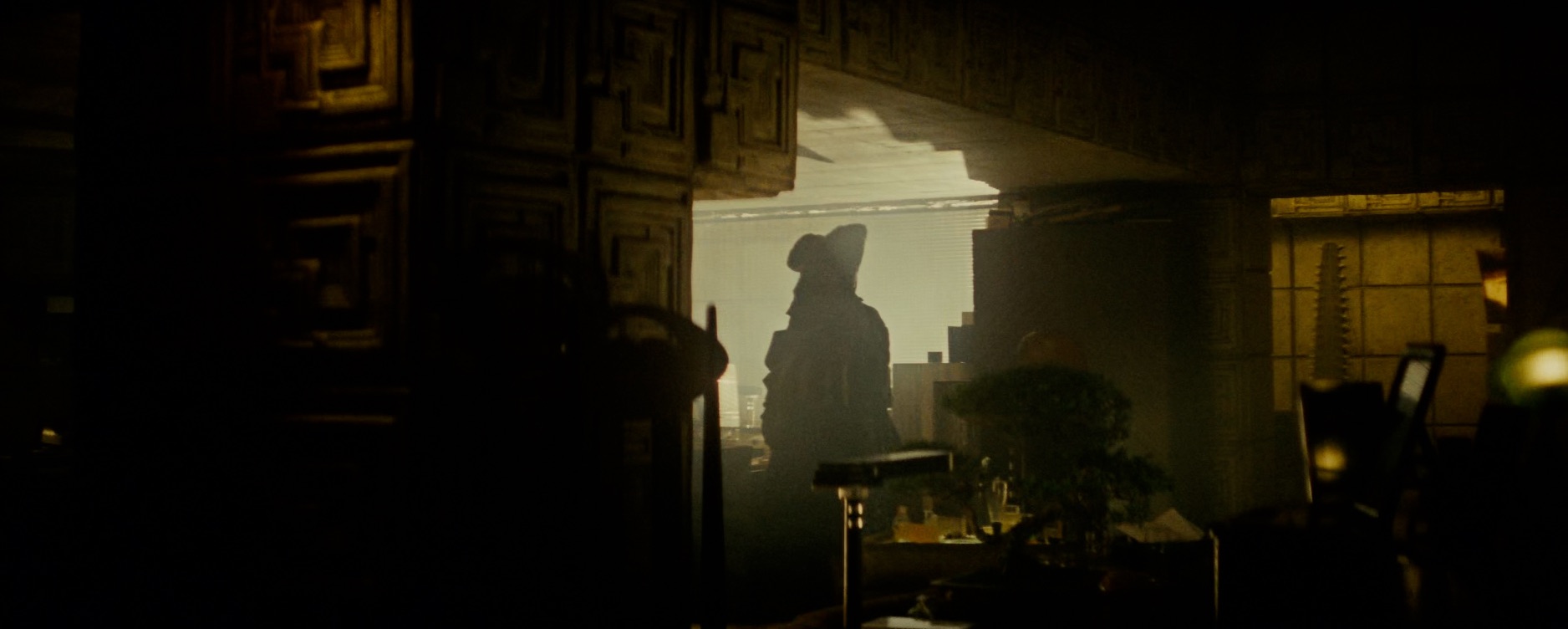
At first, this seemed like an inconsistency. Eventually, it became the central evidence. My fragmented way of watching had created an internal version of the film: an affective montage formed through repetition, memory and visual attraction. That discovery then connected with another question I had been developing elsewhere in theological and mathematical language: can knowledge be genuinely adequate without becoming exhaustive possession?
The connection was not present as a finished thesis at the beginning. It became possible only after the images had been allowed to lead.
Beginning with what actually attracted me
My first descriptions concerned the enormous, somber and rain-drenched architecture. The buildings appeared to rise through the clouds. Fires emerged from an industrial landscape, but I did not feel compelled to interpret the city as hell. It was simply the city: dark, inhabited and immensely beautiful.
I had been a photographer for many years, and the film’s visual language had influenced my own style. I was drawn to the analog texture, the high contrast, the uncertain boundaries between objects, the way smoke and rain held light in the air, and the courage to leave large portions of the frame difficult to read. The images seemed to contain more space than their dimensions should have permitted.
My relation to this film differed from my relation to Éric Rohmer’s A Tale of Winter. With Rohmer, I need to follow the dialogue, chronology and decisions. A missed sentence can alter my judgment about a relationship. Meaning develops through what people say, what they conceal, and what their later actions do to their earlier convictions. The film asks to be followed.
In Blade Runner, I first apprehend an entire field: height, darkness, rain, reflected light, architectural mass, a face, a distant voice and an electronic sound. Language arrives afterward. I originally described this by saying that content mattered less than image and music. That was directionally true but incomplete. The content had not disappeared. It had migrated from sequential explanation into the audiovisual environment.
A window could become content. A reflection could become content. A saxophone note decaying into electronic space could become content. The film did not always need to tell me what its city meant because it allowed me to inhabit the conditions under which meanings proliferated.
The AI proposed the term nonlinear inhabitation. I accepted it because it explained something that “incomplete viewing” could not. I do not always watch the film as a sequence moving toward narrative resolution. I revisit it as one revisits a city. I may enter a familiar street, remain near one building, listen to the atmosphere and depart without crossing the entire territory.
That explanation, however, raised a further question. If I was not primarily following the story, what exactly was I returning to? The screenshots I began supplying allowed the answer to develop gradually.
When factual knowledge made the city smaller
One of the first discoveries arose from regret. Before I saw the production models, the pyramid-like buildings appeared to soar indefinitely through the clouds. Once I saw the physical model, the immeasurable structure became visibly finite. I could immediately understand it as a small object manufactured for filming.
The factual knowledge was real. I had learned something about how the image was produced. Yet the imagined architecture contracted. This produced one of the earliest formulations that I strongly recognized:
Demystification can produce factual gain and imaginative loss simultaneously.
That formulation seemed convincing because it preserved both sides. Production history is valuable, and understanding craft can deepen admiration. The loss occurred because the new information answered a question my imagination had left productively open. Before seeing the model, the building possessed no final upper boundary within my experience. Afterward, the limitless city could be mentally translated back into a finite object.
A similar transition occurred around the gigantic advertisement of an East Asian woman placing something in her mouth. The action was visually simple but semantically obscure. It might have involved food, medicine, pleasure, appetite, bodily control or an unknown future commodity. The gesture became ritual-like because it repeated at an architectural scale above the city.
When a production explanation identified the object more specifically, the image became easier to understand and less expansive. Before the explanation, eating could mean many things. Afterward, one intended function threatened to replace the field of possibilities.
This did not lead me to reject factual explanation. It led to a more precise question: what happens when correct contextual information is mistaken for the complete meaning of an experienced image?
The distinction mattered because I was beginning to see that factual adequacy and imaginative inexhaustibility could coexist. A production fact may correctly explain what an object was designed to represent. It does not follow that the viewer’s entire encounter with the image has been exhausted. The factual answer settles one question while leaving others open.
The building as an inexhaustible container
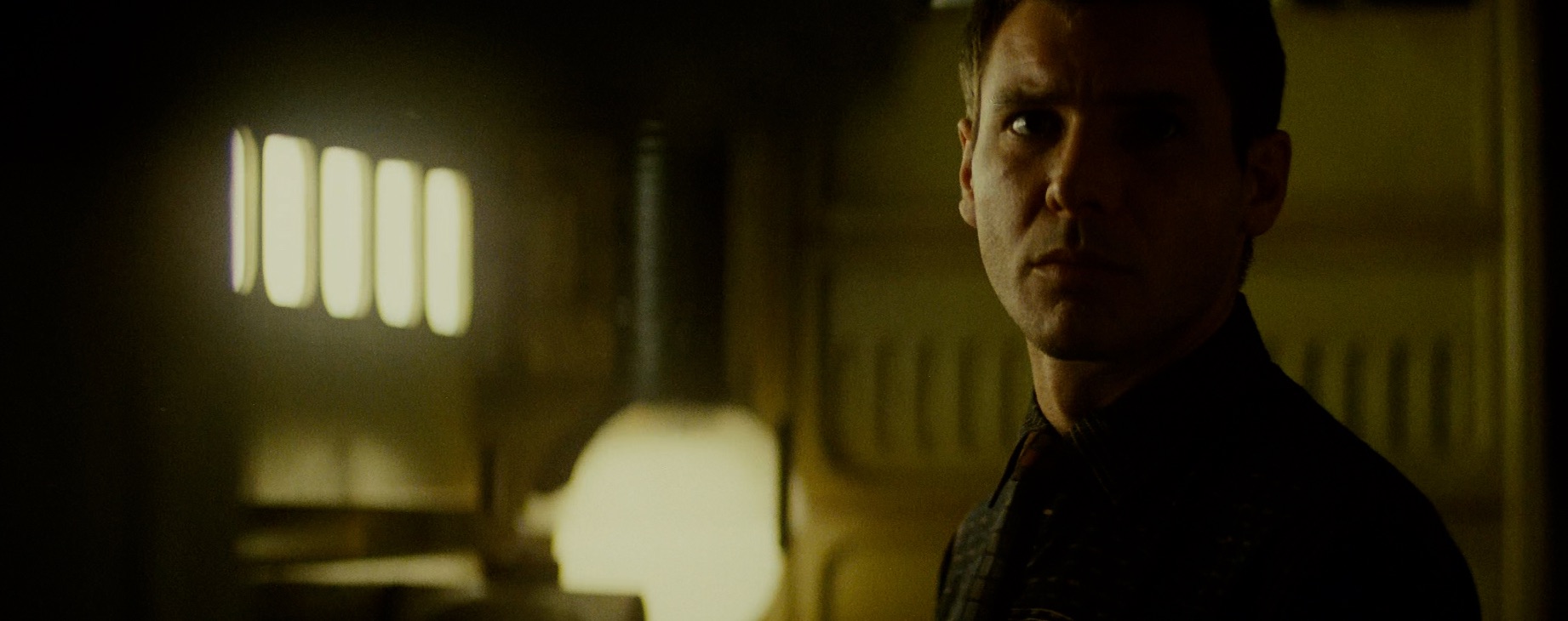
The screenshots of the city gradually moved the discussion away from individual objects and toward scale. One frame showed Deckard at the edge of an interior, looking outward and downward into an expanse of buildings and lights. Ground and roof were absent. The city seemed to continue below, above and beyond every visible boundary.
The AI initially offered practical questions that such a building might provoke: how long would the elevator journey take, whether the upper floors would rise above the rain, whether internal communities might develop, or whether someone could live there without reaching the ground. These possibilities were interesting, but they did not describe my actual experience. I corrected the direction. I did not want to design the building or solve its logistical problems. I wanted simply to look and allow my mind to move within it.
That objection changed the analysis. The building’s value did not arise from inviting detailed world-building. Filling every floor with an invented story could make the structure smaller, much as seeing the production model had made its exterior smaller. I wanted the inhabitants to exist without forcing them into fully imagined biographies.
I had looked at the illuminated windows and estimated that one building might contain tens of thousands of units. The calculation itself was not the point. It established that the lights were not decorative marks. Each suggested an interior. Each interior suggested a life.
This produced the concept of latent interiority: a visible surface implying an invisible internal world vastly larger than anything the film could display. The camera would never enter most of those rooms. Their inhabitants were not missing characters awaiting introduction. Their anonymity was part of the city’s magnitude.
The experience resembled the mathematical sublime. In Kant’s account, an immense magnitude overwhelms the imagination’s capacity to comprehend it as a unified sensible whole, even while reason can think beyond every finite measure (Ginsborg, 2022). The comparison initially seemed useful because I could recognize the repeated unit—the illuminated window—while remaining unable to synthesize all the units into one adequate image of the building.
Yet my response did not culminate in the recovery of intellectual mastery. I did not want reason to triumph over the city by placing it within a total concept. The absence of measurement was itself pleasurable. The building could extend for as long as the feeling required.
This led to the idea of an inhabited architectural sublime. Its magnitude did not depend solely upon physical scale. The exterior implied an interior larger than the film could show. The building was immense because it contained innumerable lives.
Then the relationship began moving in two directions. The little light was contained by a building, the building by the city, and the city by the universe. At the same time, the light contained a room, the room contained a person, and the person contained an interior world of memory, feeling and consciousness.
The AI formulated this as a double infinity:
There is an outward infinity of towers, darkness, atmosphere and space, and an inward infinity of memory, feeling and consciousness behind each window.
This was one of the moments that gave me goosebumps. I had not previously formulated the structure, yet I recognized it immediately. The description did not feel like a theory being placed over the image. It felt like language reaching something that had already been active in my perception.
Still, recognition is not proof that an interpretation is final. The formulation remained valuable because it organized several observations without cancelling their openness. The city appeared cosmic because its architecture dissolved into darkness until windows resembled stars and buildings resembled constellations. At the same time, every apparent star indicated a domestic interior.
The totality did not erase the individual. The individual did not reduce the totality to a collection of personal stories. The two scales intensified one another:
The building is immense because of the innumerable lives inside it; the small light matters because it participates in something immeasurably larger.
This was more humanistic than my original language of dark architecture had suggested. I did not desire a cold or empty infinity. I needed the enormous city and the tiny lights together. The result might be called an inhabited sublime, a compassionate sublime, or, more provisionally, hospitable inexhaustibility: a world too large to possess, yet warm enough to inhabit.
From darkness to contrast
Darkness initially appeared to be the obvious explanation for my attraction. I love dark tones, high contrast, dramatic illumination and rain. Other people may find these qualities frightening or gloomy, while I experience them as beautiful and spacious.
The first attempt to explain this became too general. The AI suggested reasons people might associate darkness with fear and then connected Prof. Yvonne Dohna’s reaction to the visual atmosphere. I corrected an important factual assumption: she had not seen the images. She had heard only the soundtrack and felt un po’ di paura.
That correction separated two questions that had been prematurely joined. The images and music could produce a particular world for me, while the music alone could affect another listener differently. Her response did not confirm an interpretation of the cinematography. It showed instead that the score retained emotional ambiguity outside my preferred audiovisual combination.
The discussion of visual darkness continued, but I eventually found the question itself too narrow. Darkness was never present alone. What attracted me was darkness appearing with bright light—the black with the white, the hidden with the suddenly illuminated. I therefore corrected the central term. The important quality was contrast.
This revision found historical and technical support in Jordan Cronenweth’s account of the film’s cinematography. Cronenweth described high contrast, backlight, smoke, rain, lightning and strong shafts of light as fundamental to the film’s visual personality. Smoke gave the light a material medium through which it could become visible in space. He also explained that the moving searchlights could signify surveillance and invasion of privacy (Lightman and Patterson, 1982).
The production evidence did not explain why I personally loved the images, but it changed the status of one part of the discussion. The contrast was deliberate rather than simply a technological limitation of the period. Analog film, optical processes and available lighting technologies contributed to the texture, but the filmmakers actively pursued visual extremes.
A small light makes the surrounding darkness perceptible as immensity. The darkness, in return, gives the light its intensity. Uniform black would disclose nothing; uniform brightness would leave nothing protected. Their relationship holds manifestation and reserve within the same image:
Light says that something is present. Darkness says that what is present exceeds what can presently be seen.
This became a chiaroscuro epistemology. Knowledge occurs through selective illumination surrounded by what remains undisclosed. A face can be seen genuinely without being seen completely. A room can become present without yielding its whole interior. One illuminated window can indicate a life without disclosing the person living there.
The conventional symbolism in which light equals truth and goodness while darkness equals ignorance or evil was inadequate. In Blade Runner, light can interrogate, expose and control. The Voight-Kampff apparatus scrutinizes the eye. Searchlights penetrate private interiors. Photographic enlargement extracts information from an image. Visibility can become coercive.
Darkness, conversely, can shelter interiority from compulsory legibility. This gave the discussion a possible ethical dimension. Édouard Glissant’s defence of a “right to opacity” offers a relevant conceptual resonance, although his argument belongs to a specific postcolonial and political history that should not be absorbed casually into film aesthetics. Glissant challenged demands that persons and cultures become completely transparent within an external system of comprehension (Glissant, 1997). My cinematic experience is not equivalent to the conditions he analysed. It nonetheless helped me formulate an analogous question:
Can I care about another presence without requiring it to become fully transparent to me?
This was a romantic insight, but it was also epistemically serious. Intimacy does not eliminate the other person’s inexhaustibility. I may know someone truly without knowing that person totally. Partial visibility can be sufficient for relation while remaining insufficient for possession.
The correction from darkness to contrast also clarified my dissatisfaction with images that appear too clean. A uniformly exposed and highly legible frame may contain more visible surface information, yet imply less beyond it. In the 1982 film, local reductions in visibility expand the global sense of a world:
Less explicit information can generate greater implied reality.
This is not a universal rule of photography. It describes how contrast functions in my experience of this film. The dark area is not perceived as an empty defect. It becomes a reservoir of possible distance, architecture and life.
Architecture, texture and the danger of explanation
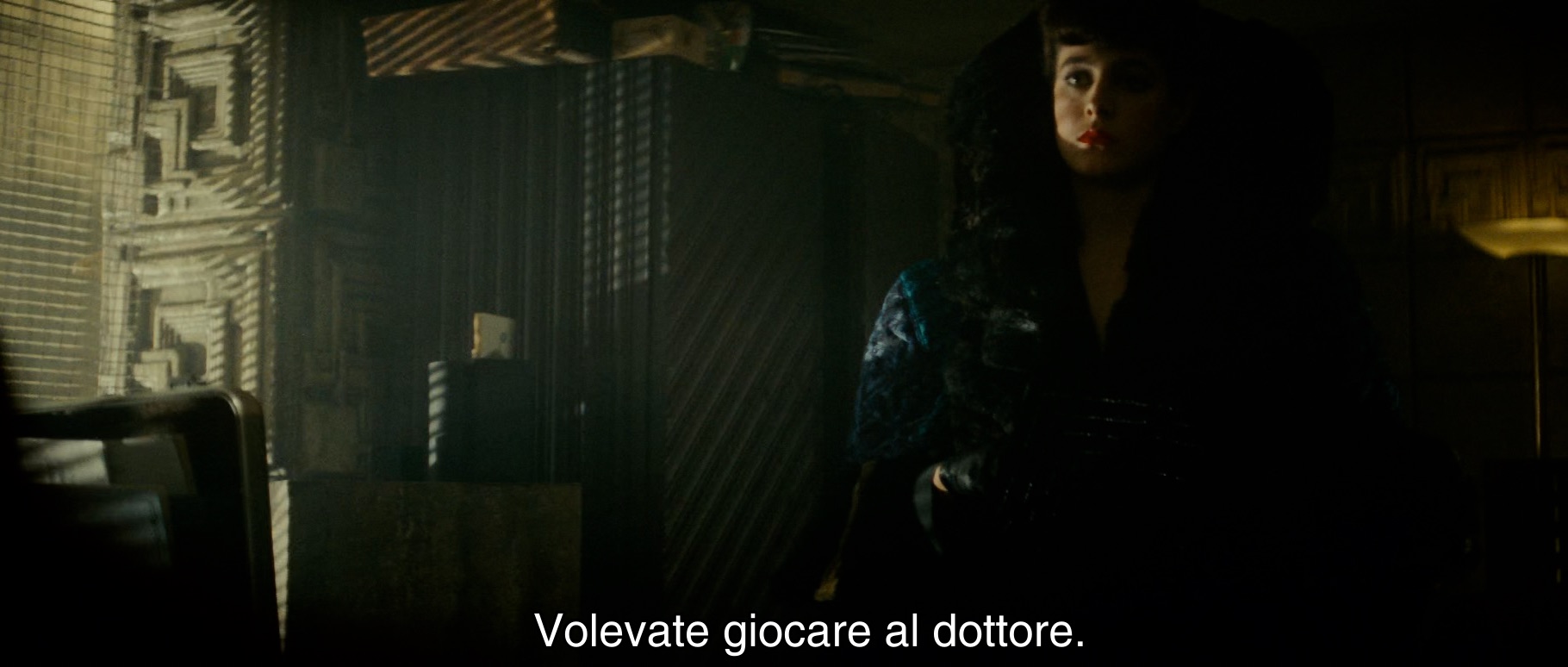
The interior associated with Deckard’s apartment gave the visual inquiry another material direction. I later learned of its relationship with Frank Lloyd Wright’s Ennis House and its Maya Revival textile blocks. The Frank Lloyd Wright Foundation describes the film’s apartment as a replica or cinematic reuse of this architectural language, allowing an apparently futuristic dwelling to carry an implied history (Anderson, 2020).
This factual information did not diminish the image in the way the production model had. It helped explain a texture I had already noticed: repetitive geometric blocks that feel ancient, modern, domestic and monumental simultaneously. The architecture has depth because it does not resemble a smooth surface invented exclusively for an imagined future. It seems to have survived from another time and acquired another life.
This difference between productive context and destructive demystification became important. Additional knowledge is not inherently narrowing. It narrows when it replaces the experienced object with a finite explanation. It can also enlarge the object by revealing further relations without claiming to settle them.
The question therefore shifted again. The problem was no longer whether one should seek factual explanations. It became a question of how explanation behaves:
Does explanation open further relations, or does it declare that the image has now been completely accounted for?
That question would later return when the discussion moved from architecture to persons.
Rachael, Deckard and Sebastian as sympathetic presences
The city’s architecture would not affect me in the same way if it contained only monumental forms. Deckard, Rachael and J. F. Sebastian all feel simpatici to me. I experience this initially through their faces and gestures rather than through a systematic moral evaluation.
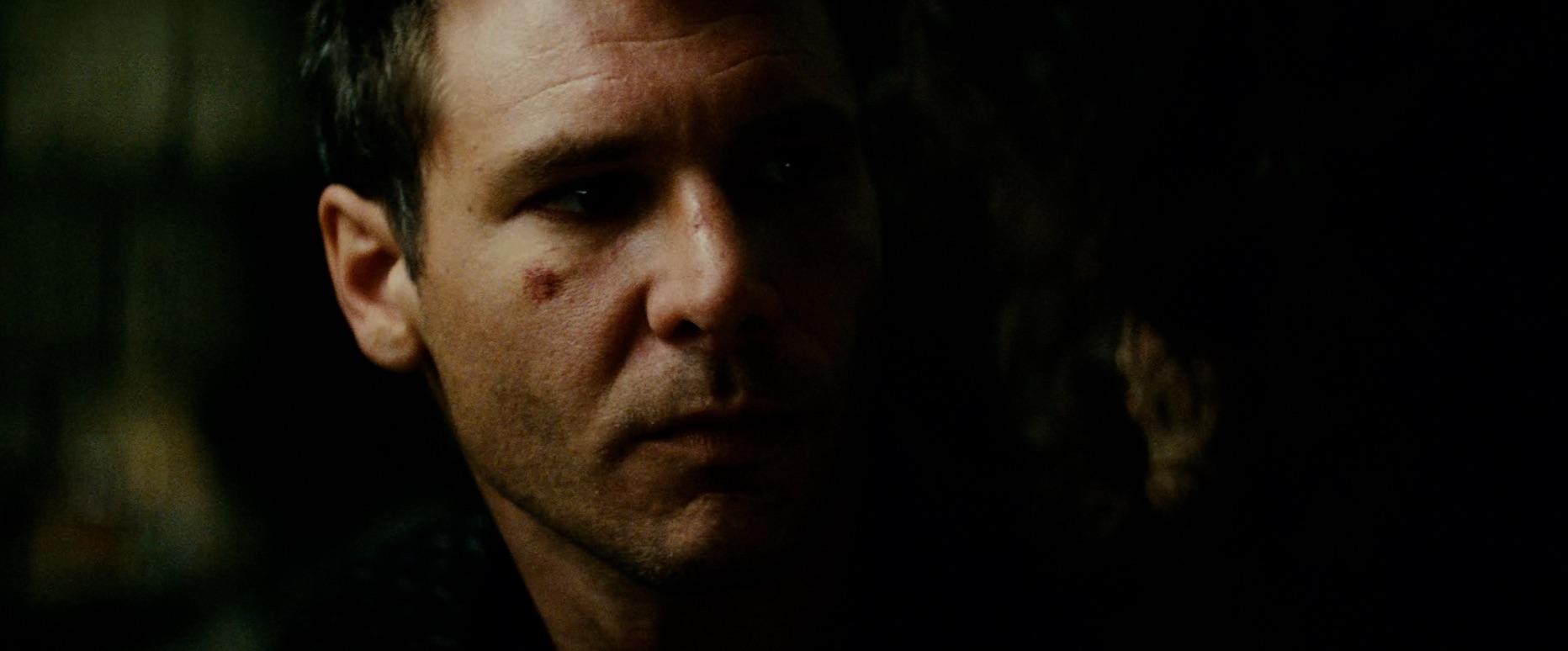
Deckard often appears tired and inwardly displaced. Rachael’s elegance contains uncertainty. Sebastian’s cautious eyes, compressed lips, worn clothes and hesitant movements suggest an unusually unguarded presence. I can imagine existing near such people without having to defend or prove myself continuously. Because genuinely sympathetic people do not always seem common in ordinary life, the film offers a form of companionship as well as visual grandeur.
My perception of Rachael produced an early clarification. The discussion emphasized the irony that a character suspected of being artificial receives some of the film’s most tactile and organic photography. I agreed with the visual observation but found the ontological question less important than expected. I did not care whether she was classified as artificial. I saw a real person within the film’s world.
The cinematography supports that perception. Rachael is not rendered as a clinically perfect synthetic object. Her face exists among grain, smoke, optical softness and unstable illumination. Yet my response did not originate from a theory of artificial personhood. It began from presence: she is there, she is beautiful and elegant, and I feel her vulnerability.
Another relation appeared when Cecilia watched one of these scenes during lunch because Rachael reminded her strongly of her mother. Cecilia became attached to the resemblance. At that moment, the film acquired a personal association that could not have been contained in the screenplay as an intention. Rachael’s face entered our shared memory.
Sebastian then produced one of the most important corrections in the whole discussion. I supplied screenshots of him and described the humble, friendly impression he gave me. I imagined that he might have been a good friend in real life. The AI interpreted his hospitality by comparing him with Tyrell, proposing two contrasting forms of knowledge and creation.
The comparison was intellectually coherent, and I initially found aspects of it interesting. Yet I soon objected to the direction itself. I did not want to compare them. I did not know enough about their relationship, and I did not want to judge Tyrell in order to appreciate Sebastian.
This was more than a preference about one character. It exposed a problem in the analytical method. The comparison had converted Sebastian into one side of an argument. His hospitality became evidence for a theory, and his meaning depended upon opposition to another person.
I wanted to remain with Sebastian’s presence without making him useful.
The correction changed the emerging philosophy of interpretation. Analysis can illuminate, but it can also appropriate. It may convert every beloved element into a symbol serving the interpreter’s conceptual system. In doing so, analysis risks repeating the same operation that reduced the imagined pyramid to a small model.
The stronger formulation was therefore simpler:
A person does not require an opposite in order to become meaningful.
Sebastian could remain Sebastian. Affection did not require comparative judgment. This was another form of non-exhaustive relation: I had encountered something genuine in his face, hesitations and hospitality without claiming to possess his complete meaning.
There remained a necessary caution. Feeling that someone is simpatico through facial expression is meaningful, but it does not provide total knowledge of character. Years of photography may have made me sensitive to posture, eye direction and small changes in expression. Nevertheless, a guarded face may belong to someone who is anxious, exhausted or culturally unfamiliar. Affective recognition is evidence of an encounter, not a final verdict about a person.
Why the music changes what the image is
Music had been present from the beginning of my experience, but I initially had less language for it. I could describe composition, contrast, architecture and photographic texture with some precision because I had worked as a photographer for years. Vangelis’s music felt equally important, perhaps indispensable, yet I could say little beyond calling it gorgeous, slow and atmospheric.
The first useful clarification was that the music did not simply instruct me to feel one emotion. It could be melancholy, majestic, lonely, tender and threatening at once. Prof. Dohna’s experience of slight fear confirmed this ambiguity, although, as I had corrected earlier, she heard the soundtrack without the images.
The next formulation proposed that the slow music gave time the same indefiniteness that darkness gave space. Harmonies hover; tones decay; melodies emerge and recede; the listener is carried forward without reaching a firm destination. I found this compelling, but then I introduced another correction: the atmosphere could not be explained by slowness alone.
I could feel the universe and outer space within the score, but also the human mind. The wild saxophone mattered. Electronic immensity and embodied feeling were present together.
This made the music structurally continuous with the images. Architecture opened an outward infinity. The illuminated windows opened an inward infinity. Music opened a third infinity through duration.
The score is electronic without becoming emotionally mechanical. Tones swell, bend and tremble. Reverberation gives sounds a spatial afterlife, allowing them to continue beyond their apparent source. Some elements feel close to the body; others seem to travel across enormous distances. The music has an acoustic foreground, middle distance and background.
Michel Chion’s concept of audio-vision helped clarify why separating soundtrack and image could be misleading. In cinematic perception, sound and image transform one another; they are not two finished channels whose meanings are merely added together (Chion, 2019). This gave theoretical support to something I had already expressed intuitively: without Vangelis, the scenes would lose much of their colour.
The colour is not literal. Music changes the emotional visibility of what is on screen. Darkness becomes melancholy rather than simple absence. Rain becomes tenderness and memory rather than meteorology. Distant lights become signs of longing. Architecture acquires a past.
Darkness acquires colour; architecture acquires memory; distance becomes longing.
This phrase affected me because it captured the way sound alters sight. Vangelis does not sit behind the city as accompaniment. The score participates in constructing what kind of city the viewer can perceive.
The synthesizers suggest technological and cosmic extension, while jazz and blues inflections introduce an older urban loneliness. The future sounds as though it already remembers something. It feels ancient before it has finished becoming new.
The wild saxophone that had remained in my memory was eventually identified more securely. It is almost certainly Dick Morrissey’s performance in “Love Theme”; the official album credits identify him as its saxophonist (Vangelis, 1994). The factual identification did not reduce the music as the production model had reduced the pyramid. It added a human performer to what I had already heard as a bodily voice.
The saxophone introduces breath, pressure, hesitation and desire into the electronic field. It resembles one illuminated window sounding within the universe:
The synthesizer opens outward into cosmic space; the saxophone opens inward into human consciousness.
The musical structure also returned me to the architecture. A conventional resolution can function like a visible roof, announcing that the movement has reached its destination. Vangelis frequently suspends that closure. Sounds seem to have existed before I began hearing them and to continue after they fade below audibility.
The music therefore became architecture without a roof. It offered direction without termination. I did not need to know where it was going in order to feel that I was travelling.
The sequel clarified what I loved by failing to preserve it
Blade Runner 2049 entered the discussion as a negative comparison. I had watched it only once, but I remembered finding its images too minimalist and too clear. They seemed to contain less information and less space for thought. Its presentation of an older Deckard also disturbed the character I had preserved from 1982.
The first explanation focused on the difference between analog and digital photography. That captured part of my response but risked becoming technologically deterministic. Digital cameras are capable of softness, atmospheric depth and ambiguity; analog film does not automatically produce them. The distinction needed revision.
The stronger explanation concerned an entire visual logic: production design, composition, palette, texture, optical softness, the distribution of objects within the frame and the relation between visibility and obscurity.
Roger Deakins described Blade Runner 2049 as a film developed largely on its own visual terms, with stark, minimal Brutalist architecture and unusually precise storyboarding (Bosley, 2017). This evidence did not prove my judgment that the sequel was less imaginatively fertile, but it confirmed that the difference I felt was not imaginary. The sequel deliberately pursued another aesthetic organization.
The AI introduced a useful distinction between optical haze and ontological haze. Blade Runner 2049 contains literal fog, mist, dust and atmospheric diffusion. I nevertheless felt that there was “no hazy atmosphere whatsoever.” Taken literally, my description could be disproved by individual frames. As an account of my experience, it referred to something else. Fog in the sequel often isolates and simplifies monumental forms. The 1982 film’s smoke, rain, grain, reflections, neon and accumulated architecture make the world feel internally entangled.
Thus an image can be meteorologically hazy while remaining conceptually clear. Conversely, a dark image can generate an immense field of implied information.
The older Deckard raised a parallel problem in time. The original film left his future aesthetically indefinite. I could retain him within the rain, architecture and light of 1982. The sequel specified what happened: this is how he aged, where he went and what time did to his face and character.
I did not want that knowledge. I even considered blocking present-day cast photographs in Emby through CSS or HTML because the interface automatically places the actors’ later faces beside the film. I wanted Deckard to remain Deckard rather than becoming one stage in Harrison Ford’s publicly documented biography.
At first, this seemed like a strong preference for immersion. Later, it appeared as another instance of demystification. The sequel did to time what the production model had done to space. A previously open continuation acquired a finite, canonical form.
Discovering that I had made an internal cut
The most surprising conceptual transition arrived when the AI described my repeated return to selected scenes as an “internal cut.” Until then, I had considered my viewing random and perhaps deficient. The new term suggested that repetition had created an organization of its own.
I initially reacted with surprise. Could a collection of scenes selected almost randomly count as a new creation?
The randomness became less simple once I examined it. Certain scenes repeatedly held me: the opening city, the endless buildings, the enormous advertisement, Deckard looking outward, Rachael entering dramatic light, Sebastian’s face, the rain, Vangelis’s music and Roy Batty’s final monologue. These fragments behaved like affective attractors. Each return strengthened their connections, while other scenes receded.
The resulting internal film was organized by emotional and visual gravity rather than by narrative chronology. It did not replace Ridley Scott’s film, and I had not created a new material or legal object. Yet the relations among its elements had changed. The source supplied the images and sounds; my memory, preferences and repeated encounters supplied another grammar.
Reader-response theory provided a useful context after the discovery had already emerged. Wolfgang Iser argued that the realized work develops through an interaction between the structured text and the reader’s activity, especially where gaps invite connection (Iser, 1978). Umberto Eco’s account of the “open work” similarly examined how artworks can sustain plural realizations without supporting every interpretation indiscriminately (Eco, 1989).
These theories prevent me from claiming historical novelty for the idea that reception can be creative. They also prevent the opposite mistake: assuming that my internal cut is arbitrary simply because it is personal. The fixed film constrains what can be selected, but selection, repetition and memory determine how those elements become related within experience.
The process resembles my work with photographic archives and generative art. An archive can function as a vocabulary; changing rules supply different grammars; each execution produces new relations among source images that remain materially unchanged. In my internal cut, the film is the archive, affective attention is the selection rule, memory is the changing state, and each viewing is another rendering.
I did not remake the images. I remade the space between them.
This formulation connected the film discussion with a wider question about creation and the transformation of the maker. Blade Runner influenced my photographic eye. That eye later determined which parts of the film I preserved. The selected fragments helped me articulate non-exhaustive knowledge. That emerging theory now changes how I see the film again.
The feedback loop can be represented provisionally as follows:
film → photographic seeing → selective return → internal cut → conceptual articulation → film seen anew
The film and viewer do not occupy fixed positions as active creator and passive recipient. The film changes the viewer; the changed viewer realizes another configuration of the film. I remain responsible for the judgments and exclusions involved, but I did not possess the final meaning in advance.
The internal cut also revealed a paradox related to the “tears in rain” monologue. The film’s most famous moment mourns the disappearance of experiences in time. My way of loving the film attempts to rescue certain moments from that disappearance. I replay them, protect them from later biographical images and allow Deckard, Rachael and Sebastian to remain within the light in which I first encountered them.
This may be a photographer’s response to impermanence. I cannot prevent the moment from passing, but I can frame it, revisit it and give it another duration.
Still, the internal cut contains a possible weakness. By returning mainly to the scenes that sustain my desired world, I may avoid material that complicates it morally or narratively. My version preserves possibilities through exclusion. Recognizing this does not require me to abandon nonlinear inhabitation, but it prevents me from treating the internal film as equivalent to the complete cinematic work.
The uncertainty remains productive: is an internal cut already a form of creation, or does it become an artwork only when externalized? Would fixing it as a literal edited sequence preserve its meaning, or would that operation destroy the variability that makes it alive?
When a theory of film became a theory of knowing
The connection with non-exhaustive knowledge appeared relatively late. I did not begin with a theological or mathematical thesis and search for cinematic examples. I had explicitly refused that method at the beginning. The connection became possible only after the city, windows, faces, darkness, light and music had developed their own conceptual relations.
The turning point was the recognition that the city was locally perceptible but globally inexhaustible. I genuinely saw a light, a façade and a person. The perception was neither false nor meaningless. Yet nothing I saw permitted me to claim possession of the whole.
Every window can be an adequate sign of a life, while no collection of windows exhausts the city.
This resembled the question I had been asking in more formal language: can a representation be adequate within a declared scope while remaining corrigible, extensible and structurally unable to convert local adequacy into exhaustive possession?
The film did not answer the mathematical question. Cinematic experience cannot establish a theorem. What it provided was an experiential structure showing why the problem mattered. The illuminated window demonstrated how disclosure and incompleteness could coexist without contradiction. Its partiality was not automatically a defect to be eliminated.
This made me reconsider the chronology of my own thought. Perhaps the theoretical project did not originate solely in recent abstract reasoning. Long before I formulated non-exhaustive knowledge explicitly, I had already been attracted to fragments, frames, shadow, selective focus and worlds continuing beyond the image.
My photography may have been practising an epistemology before I possessed the language to describe it.
This does not mean that every aesthetic preference secretly contains a rigorous theory. The connection remains interpretive and must be tested rather than celebrated automatically. Yet the recurrence across different domains is difficult to ignore. In photography, film, theology and formal reasoning, I repeatedly return to the possibility that something can become truly present without becoming completely captured by its representation.
What AI contributed and what changed through correction
AI materially participated in this inquiry, and concealing that participation would falsify the history of the thinking. At the same time, its fluency cannot be treated as evidence that the resulting interpretations are true.
The originating experiences were mine: the love of high-contrast cinematography, the disappointment upon seeing the models, the attraction to the mysterious advertisement, the imagined inhabitants, the random viewing, the affection for Rachael and Sebastian, the rejection of the older Deckard, and the sense that Vangelis opened another world.
The AI’s principal contribution was articulation. It proposed terms such as nonlinear inhabitation, vertical sublime, latent interiority, anonymous co-presence, ontological generosity, nested worlds, internal cut and eventually luminous incompletion. Some formulations generated an immediate sense of recognition, especially the outward and inward infinities.
However, the inquiry developed equally through my refusals. I corrected the assumption about Prof. Dohna and the images. I rejected practical world-building questions about elevators and internal streets because they moved away from my actual experience. I insisted that darkness alone was insufficient and introduced the importance of white, light and contrast. I clarified that literal fog in Blade Runner 2049 did not create the imaginative haze I experienced in the earlier film. I resisted the Tyrell–Sebastian comparison because it instrumentalized a character I wanted simply to appreciate. I repeatedly refused a theological framework when it arrived before the images had produced a genuine theological question.
Each correction changed what the AI could formulate next. The dialogue followed a recursive pattern:
experience → AI formulation → recognition or objection → additional evidence → revised distinction → new question
Human agency in this process consisted in more than supplying prompts or approving prose. I determined what counted as faithful to the experience. I introduced missing facts, rejected explanations that were plausible but misdirected, distinguished metaphor from literal description, and decided when an interpretation had begun to reduce its object.
At one point, I said that the AI seemed to have discovered my mind or subconscious. That emotional response mattered because it registered the force of recognition. Yet it required another epistemic correction. AI cannot inspect my subconscious as an object. Its advantage came from seeing recurring structures across many statements, while I experienced each statement locally from within.
The asymmetry can be expressed through the film’s own architecture:
The AI can observe something of the pattern of illuminated windows across the façade; I remain the person inhabiting the rooms.
Neither perspective is exhaustive. Distance can reveal repetition that is difficult to see from inside, while first-person experience contains meanings unavailable to external pattern recognition. The dialogue became trustworthy only insofar as both perspectives remained corrigible.
This created a recursive result. We were discussing representations that can be meaningful without becoming exhaustive, while the AI was constructing a meaningful but non-exhaustive representation of my developing thought. I could recognize myself within its language without surrendering the authority to correct it.
This inquiry did not begin with a theory of light. It began with a small, obscure gesture enlarged until it became architectural: the gigantic face of an East Asian woman above the city, placing something in her mouth. I could see the action clearly enough, but I did not know what it meant. She might have been eating food, swallowing medicine, advertising pleasure, participating in bodily regulation, or presenting some future commodity for which I lacked a category. I did not initially experience that uncertainty as a problem. The absence of explanation was part of the image’s attraction.
In my dialogue with AI, the gesture was described as ritual-like. Its repetition, remoteness and enormous scale made an ordinary bodily action resemble a ceremony performed above the city. AI also supplied a reported production explanation, attributed in secondary accounts to special-effects supervisor David Dryer, according to which the object was intended as birth-control medication. I found the information interesting. Yet my reaction was immediately qualified: yes, perhaps that was what the filmmakers intended, but the content seemed less important to me than the image and music.
That response became the first methodological turning point. I did not reject historical evidence, and I did not claim that the woman was “really” performing some other action. I resisted allowing one production explanation to close an image that had previously supported several possibilities. Before the explanation, the gesture could involve food, medicine, appetite, pleasure, bodily control or something still unknown. Afterward, it risked becoming simply “the birth-control advertisement.” Factual knowledge increased while imaginative range contracted.
Toward an aesthetic of luminous incompletion
The final phrase, an aesthetic of luminous incompletion, did not exist at the beginning. It emerged only after several earlier explanations proved too narrow.
“Darkness” was insufficient because light was equally necessary. “The sublime” was insufficient because I cared about the people inside the magnitude. “Atmosphere” was insufficient because Vangelis transformed the images through a specific temporal and acoustic structure. “Personal preference” was insufficient because the same relational pattern appeared in my photography and research. “Interpretation” was insufficient when it turned Sebastian into an instrument. “Random viewing” was insufficient once repetition had created an internal cut.
Luminous incompletion retains what survived those corrections:
Something becomes genuinely present, while the surrounding world remains open.
The light reveals without abolishing darkness. The face communicates without becoming transparent. The window indicates a life without exposing its interior. The building appears without yielding its final height. The music moves without arriving. The internal cut creates new relations without replacing the source. The AI articulates a pattern without possessing the person.
This is why the concept is aesthetic, epistemic and potentially ethical at once. It concerns how something appears, what can responsibly be claimed from that appearance, and how one can remain in relation with what exceeds one’s knowledge.
Several problems remain unresolved. Opacity can protect interiority, but it can also be invoked to avoid necessary communication or accountability. Selective viewing can preserve imaginative freedom, but it can also protect a beloved world from moral challenge. Externalizing the internal cut might make its creative structure visible, yet fixing it could reduce the openness that generated it. The analogy with non-exhaustive knowledge may prove philosophically productive, but it has not yet become a formal result.
I therefore end with a better question rather than a closed system:
How can something become genuinely present without being reduced to everything that can be said, calculated or represented about it?
I began with a favourite film I had never properly finished. I thought perhaps I cared more about cinematography and music than content. That explanation survived only after being transformed. My way of watching was itself producing content: a personal organization of fragments, atmospheres and relations.
The city became more than an image of height. It became an outward infinity containing innumerable inward infinities. Darkness became more than darkness; it became one term in a relation of contrast. Music became more than slowness; it became a temporal and emotional architecture. Sebastian became more than a symbol; he became the point at which interpretation learned to stop. Random selection became an internal cut. A film review became an inquiry into how perception, memory and knowledge can disclose without exhausting.
I still do not need to know where the buildings end. I need the rain, the small lights, the faces, the darkness surrounding them and the music continuing after it seems to have disappeared. Together they form a world too large to possess, yet intimate enough to inhabit.
References
Anderson, Darran. 2020. “A Step Ahead: Frank Lloyd Wright’s Infinite Relevance.” Frank Lloyd Wright Foundation, 24 January 2020. https://franklloydwright.org/a-step-ahead-frank-lloyd-wrights-infinite-relevance/.
Bosley, Rachael. 2017. “Uncanny Valley: Blade Runner 2049.” American Cinematographer, December 2017; online publication 6 March 2018. https://theasc.com/article/uncanny-valley-blade-runner-2049/.
Chion, Michel. 2019. Audio-Vision: Sound on Screen. Second edition. Edited and translated by Claudia Gorbman. New York: Columbia University Press. https://cup.columbia.edu/book/audio-vision-sound-on-screen/9780231185899/.
Eco, Umberto. 1989. The Open Work. Translated by Anna Cancogni. Cambridge, MA: Harvard University Press. Originally published as Opera aperta in 1962. https://www.hup.harvard.edu/books/9780674639768.
Ginsborg, Hannah. 2022. “Kant’s Aesthetics and Teleology.” In The Stanford Encyclopedia of Philosophy, Fall 2022 edition, edited by Edward N. Zalta and Uri Nodelman. https://plato.stanford.edu/archives/fall2022/entries/kant-aesthetics/.
Glissant, Édouard. 1997. Poetics of Relation. Translated by Betsy Wing. Ann Arbor: University of Michigan Press. https://doi.org/10.3998/mpub.10257.
Iser, Wolfgang. 1978. The Act of Reading: A Theory of Aesthetic Response. Baltimore: Johns Hopkins University Press.
Lightman, Herb A., and Richard Patterson. 1982. “Blade Runner: Cronenweth’s Photography.” American Cinematographer, July 1982; republished online 14 August 2020. https://theasc.com/article/blade-runner-cronenweths-photography/.
Vangelis. 1994. Blade Runner. Original motion-picture soundtrack. EastWest/Atlantic. Album credits and recording information archived at Vangelis Online. https://vangelis.online/music/1990s/bladerunneralbum.
Appendix I: The Liturgy of Passing Light: Chiaroscuro in Time
I thought at first that this single advertisement might support an appendix about the liturgical character of architecture in Blade Runner. That proposal remained plausible only briefly. I then objected to the narrowness of the question. The possible liturgy was not confined to the repeated woman above the city. It was also present in the contrast of illumination and darkness when Deckard first meets Rachael, in the bands of light crossing bodies inside his apartment, in the faint exterior beam that appears and disappears during their encounter, and in the visible haze behind Deckard.
The object of inquiry changed. I had begun by asking whether one enlarged gesture resembled ritual. I ended up asking whether light itself performs something throughout the film.
The light arrives, passes through the room, touches a face, withdraws, and leaves darkness altered.
This appendix reconstructs how that question became possible. The development was recursive. I supplied an image and a felt response; AI proposed a term; I accepted part of it, rejected another part, and introduced further screenshots. Those images then challenged the proposed interpretation. The conceptual vocabulary changed again. The result was neither an interpretation I possessed secretly from the beginning nor an explanation delivered by AI as an authority. It emerged through repeated correction between visual evidence, personal response, technical information and language that was sometimes helpful precisely because it proved insufficient.
The image I did not want completely explained
The advertisement’s obscurity mattered because eating is both elementary and semantically abundant. It can signify nourishment, medication, indulgence, discipline, communion, desire, survival or incorporation. The image does not provide enough information to decide among these possibilities. A face many floors high performs the intimate movement of putting something into the body, while remaining inaccessible to everyone below.
AI’s description of the gesture as ritual-like gave me a useful beginning. Repetition can detach an action from ordinary time. Architectural scale can detach it from an ordinary body. The gesture ceases to belong only to one woman and begins to organize the visual field around it.
Yet there was a danger in calling it liturgical too quickly. The word might become an interpretive shortcut: a repeated gesture resembles ritual, therefore the advertisement possesses a theological meaning. I did not want to impose a fixed religious code upon an image whose value partly depended upon indeterminacy. I also did not want to turn every solemn visual arrangement into an undeclared Christian symbol.
I therefore use liturgical in this appendix as a controlled analogy. Christian liturgy cannot be reduced to repetition, light, atmosphere and architectural movement. A searchlight is not a sacrament, an advertisement is not worship, and visual beauty does not establish divine presence. The analogy concerns an ordering of bodies, gestures, attention, space and time. It becomes useful only when it describes what the film formally does, rather than supplying a theology that the image has not earned.
The reported explanation of the advertisement sharpened another distinction. At the time of the conversation, the explanation came to me through AI rather than through a primary source I had examined myself. Later research confirmed that the claim is repeatedly attributed to Dryer, but I did not find it in the 1982 American Cinematographer article by Dryer that I consulted. I therefore treat “birth control” as an attributed production account, not as evidence that should govern the whole interpretation.
More importantly, even a fully documented intention would answer only one question: what was the depicted object supposed to be? It would not explain why the gesture feels ritualized, why the woman’s face becomes larger than architecture, or why semantic incompleteness contributes to the city’s mystery.
The first question therefore remained unresolved in a productive way. I could acknowledge a likely intended referent without granting that referent exhaustive interpretive authority.
The question became larger than the advertisement
The decisive correction came from returning to Rachael and Deckard. I remembered the light entering from outside, crossing the apartment and then fading. I also remembered the encounter with Rachael in the monumental Tyrell interior, where columns, reflective floors, human figures and dark recesses coexist without becoming equally legible.
The advertisement involved a repeated image placed upon architecture. The Rachael sequences showed illumination acting upon architecture and bodies in real time. If I continued to concentrate on the billboard, I would miss the film’s more pervasive temporal structure.
At this stage, AI proposed a formulation that I found useful: the light “arrives, reveals, touches and departs.” I accepted it because it described a movement I had already noticed but had not yet named. The formulation also created another question. If arrival and withdrawal are essential, can a static screenshot represent what attracts me?
My answer was no—or at least, not sufficiently.
The screenshots were beautiful. They allowed me to inspect the distribution of black, amber, green and white; the modelling of Rachael’s face; Deckard’s silhouette; the texture of skin; the horizontal bands produced by blinds; and the bloom surrounding bright sources. Yet each still converted a temporal event into a stable composition. It encouraged comparison with painting while concealing the passage that joined one state of visibility to another.
I had begun with an interpretation of a repeated gesture. I now needed an interpretation of changing illumination.
Darkness was not the whole answer
An early explanation concentrated upon my attraction to darkness. That seemed plausible because enormous portions of Blade Runner remain unreadable. Faces recede, rooms lose their boundaries, and buildings merge with the night until windows resemble stars.
But I corrected that description. Darkness alone was not what I loved. The contrast was essential: dark together with white or coloured light. Darkness acquired significance through the illuminated region, while the illuminated region gained intensity from the surrounding black.
This correction changed the title as well as the argument. “Darkness acquires colour” is meaningful only because the acquisition happens under particular conditions. The word when matters. Darkness does not possess this colour constantly. A beam passes through it, and olive, amber, blue-green, brown or muted gold becomes perceptible. When the source withdraws, those colours recede.
The dark regions of the film are therefore neither neutral absence nor a permanent symbol of evil. They contain latent texture. Light activates that texture temporarily. Illumination is likewise changed by what it encounters: smoke gives it a body, rain breaks it into reflections, skin warms it, and architectural surfaces colour its return.
The relation is reciprocal:
Darkness allows the beam to become visible; the beam allows darkness to disclose its colours.
This helped me understand why high contrast can increase mystery instead of eliminating it. A high-contrast image may be visually decisive while remaining informationally incomplete. I see a brilliant band crossing a face and know strongly that someone is present, yet most of that person remains unavailable.
The structure might be described as certainty of presence without completeness of description. This phrase was not where the inquiry began. It became thinkable only after I rejected “a love of darkness” as too simple and insisted upon the relation between dark and light.
Rembrandt seemed right until the stills proved insufficient
I next asked whether the lighting should be called Rembrandt-like or chiaroscuro. Rembrandt seemed plausible because Rachael’s face often emerges from darkness with sculptural gravity. One side may be softly illuminated while another recedes, and the surrounding field can become so dark that the face appears almost detached from ordinary space.
AI distinguished the terms. Rembrandt lighting, in contemporary portrait photography, usually refers to a comparatively specific arrangement in which a light above and to one side produces a small triangular illumination beneath the eye on the shadowed side. Some frames in Blade Runner resemble this pattern, but many do not. They use split lighting, underlighting, hard backlight, projected bands, silhouette or the more extensive darkness associated with tenebrism.
Chiaroscuro was the more adequate general category. Historical evidence supported that correction. Jordan Cronenweth explained that Ridley Scott looked to Citizen Kane for high contrast, unusual angles and strong shafts of illumination. Cronenweth identified contrast, backlighting, smoke, rain and lightning as central components of the film’s visual character (Lightman and Patterson, 1982/2020).
I provisionally accepted the distinction: occasional Rembrandtesque faces within a broader noir chiaroscuro. Then the screenshots created a further objection. Calling the lighting Rembrandt-like or chiaroscurist still treated it primarily as a static arrangement. It compared cinema with painting without adequately accounting for duration.
I explicitly remarked that “perhaps the static screenshot cannot represent the dynamic.” I then pointed to the light shining from outside behind Deckard. A luminous haze fills the region around him; the bright source produces halo-like diffusion; Deckard’s body remains dark while the atmosphere becomes visible.
This observation altered the method. Instead of analysing only where illumination fell within one frame, I began comparing successive captures. The relevant object was no longer a single composition. It was the transition among several compositions.
The result was chiaroscuro in time.
What I first called the Tyndall effect
I initially described the visible beam behind Deckard as including a halo and the Tyndall effect. That description was perceptually accurate enough to direct attention toward the phenomenon, but technically it required refinement.
In cinematographic language, volumetric illumination through haze is the safer expression. The beam becomes visible because suspended particles scatter light toward the camera; depending upon particle size, the physical process may be closer to Mie scattering than to the narrowly defined Tyndall effect. The halo-like region may combine atmospheric scattering, lens diffusion, veiling flare, optical filters and film halation. A digital screenshot of the finished transfer cannot reliably separate their individual contributions.
The correction did not invalidate what I saw. It distinguished the visible effect from its precise physical causes. My observation came first: the light had acquired a body. Technical vocabulary then made the observation more discriminating.
Cronenweth’s production account confirms that the visible shaft was deliberate. Smoke supplied the necessary medium; soft frontal illumination was often combined with harder backlight; low-contrast filters preserved a related texture when the smoke was less dense. He regarded shafts of light as a recurring photographic theme rather than as an incidental effect (Lightman and Patterson, 1982/2020).
What changed philosophically was more important than the terminological correction. In the backlit image, illumination does not disclose Deckard completely. It reveals the atmosphere surrounding him. I can see where his body interrupts the beam, but I cannot see everything within that boundary.
The relation between source, medium and person becomes more visible than the person’s face.
This suggested a form of presence that does not depend upon total exposure. Deckard is unmistakably there, but much of him remains withheld. The light gives darkness a contour rather than abolishing it.
The screenshots became evidence of their own insufficiency
I continued supplying screenshots. Each new group changed the interpretation rather than merely illustrating a conclusion already reached.
One sequence showed Deckard and Rachael in alternating degrees of illumination. Deckard’s face could be warm and partially visible, then crossed by bands, then reduced to an outline against a luminous background. Rachael could appear as a face suspended in blackness, as a body bearing projected architectural lines, or as a tactile presence whose eyes and lips carried small concentrations of reflected light.
Placed in succession, the images revealed a recurrent movement:
darkness → arrival → partial manifestation → passage → withdrawal
A permanently divided portrait might invite a fixed interpretation: light equals truth, darkness equals falsehood; one half is human, the other artificial; one region is good, the other dangerous. The moving beam makes that symbolic code unstable. The boundary travels. What is visible now may become invisible several seconds later. Neither illumination nor concealment belongs permanently to the character.
This led to the idea of intra-shot montage. Montage ordinarily controls attention through cuts between images. In these scenes, light performs an analogous selection within a continuous shot. It enters, chooses a region, produces a temporary image and moves away. The physical room remains, but the architecture of visibility is repeatedly rebuilt.
I would not have arrived at this concept by studying one “perfect” still. The screenshots became useful precisely because they failed individually. Their sequence disclosed the movement that each one froze.
The inquiry therefore developed through a feedback loop:
felt attraction → screenshot → proposed explanation → objection → further screenshots → revised concept
The process was collaborative, but the roles were distinct. AI supplied terminology such as “processional chiaroscuro” and “intra-shot montage.” I decided whether those terms corresponded to the images. I also introduced the counterevidence that forced the interpretation to change: the moving beam, the atmospheric halo, the corridor after the figures departed, and the repeated difference between a still frame and the scene in motion.
Light becomes an internal editor
The relation to photography became clearer through the word exposure. Photographically, exposure describes the duration and quantity of light admitted to a sensitive surface. Existentially, exposure means becoming vulnerable to a gaze or force.
In Deckard’s apartment, the moving bands perform both actions. They photograph him inside the film. His eye, bruised cheek, mouth or forehead becomes visible for a moment, while the remaining face recedes. The blinds resemble bars, but they also resemble the regulating mechanisms through which photography admits and limits illumination.
The beam edits without cutting:
it enters the frame, selects a face or surface, produces an image, and erases its selection by moving on.
This made the liturgical analogy more precise. A static luminous symbol may resemble religious art. A moving illumination performs a sequence. It arrives, interrupts, exposes, passes and withdraws. Its significance lies partly in duration and recurrence.
The sequence does not culminate in complete revelation. Light repeatedly offers partial access and then removes it. What matters is not a final state of total visibility, but a rhythm in which presence and concealment coexist.
The city looks back through the window
External evidence then complicated the apparent tenderness of the light. Cronenweth explained that the moving shafts were justified within the fictional world as powerful Xenon searchlights associated with airships. They served advertising and crime control, resembling the searchlights used to monitor a prison. He described them as an “invasion of privacy by a supervising force” (Lightman and Patterson, 1982/2020).
This evidence did not cancel the beauty of the beam. It introduced a tension that a purely aesthetic reading could miss. The same light that gives the apartment its mysterious atmosphere is also a mechanism of surveillance. It can enter the private room without permission, cross a person’s body and disappear before its source becomes visible.
The window therefore changed function during the inquiry. Earlier, I had concentrated upon Deckard looking outward from one hidden interior toward thousands of other hidden interiors. I imagined people behind distant windows whose lives would never enter the plot. Deckard’s room was one centre of perception looking toward innumerable unknown centres.
The searchlight reverses the direction:
Deckard looks into the city, and the city looks back into Deckard’s room.
The window is a membrane rather than a passive frame. Human sight travels outward through it; surveillance, advertising, colour and atmospheric disturbance travel inward. The apartment exists inside the city, and the city enters the apartment as moving illumination.
AI proposed that the beam might be understood as a third participant in the encounter between Deckard and Rachael. I accepted this formulation because the light does not belong fully to either character. It comes from elsewhere, touches them unequally and continually changes what each can see of the other.
Sometimes it reveals one face while leaving the other almost absent. Sometimes it crosses both bodies. Sometimes the haze between them becomes more visible than either person. The beam establishes a relation without delivering complete portraits.
This supported another formulation that emerged gradually through the dialogue:
A person can become genuinely present without becoming completely transparent.
A technological theophany that may also be surveillance
Because the beam arrives from beyond the room, becomes embodied in haze and surrounds a dark human outline, it recalls the visual grammar of an aureole or theophany. Yet calling it divine light would resolve the contradiction too quickly. Its fictional source is technological; its documented function includes supervision and control.
I provisionally use the phrase technological theophany to preserve that contradiction. The term does not identify technology with God. It describes a technological power adopting a mode of appearance historically associated with sacred presence.
The interpretation remains interrogative. Does the light reveal or inspect? Does it bless, scan or expose? Does it permit encounter, or does it invade the privacy required for encounter? Can a coercive instrument create genuine beauty without ceasing to be coercive?
The production evidence made these questions unavoidable. Before reading Cronenweth’s explanation, I could have romanticized the beam as a visitation. Afterward, surveillance entered the image. Yet surveillance did not exhaust it either. The visible effect still carries tenderness, fear, intimacy and wonder.
This is one reason I resist assigning a single theological meaning to the sequence. A theological reading should preserve the light’s ambiguity instead of baptizing it. Revelation here is neither comfortable nor complete. It interrupts, exposes and withdraws.
The same caution applies to the physical encounter between Deckard and Rachael. Cinematographic tenderness does not decide the ethical meaning of every action. The scene’s lighting can create shared vulnerability while questions of pressure and power remain. Aesthetic beauty should not be used to settle an ethical dispute that belongs to another level of analysis.
What the image does show is that proximity fails to produce total visibility. As the figures approach one another, their faces overlap and block the available light. Physical closeness can make the image less complete.
Intimacy increases, but transparency does not.
Rachael was already real to me
At one point, AI proposed an interpretation based upon Rachael’s artificial status: she is suspected of being manufactured, yet the film gives her organic and tactile photography. I accepted the observation about texture but corrected the implied starting point. I did not first experience Rachael as an artificial being who later acquired humanity. I simply saw a real person: beautiful, elegant, emotionally present and capable of affection.
This correction matters because it prevents the cinematography from being treated as a machine that manufactures humanity for an otherwise unreal figure. The light reveals a presence I already recognize; it does not create that presence from nothing.
Cronenweth’s technical account supports the visual observation without dictating its philosophical meaning. He described Sean Young’s reflective skin and raised hairstyle as allowing separate illumination of her face, hair, neck, hand and cigarette smoke. In his favourite Voight-Kampff close-up, the key was arranged to strike selected surfaces rather than reveal the whole figure (Lightman and Patterson, 1982/2020).
The selectivity corresponds to what I saw. Rachael is photographed through partial manifestation. Her dark hair can merge with the surrounding blackness while eyes, lips and skin emerge gradually. Analogue grain, soft frontal illumination, harder edge light and atmospheric diffusion keep her face tactile rather than clinically perfect.
In another frame, horizontal illumination crosses her white clothing while her face remains comparatively shadowed. Her body becomes a temporary screen upon which the architecture writes itself. The city’s geometry appears upon her without making her interior life available.
When her hair later becomes loose and irregular, the image grows more organic and intimate. I hesitate to call this a transition from artificiality to humanity. It is closer to a transition from controlled presentation toward tactile proximity. She was already real to me; the changing photography allows that reality to appear differently.
The corridor continued after the people left
A further set of screenshots introduced Sebastian’s building. Two figures move through a long corridor structured by columns, balustrades, blue haze and wet reflections. The repeated architectural elements create rhythm, while the bodies pass through alternating zones of darkness and illumination.
AI proposed the phrase processional architecture. Here the liturgical analogy became spatial. The corridor resembles an aisle or ambulatory, although I do not need to claim that it symbolizes a church. Its form becomes intelligible through bodily passage. The figures enter, proceed and disappear.
The next screenshot changed the interpretation again: the corridor remained after the people had left.
The empty frame did not feel empty. Reflections, moisture and luminous atmosphere persisted. The space seemed to preserve an afterimage of the vanished bodies. I began to think of the sequence as:
presence → passage → disappearance → atmospheric remainder
The significance of the scene did not reside solely in character or dialogue. Light and architecture continued the event after the actors had departed. This helped explain my unusual way of watching Blade Runner. I can enter the film at a random moment, listen to Vangelis and remain absorbed without reconstructing the whole narrative. When characters stop speaking, the world does not stop thinking. Architecture, rain, haze, reflection and music continue.
This recognition also corrected the original proposal about liturgy. The liturgical quality was no longer located only in a repeated human gesture. It could inhabit an interval, a departure, or the illuminated space that remains after a procession has ended.
“I feel that millions of people live here”
The inquiry then moved from passing light to the lights embedded within enormous façades. Looking closely at the Tyrell pyramid and related megastructures, I said that I felt millions of people were living there.
The word millions did not arise from calculation. I did not count rows of windows and multiply them by an assumed number of occupants. I saw repeated illuminated units, and my imagination converted them into possible rooms. The rooms suggested people. Repetition carried those implied lives beyond anything I could synthesize as a single population.
AI proposed the phrase demographic sublime. The term helped articulate my experience, but the experience itself came first. I had already populated the building before possessing a conceptual category for that act.
The resemblance to Kant’s mathematical sublime is limited but useful. Kant associates sublimity with the imagination’s inadequacy before magnitude, while insisting that sublimity properly belongs to the mind rather than residing straightforwardly in the perceived object. His own account raises questions about the application of the sublime to art, and later interpreters disagree about that extension (Ginsborg, 2022).
My response to the building also differs from a desire to measure it. I did not need a final height. The pleasure came from allowing the structure to continue beyond practical estimation. “Millions” named a threshold at which number became atmosphere.
The visual-effects record provides important factual context. Model maker Mark Stetson described the Tyrell pyramid as a clear shell covered by intricate panels designed to resemble thousands of illuminated windows. Raised areas were scraped to reveal internal light, and cooler fluorescent sources in the buttresses became part of the building’s appearance (Failes, 2017).
This confirms that the façade was deliberately constructed to imply innumerable lit apertures. It does not prove that every mark represents an apartment or that millions literally inhabit the Tyrell building. Some lights may suggest offices, service spaces, machinery or architectural illumination. I therefore distinguish the literal claim from the aesthetic experience.
The image nevertheless encourages an inference of activity. Each light is less than a portrait but more than decoration. The dark apertures also become potentially inhabited: someone may be asleep, absent or living without a visible lamp. A limited field of evidence generates a much larger invisible population.
The building becomes a census without names.
The film follows one moving light and I see all the others
A tiny vehicle crossing the immense façade supplies a scale reference. It is large enough to contain people, yet it appears almost negligible against the repeated architectural bays. The plot may ask me to follow that moving vehicle, but my attention returns to the stationary lights around it.
AI formulated the contrast in a way that gave me a strong sense of recognition:
The film follows one moving light through the city; you keep seeing all the other lights.
I accepted this because it describes my relation to narrative itself. I care deeply about Deckard, Rachael and Sebastian. Their faces feel simpatico to me. Their vulnerability, humility and reserve make them emotionally inhabitable. But their importance does not require the unseen residents to become irrelevant.
From outside, another person’s room contracts into one point of illumination. From inside, the same room contains an immediate world. The life within it has not become smaller; only its representation has changed scale.
The city is therefore pluricentric. The camera privileges one protagonist, while the architecture resists the suggestion that only the protagonist possesses interiority. Millions of people can be present without appearing as a crowd. They exist as distributed and inaccessible centres.
This creates an unusual form of companionship. The city is too inhabited for metaphysical solitude, yet its inhabitants remain too inaccessible to eliminate loneliness. I do not know what lies in their minds, but I do not therefore treat them as empty.
At this stage, the earlier discussion of light and the later discussion of population converged. Outwardly, one light belongs to a façade, the façade to a building, the building to a city, and the city to an atmosphere resembling outer space. Inwardly, the light suggests a room, the room a person, and the person an interior world potentially as inexhaustible as the city.
There is an outward infinity of architecture, atmosphere and space, and an inward infinity of memory, feeling and consciousness.
The façade stands between them.
The model returned and broke the spell
The inquiry might have ended there with a polished theory of nested worlds and demographic sublimity. It did not. An earlier disturbance returned with greater force.
I had seen production photographs of the Tyrell pyramid. The structure that had appeared to rise through clouds and contain an incalculable population became a workshop-scale object that people could stand beside, illuminate and manipulate. Once I remembered the model, the sublime disappeared.
I did not experience this as a neutral correction. It was frustrating and sad.
Before seeing the production object, each luminous point could develop through an imaginative sequence:
light → room → person → interior world
Afterward, the sequence reversed:
light → scraped aperture → plastic component → studio lamp → model
AI proposed the term scale collapse. It accurately described the perceptual event: knowledge of the production level displaced the cinematic level. The building no longer appeared as an inexhaustible container. It became a finite object whose dimensions could be mentally surrounded.
The production research confirmed the miniature work while also making the causal history more complex. The effects team combined constructed models, motion-control photography, optical compositing and 65mm film. Smoke produced aerial perspective by softening colour and resolution with apparent distance. Interactive lighting allowed separate elements to respond coherently to explosions, searchlights and moving vehicles. Some finished shots combined dozens of elements and several generations of optical work (Dryer, 1982/2020).
The finished city was therefore never equivalent to one object photographed once. It emerged from models, lenses, programmed motion, separate lighting passes, smoke, matte work, optical printing and projection. Mark Stetson’s account similarly describes a visual-effects ecology involving forced perspective, fibre optics, internal lamps, model vehicles and heavily smoked stages (Failes, 2017).
This evidence produced a “yes, but” of its own. Yes, the building was generated through material fabrication at reduced scale. But identifying those causes does not automatically explain the cinematic world they produced.
Even so, the distinction did not restore my feeling. This is where the first draft of the argument risked becoming too reassuring. It was tempting to say that the model was merely one component and that the sublime therefore remained philosophically intact. Intellectually, that may be defensible. Emotionally, the model had already contracted the city.
I could distinguish levels of description and still feel the loss.
What the factual explanation can and cannot do
The disappointment connected unexpectedly with my work on non-exhaustive knowledge. “The building was produced through miniatures” is a true causal explanation. It answers how particular visual material was created. The problem begins when that explanation expands beyond its scope and claims to determine everything the image can be.
At least three levels must be distinguished. There was a physical model within a production environment. There was a photographed and composited structure created through optics, illumination, atmosphere and motion. There was also the megastructure encountered within the experienced world of the film.
These levels are causally related, but they are not interchangeable.
As a photographer, I already know a related distinction. A 35mm negative may be only 36 millimetres wide, but the mountain represented through it does not become 36 millimetres wide. Material support and represented space operate at different scales. Blade Runner is more complicated because the photographed referent was itself fabricated at reduced scale. Yet the finished cinematic building still cannot be identified exhaustively with the workshop object.
The model functioned as a world-producing instrument. Its artistic purpose was to exceed its physical dimensions.
The mistake would be:
Because I know how the image was made, I now know everything the image is.
That conclusion does not follow. Production knowledge explains the construction of visible marks. It does not explain completely why those marks became possible rooms, why the rooms became millions of unseen lives, or why the architecture appeared to extend into cosmic space.
Nor does this mean that subjective experience overrules factual evidence. The model remains a model. The inhabitants cannot be presented as a documentary population. The claim is more limited: causal explanation and aesthetic interpretation address different aspects of the work, and neither becomes exhaustive by eliminating the other.
This distinction is philosophically useful. It has not yet repaired the imaginative loss.
Second naïveté may be a possibility rather than a solution
AI suggested that Paul Ricœur’s idea of a second naïveté might describe a possible recovery after demystification. Ricœur’s hermeneutical trajectory does not require a permanent choice between uncritical reception and suspicion. Later understanding may incorporate explanatory criticism while becoming capable of listening again. Scholarship on Ricœur describes this as a dialectic in which explanation can be incorporated into a movement toward deeper interpretation (Buzási, 2022).
I found the connection promising, but I cannot present it as an accomplished resolution. I cannot return to the first viewing in which I did not know about the production model. I also cannot force myself to experience the building as immense simply because philosophy tells me that artistic representation exceeds its material support.
If a second seeing becomes possible, it would have to hold two truths together:
I know that a finite production object participated in creating the shot, and I allow the finished image to present a city whose scale I cannot imaginatively complete.
Watching the film in motion may help more than looking at production photographs. Vangelis’s music, moving illumination, haze, optical softness and the disappearance of boundaries restore relations that the photograph of a model removes. The workshop image says, “Here is the object that was constructed.” The film says, “Here is a world continuing outside the frame.”
Yet I still do not know whether the earlier sublimity will return. The idea of second naïveté names a possibility; it should not be used to manufacture closure.
I also think it can be legitimate to decline further demystification when it contributes little to understanding and threatens a valued imaginative relation. This need not express hostility toward truth. It may reflect an awareness that attention is finite and that different forms of evidence disclose different dimensions of a work. No one is obliged to perform a complete autopsy upon every beloved image.
What AI contributed and what remained mine
Because this appendix emerged through sustained AI dialogue, the history of the inquiry would be distorted if AI disappeared from the final account. It would be equally distorted if AI were presented as the source of the experience or as an authority that discovered the film’s meaning.
My contributions came first as perceptions and objections. I supplied the screenshots. I noticed the obscure gesture, the scale of the advertisement, the dark-and-white contrast, the moving light, the halo behind Deckard, the inadequacy of static frames, the millions of implied inhabitants and the grief caused by seeing the model. I also rejected interpretations that narrowed the image, treated Rachael’s artificial status as primary, confined liturgy to the advertisement, or described my attraction as a simple preference for darkness.
AI’s most useful contribution was articulation. It proposed terms such as processional chiaroscuro, intra-shot montage, demographic sublime, technological theophany and scale collapse. Some of those formulations gave me a strong sense of recognition. Others became useful only after I corrected them or supplied further evidence.
The process did not follow the pattern of a question receiving a final answer. It behaved more like feedback:
observation → proposed language → recognition or resistance → new evidence → revised language → changed question
AI-generated fluency was never evidence that an interpretation was true. The screenshots, the production sources, my own sustained response and the fit between concept and image remained separate forms of evidence. I retained responsibility for deciding which formulations illuminated the experience and which ones closed it too quickly.
The dialogue also became recursive. We began by analysing how the film made light, architecture and unseen lives available to imagination. We ended by examining how our own explanations could either preserve or diminish that availability. Interpretation became part of the phenomenon it was interpreting.
The provisional argument
The inquiry began with one woman performing an unexplained gesture above the city. I briefly thought the liturgical question belonged to that advertisement. My objection broadened the object from one repeated image to the film’s moving illumination. A second correction shifted attention from darkness alone to the relation of darkness and light. The question about Rembrandt and chiaroscuro then proved too static. Successive screenshots revealed that the film temporalizes chiaroscuro: illumination arrives, selects, exposes and withdraws.
Production evidence complicated the apparent sacredness of those beams. They also signify advertising, crime control and invasion of privacy. The light resembles revelation while functioning as surveillance. It can produce tenderness and coercion within the same visual system.
The illuminated façades then moved the inquiry from individual visibility to unseen population. Thousands of apertures suggested millions of possible lives. The film followed one moving light, while I kept seeing the others. The building became immense because of its innumerable units, and each unit became immense because it might contain an interior world.
Finally, the production model disrupted the interpretation that had emerged. Knowledge of miniature construction replaced rooms with components and inhabitants with technical effects. The city contracted. Concepts such as non-exhaustive explanation and second naïveté can describe why the production fact need not exhaust the cinematic experience. They cannot guarantee the restoration of sublimity.
The liturgy of passing light therefore remains an unfinished idea. Light travels between exterior and interior, surveillance and intimacy, architecture and body, visible evidence and invisible life. It gives presence without complete possession. It also reveals how vulnerable imagination can be to an explanation that changes the level at which an image is seen.
The inhabitants were never physically contained within the production model. Yet they were not arbitrary additions unrelated to the film. Repeated lights, obscured boundaries, moving vehicles, atmospheric depth and inaccessible façades gave me reasons to imagine them. The cinematic world supported their possibility, even though the camera never entered their rooms.
I can therefore end only with a distinction rather than a resolution:
The model is small, but the world it opened in me was not.
Whether that world can become immense again after the mechanism has been seen remains uncertain. Perhaps a second seeing will emerge through motion, music and renewed attention. Perhaps some imaginative losses cannot be reversed. The question now is no longer simply what the building represents or how the light was made.
It is whether truthful knowledge can remain truthful without claiming the right to exhaust the world that first made knowledge desirable.
- Buzási, Áron. 2022. “Paul Ricœur and the Idea of Second Naivety: Origins, Analogues, Applications.” Études Ricœuriennes / Ricœur Studies 13 (2): 39–58. https://doi.org/10.5195/errs.2022.606.
- Dryer, David. 1982. “Blade Runner: Special Photographic Effects.” American Cinematographer, July 1982. Republished 4 November 2020. https://theasc.com/article/blade-runner-photographic-effects/.
- Failes, Ian. 2017. “The Miniature Models of Blade Runner.” VFX Voice, Fall 2017. https://vfxvoice.com/the-miniature-models-of-blade-runner/.
- Ginsborg, Hannah. 2022. “Kant’s Aesthetics and Teleology.” In The Stanford Encyclopedia of Philosophy. First published 2005; substantively revised 2022. https://plato.stanford.edu/entries/kant-aesthetics/.
- Lightman, Herb A., and Richard Patterson. 1982. “Blade Runner: Cronenweth’s Photography.” American Cinematographer, July 1982. Republished 14 August 2020. https://theasc.com/article/blade-runner-cronenweths-photography/.